
The Premier League lacks excitement currently: A strategic approach to revitalization.
The Premier League is currently experiencing a stagnation.
The last time the league felt this way was roughly ten years ago. Even with television revenues surpassing those of the rest of Europe, the top Premier League clubs — how can I phrase this? — underperformed.
The league lacked distinctiveness in terms of tactics or talent. The finest soccer was being showcased in Germany, Spain, and even Italy. Teams such as Bayern Munich, Real Madrid, Barcelona, and Juventus were undeniably superior to any club in England. To illustrate this point, Leicester City clinched the Premier League title in 2016.
The subsequent season marked the arrival of Jürgen Klopp and Pep Guardiola in England, and the issues were swiftly addressed. Liverpool and Manchester City rapidly emerged as two of the world’s elite teams, achieving this through engaging, risk-oriented soccer: Manchester City by aiming for unprecedented possession dominance outside of continental Europe, and Liverpool with their vertical, high-pressing “heavy metal football.”
Other teams were compelled to adapt or face decline, and the ensuing decade may have represented the pinnacle of English soccer: a period that fused technical and physical prowess with on-field success. The teams excelled — and they were enjoyable to watch.
However, the remedy for the Premier League’s current predicament is not as evident. Previously, Premier League clubs were affluent, and all they needed to do was recruit the individuals who had developed the superior soccer being played elsewhere in Europe. Now, while Premier League teams remain wealthy — and, as demonstrated in the Champions League, they are outperforming their European counterparts — the game has become inundated with set plays in a manner I did not foresee, even when I cautioned about it last October.
After 28 weeks, Premier League teams have amassed 505 open-play goals — the lowest total since the pandemic-affected 2020-21 season. If we exclude that particular season in the history of England’s top division when there were no spectators, this marks the lowest-scoring season from open play since 2009-10.
Teams have recorded only 1,659 open-play shots on target this season — significantly the lowest in Opta’s 17-season database, and over 300 shots fewer than in either of the previous two seasons.
If you prefer aesthetically pleasing passing over goal-scoring opportunities, this year has also been disappointing: teams have completed 48,248 open-play passes in the attacking third. This is the lowest since 2011-12 and nearly 10,000 fewer than what was observed in the last two seasons.
The top soccer teams globally have adopted a style that largely avoids many aspects that fans typically enjoy about the sport: daring, intricate passing sequences and attempts on goal.
Addressing this issue — which certainly needs attention, unless one believes soccer’s global popularity stems from “watching numerous corner kicks” being our universal language — will necessitate rule modifications and new methods of on-field enforcement. Additionally, it will require a coach or club willing to undertake an approach that could liberate the sport from its current impasse.
To any potential innovator out there, I propose: undertake something no one else is currently doing and fully commit to the back three.
– Top 50 USMNT players of 2026, ranked by club form
– Do Premier League summer transfers need more patience?
– Premier League Power Rankings: Chelsea up, Liverpool down
Why nobody plays a back three
Hold on, where are you heading?
“Um, your grand idea is that more coaches and clubs should adopt what, uh, Ruben Amorim was implementing before his dismissal? Have you observed Manchester United’s performance since they abandoned the back three?”
To begin with, Amorim had the team in sixth place when he was let go. Furthermore, I would contend that Manchester United was the one club in the league genuinely playing adventurous, open soccer. Their matches featured numerous shots — at both ends of the pitch. It’s not as if he was dismissed due to poor performance. He was let go because he was difficult to collaborate with, as his pre-dismissal press conference indicated.
“Well, he was challenging to work with because he insisted on using his inflexible back three!”
This leads us to the primary issue with assessing the impact of employing a back three: many individuals have tarnished its reputation.
In 2022, soccer data analysts Pascal Bauer, Gabriel Anzer, and Laurie Shaw authored an insightful paper titled “Putting team formations in association football into context” for the Journal of Sports Analytics. Bauer is affiliated with the German FA, Anzer with RB Leipzig, and Shaw recently joined Liverpool after leaving City. These analysts are among the most accomplished in the sport, and their expertise is evident in the paper.
Formation labels, of course, are largely insignificant. Matches are dynamic, and player movement is fluid and unpredictable. “No 4-4-2s are created equal,” and so forth. To define a team’s formation, the trio examined how a team positioned its players during the buildup phase — once they had established possession, the opposition had settled into its defensive structure, and the challenge became: “How do we advance the ball up the field?”
By utilizing tracking data from seven Bundesliga seasons, they discovered that most teams typically build up with either two or three defenders as the deepest line of players — the former indicating a back four, the latter indicating a back three. Most teams also defended the buildup phase with either a back four or a back three. They compared the effectiveness of various formations against one another by analyzing the average expected goals generated in each matchup.
“The conclusion is that the three-defender build-up formation appears to be more easily countered than the two-defender formation while showing less of an upside benefit against other formations,” they stated. “Building up with two defenders is significantly more popular among Bundesliga teams than building with three defenders; our results indicate that the latter does indeed appear to be a weaker option.”
The one caveat to their findings, the authors note, is whether there is a tendency among stronger or weaker teams to favor a specific buildup structure. The paper was published in March 2023, and the back four was the preferred formation at Bayern Munich, who would secure their 11th consecutive title just a few months later.
A year later, the Bundesliga champion could achieve an undefeated season for the first time ever — except, this time, it wasn’t Bayern Munich. It was Xabi Alonso’s Bayer Leverkusen, and they utilized a back three.
Want to overachieve? Play a back three
In the past 10 to 15 years, if a team has exceeded expectations, they were likely employing a back three.
Who has been the most significant overachiever in the Champions League over the last five years? Inter Milan’s annual revenues typically rank them as the 13th or 14th richest club globally, yet they have reached two of the last three finals in the European competition — a feat no other team can claim.
The most unexpected Champions League winner in the past decade? Frankly, the only surprising Champions League winner in the last ten years? That would be Chelsea in 2021 — the same season they dismissed Frank Lampard and finished fourth in the Premier League. When Thomas Tuchel was appointed to replace Lampard midseason, what did he do? He transitioned to a back three. Oh, and the last time Chelsea clinched the Premier League title, in 2017? They utilized a back three.
When RB Leipzig advanced to the Champions League semifinals in 2020, they were utilizing a back three. Recall how Atalanta used to contend for Serie A titles each season? For much of that time, they employed a back three.
What about when Sheffield United finished ninth the season after their promotion? A back three. And remember when Tottenham Hotspur used to vie for Champions League spots instead of battling to avoid relegation? The last time they finished in the top four, they were playing a back three.
However, it’s not just underdogs surprising everyone else. Juventus used to dominate Serie A annually and make deep runs in the Champions League. While their recent decline is largely attributed to evident corruption and club mismanagement rather than their formation, they have also moved away from the back three that previously brought them significant success.
And consider perhaps the best team we have ever witnessed, the 2022-23 Manchester City squad that secured the treble. They caught Arsenal and others off guard when Guardiola shifted to a formation resembling a back three, where they would field four defenders — Rúben Dias, Nathan Aké, one of Manuel Akanji or Kyle Walker, and John Stones — with Stones stepping into midfield during possession. The outside backs would then tuck in rather than advance forward.
Here’s what their pass map looked like in the first half of the Champions League final against Inter Milan:
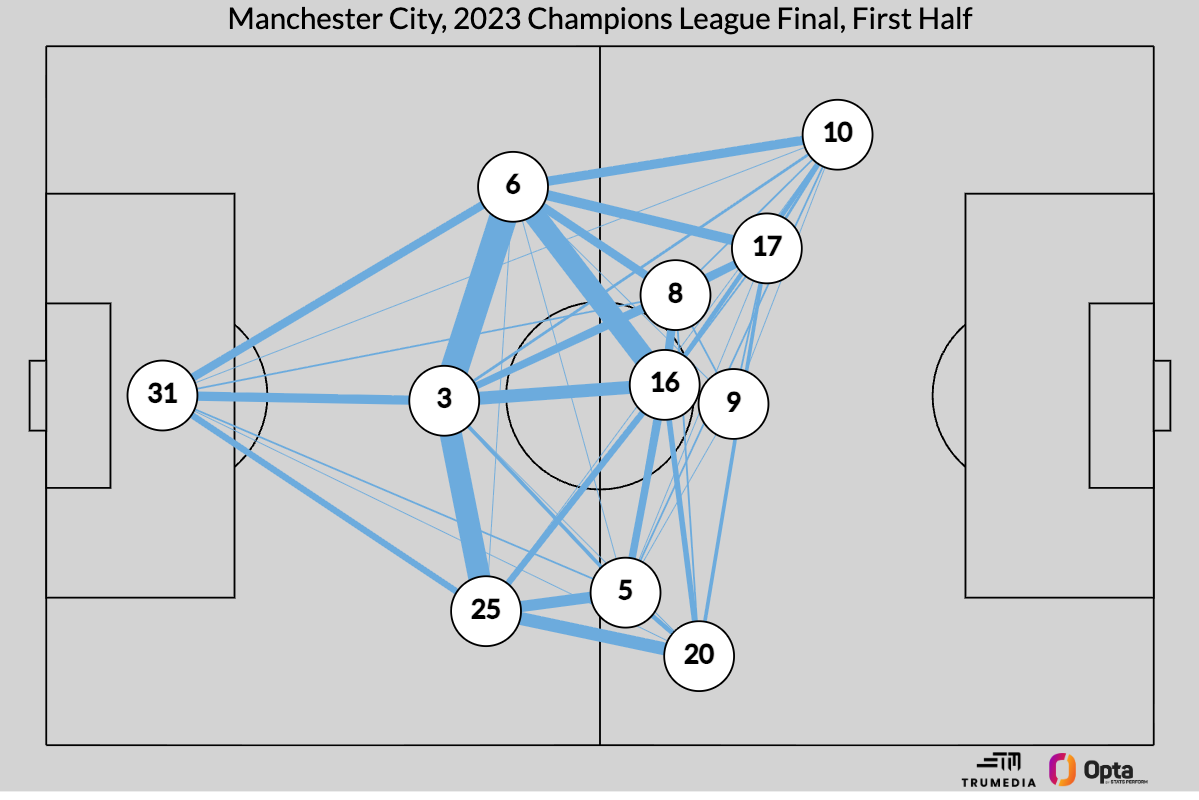
This approach has proven sufficient to secure the treble, reach multiple Champions League finals, and go undefeated in the Bundesliga, yet it has not yet been adopted by any Premier League team.
Why it’s time for the Premier League to embrace the back three
According to Opta’s classifications, here’s the frequency with which each formation has been utilized in the league since 2009:
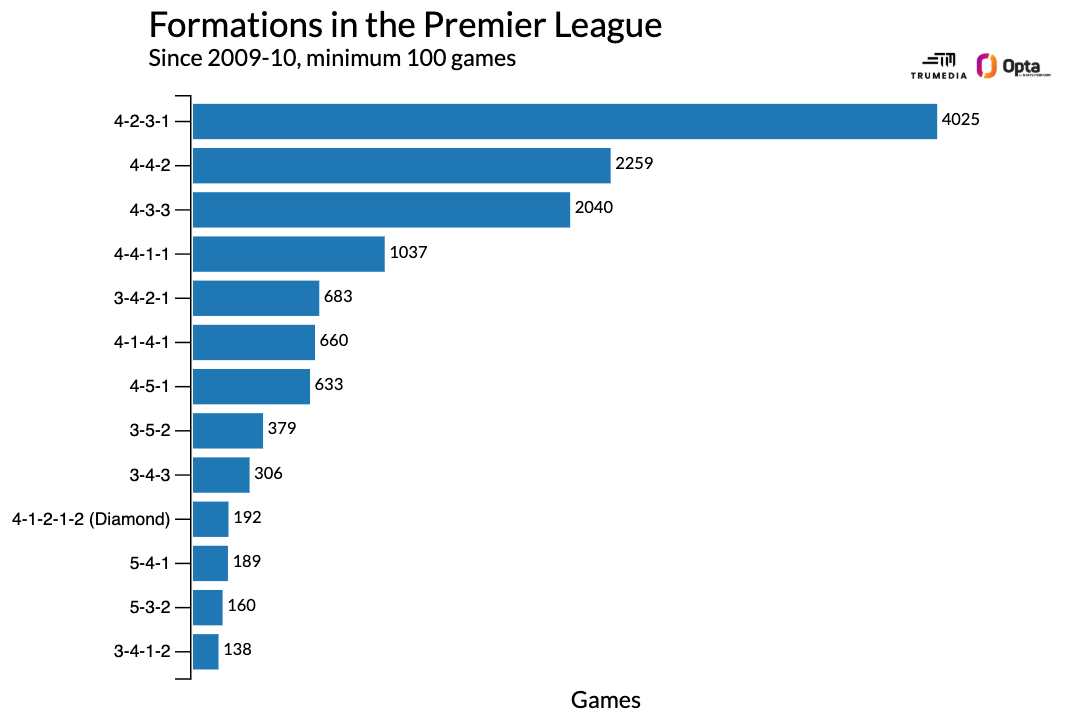
Formations are fluid and not all are created equal, so numerous caveats apply, but it is evident that the back four, in its three different variations — initially the 4-4-2, then the 4-2-3-1, followed by the 4-3-3, and now reverting to the 4-2-3-1 — remains dominant.
Moreover, the results appear to validate these selections. Here’s the collective goal differentials for all of those formations:
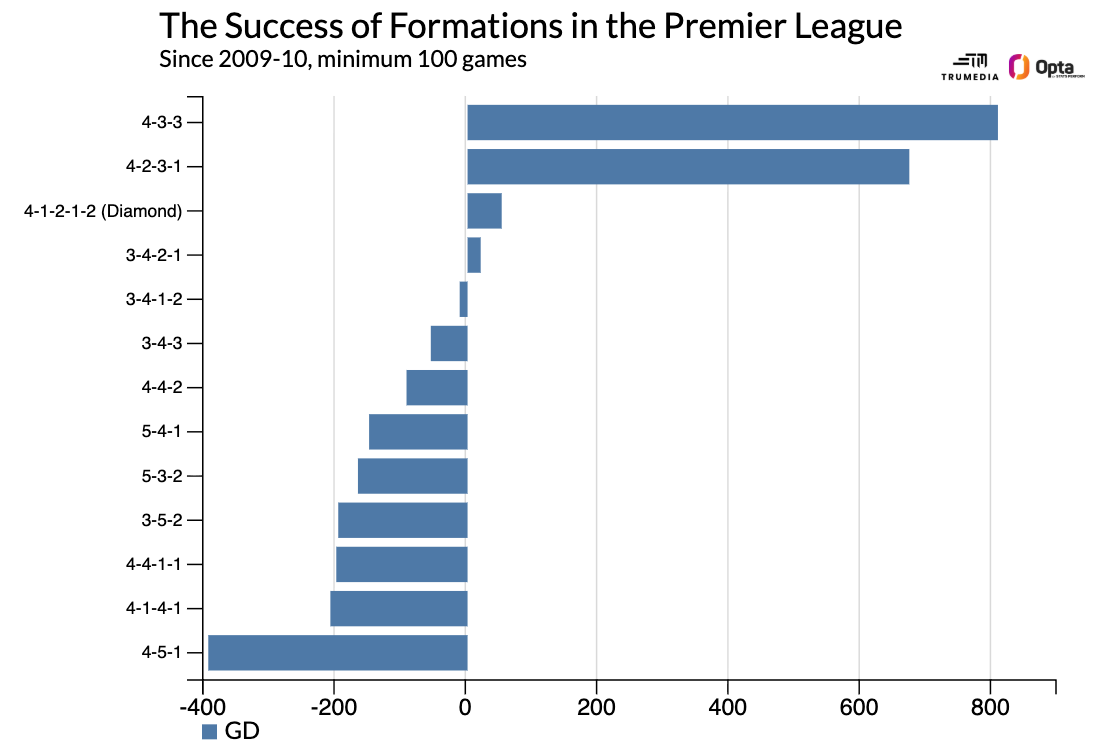
However, as the authors of the Bundesliga study inquired, how much of this is due to the actual effectiveness of the back four, and how much is simply because the top teams in the Premier League happen to utilize a back four?
Now, I believe we should acknowledge that Guardiola and Klopp, along with other leading managers, favored back fours because it was a more effective foundational arrangement to build from. And I believe it likely was. If you could pin the ball high up the field, circulate possession around and through your opponent, and only occasionally need to thwart counter-attacks, then it made sense to have only two nominal center-backs on the field.
To be a truly dominant team like Manchester City and Liverpool were — or Bayern Munich is — the back four is probably the optimal setup. Why? Simply because it allows for more attack-oriented players on the field and requires fewer players to cover the areas that occasionally need defending.
However, the Premier League has evolved. Guardiola expresses this concern weekly: everyone is more athletic, and everyone can man-mark your players now. The top clubs do not necessarily possess more elite talent than they did five or seven years ago, but the rest of the Premier League is acquiring the types of players who would have previously played for Borussia Dortmund and AC Milan.
Consequently, these teams cannot be easily pressed off the field as they once were. (Additionally, the top teams are playing so many matches that Klopp-style gegenpressing may be physically unfeasible.) And when they do get pinned back, the quality of the players who are “parking the bus” is significantly higher than it used to be, as is the quality of players capable of launching the occasional counter-attack from a deep block.
This all leads to the current situation: the ball seldom approaches the goal, and the only reliable method to score goals is from set pieces. Liverpool’s season was on the verge of collapse, then they dismissed their set-piece coach, scored seven consecutive set-piece goals, and now they are just three points behind third place. This is the current reality — and it is not enjoyable.
The game is urgently calling for someone to attempt a different approach — and to me, this is where the potential of a top team transitioning to a back three lies: it is distinct. It may not have been the optimal strategy when 90 points were required to win the league, but it is evident that the league has learned how to counter the front-foot 4-3-3 or 4-2-3-1 style that the top Premier League teams have favored over the past decade. At the very least, a back-three foundation would introduce new angles that the rest of the league is unaccustomed to encountering.
Implementing a different strategy would also yield numerous advantages in team-building.
These are the four most challenging roles to fill in the sport: (1) a ball-playing center-back who is athletic enough to operate in a high line yet also physically dominant in the air, (2) a technically proficient fullback capable of covering an entire sideline, (3) a defensive midfielder who can manage all the space behind the attackers and assist in advancing the ball up the field, (4) and a goal-scoring, ball-dominant winger. These are essential components for a back-four system. At any given moment, there may be only five players of each type globally.
To secure one of these players, you must be exceptionally fortunate and, for instance, have a stadium located in the same town where Trent Alexander-Arnold was born, or you must invest hundreds of millions in transfer fees just for the opportunity to acquire one.
But what if you could adopt a style that does not necessitate pursuing any of those player types? Wouldn’t that provide a significant advantage in the transfer market?
In a base 3-5-2 system, none of those roles are truly essential. With three center-backs, you are not requiring one or two players to cover an entire half of the field alone. The wing-backs do not carry the same defensive responsibilities as top-tier fullbacks. The midfielders do not need to be as versatile since there is more defensive support behind them. Furthermore, the attacking focus shifts more toward strikers and attacking midfielders, rather than wide forwards.
(In case you are curious: yes, Liverpool’s current and future personnel appear particularly suited for this strategy.)
While Amorim’s commitment to the back three made it seem like the least adaptable formation in existence, it should be far more versatile than the conventional styles we are accustomed to seeing from top teams. When you have those key roles, you must have those players on the field, fulfilling those roles. However, the 3-5-2 should be infinitely customizable, and it seems it would align better with the new trend of front-office-driven team building, where some clubs aim to identify undervalued players and then task the manager with figuring out how to integrate them.
If you are facing a top team, perhaps one of the front two is an attacking midfielder, allowing you to congest the midfield and maintain ball control. Against weaker opposition, you can drop the midfielder into the midfield three and field two actual strikers. The same applies to wing-backs. If you are chasing the game or expect to dominate possession, you can simply deploy a traditional winger in that role.
Need more stability? Then incorporate a more conventional fullback. This principle also applies to center-backs. Three larger center-backs can reinforce the defense, but you can experiment by dropping a midfielder or a fullback into one of the outside center-back positions. Different players will interpret the roles uniquely and alter the overall dynamic.
Formations are merely numbers, as Guardiola has stated. Selecting your starting formation does not equate to coaching or tactics — developing a style of play, a rapport between your players, and an overall willingness to take risks is what truly matters. Regardless of the formation employed, soccer will always revolve around creating space, controlling space, and exploiting space.
For the time being, however, there is limited space in the Premier League, except during instances when a player can execute a long throw-in from the sideline or deliver a cross from the corner flag. This situation will not persist indefinitely, but if change is to occur, someone must initiate a different approach.
Someone, please, attempt to win matches by utilizing a back three.
