
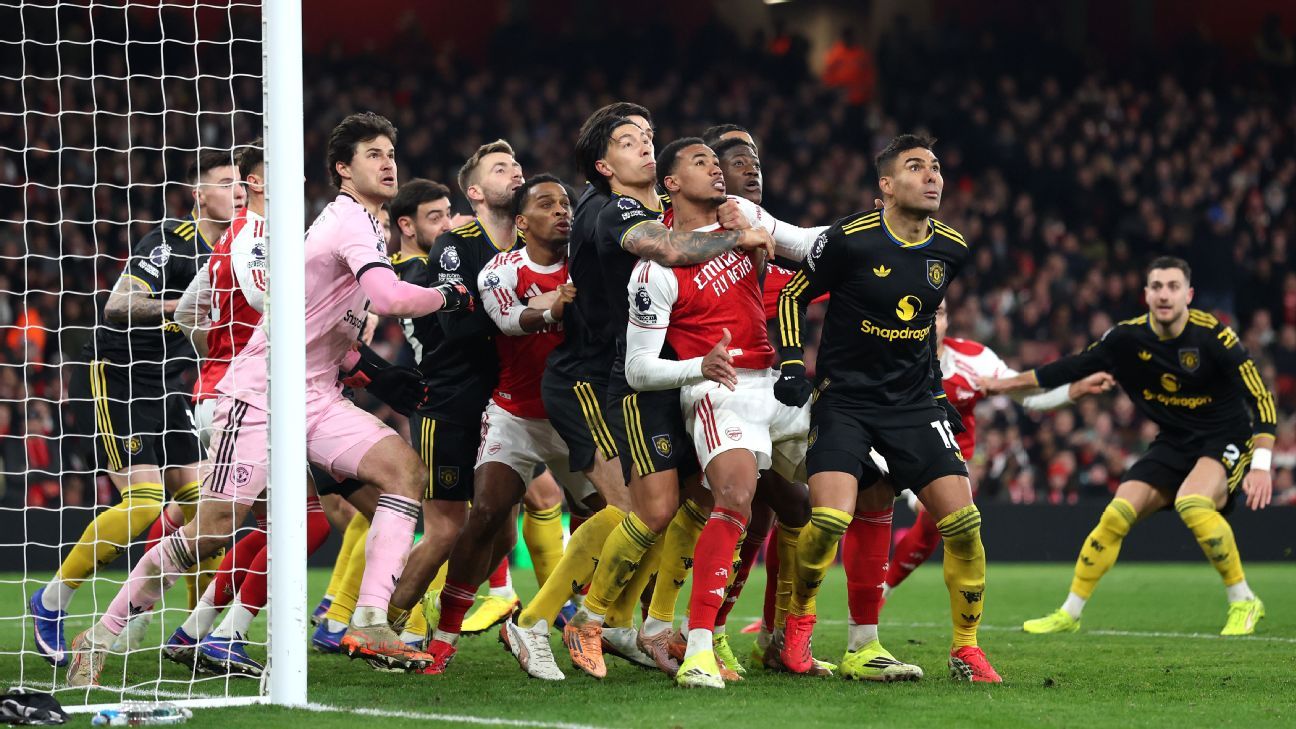
You might not immediately notice it if you watch as many matches as I (and perhaps you) do, since we often overlook gradual changes: the proverbial frog in boiling water. However, during the next corner kick or free kick from a wide area, pay close attention. Observe the grabbing, holding, twisting, blocking, and those players whose primary role is to collide with opponents. You’ll notice it while the ball is airborne, and often even more so before it is in play.
It may seem normal to you, which is understandable. At times, it appears normal to me as well.
Yet, it is not. This is detrimental to the game, and if you take a moment to reflect, it doesn’t have to be this way.
I attended the Chelsea vs. Brentford match recently. Brentford executed nine corner kicks, and each time, the same scenario unfolded. One of Brentford’s central defenders—typically Kristoffer Ajer, occasionally Nathan Collins—would position himself to shield Chelsea goalkeeper Robert Sánchez. Chelsea would counter by having someone, usually Enzo Fernández, attempt to push Ajer aside. They would grapple—smaller Fernández getting low and pushing with both hands, while the larger Ajer used his size to try to gain leverage or spin Enzo—and they often ended up in the back of the net.
And, of course, they were not the only ones involved. The penalty area was a chaotic mix of players holding, grabbing shirts, and engaging in jiu-jitsu-like maneuvers to secure an advantage.
Like you, I have become desensitized, but in a rare moment of clarity, I questioned: “What is this? What am I witnessing?”
I fell in love with this sport. What occurs in these instances—not just in this match—is not what drew me in, and likely not what attracted you either. Grown men wrestling, grabbing, and shoving is not part of it. In fact, it is not part of football, and it is not permitted elsewhere on the pitch either. If Declan Rice prevents Kylian Mbappé from making a run by giving him a bear hug, it is a foul. If Virgil van Dijk body-checks Lamine Yamal into the stands, it is a foul. Yet, when it happens during a corner kick? More often than not… play on.
I do not hold the players accountable, as they will always test the limits of what referees permit. Anyone who has participated in any sport at any level understands this. Nor do I truly blame the referees, as they do not merely adhere to the Laws of the Game: they are directed to follow guidelines from their referee associations. For reasons unknown, match officials have opted to overlook certain actions.
“Before the ball is in play, pretty much anything goes, because at worst, you’ll just receive a warning from the match official,” a former referee explained to me. “Once the ball is in play, the general rule is often that you don’t call anything if the shoving and pushing is mutual or if it’s a one-handed shove or grab. Two hands, and then yes, you’ll receive a call… Most of the time, anyway. It varies somewhat from league to league and competition to competition, but generally that’s how it’s interpreted.”
One could argue that as long as referees are consistent, there is no significant issue.
Why did the penalty decision in the recent Africa Cup of Nations final, when El Hadji Malick Diouf was deemed to have fouled Brahim Díaz, generate so much debate? Not because, strictly speaking, it wasn’t a foul—Diouf tugged his shoulder, which is simply not allowed. Rather, because that kind of behavior had been occurring throughout the match without the referee intervening.
That said, I still have an issue with it. Not only because the referee’s role is challenging enough, which leads to situations like the Díaz penalty. No: it’s because it appears poor and contributes nothing to the game. The pre-kick chaos is not the reason I cherish this game. The goals that arise from it—scrambles in the six-yard box, with the ball ricocheting around and players colliding—are not entertaining. I do not need to watch individuals earning $10 million a year engage in that. I can observe that at my local Under-10s match in the park.
This is not a criticism of scoring from set pieces or clubs employing specialized set-piece coaches, by the way. (Yes, Arsenal: I am referring to you, but not solely you here.) That can be thrilling, and it is part of the game. However, the reality is that players skilled at set pieces would excel at them even if they didn’t have to contend with being blocked, manhandled, and probed during every corner kick.
It is also not about my aversion to physical play. I fully support that. Give me a crunching tackle or a shoulder charge any day. I appreciate that. Let it flow! Just not with the hands.
Arsene Wenger, who currently serves as “Chief of Football Development” at FIFA, advocates for a “daylight rule” regarding offside, as it would result in more scoring. You know what would lead to more scoring? Not having an opponent attempting to rugby tackle Erling Haaland when the corner kick is taken.
Surely, no reasonable person enjoys this unless their team benefits from it. Therefore, I believe it is time to cease tolerating it.
The interesting aspect is that this can be accomplished without altering the Laws of the Game, either. Law 12.1 states that a direct free kick is awarded if a player “holds an opponent” or “impedes an opponent with contact.” Simple! Oh, and under the “Other Advice” section, referees are instructed to caution players who hold before the ball is in play and, if they are ignored, to book them. Implement that as well. From this, you will see more goals, better players making an impact, and likely less controversy too.
Is it absolutist? Certainly, but you can be assured that players and coaches will adapt swiftly. Because, ultimately, you are only asking them to do what comes naturally to them and what they have practiced their entire lives: play football.
