
The argument for Man United’s Fernandes as the top player in the Premier League
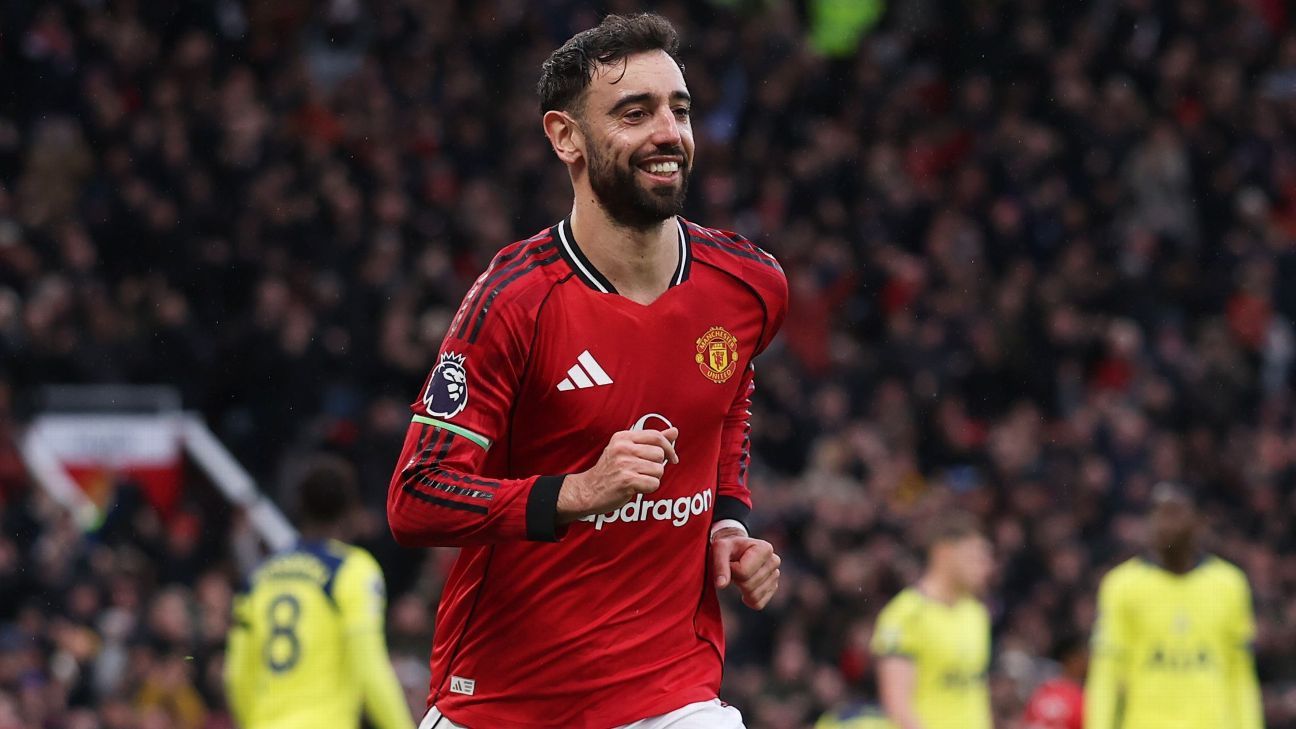
Bruno Fernandes’ influence on Manchester United since his arrival is undeniable. Consider his performances in the March fixtures against Crystal Palace and Aston Villa. Both opponents aimed to congest the midfield, and the matches were evenly poised until Fernandes took charge, contributing a goal and three assists across the two encounters. At times, a player instinctively knows the right course of action and is unafraid to execute it.
From making a splash in the Premier League as a January acquisition in 2020 and propelling United into UEFA Champions League contention — accumulating 15 goals plus assists (G+A) in 14 appearances — to serving as the creative linchpin under current manager Michael Carrick, he has consistently improved. Regardless of who occupied the managerial position or the turmoil within the locker room, there was always a player who could be counted on to deliver in crucial moments. Typically, this was through his goals and assists; even during Ruben Amorim’s challenging midseason tenure in 2024-25, he still managed to achieve 19 G+A in the league.
The widely discussed notion in the media suggests that players excel away from the intense pressure of Old Trafford — as seen with Scott McTominay’s success at Napoli or Antony’s at Real Betis. In contrast, Fernandes has consistently embraced that pressure, adapting to whatever role United required him to fulfill.
– A significant summer lies ahead for Man United, with transfers taking precedence
– The absence from the Champions League could benefit Premier League teams
– From Man United struggles to a new contract: Why Harry Maguire feels ‘rejuvenated’
His 2025-26 season represents a duality of roles, one under former coach Ruben Amorim and the other under Carrick. Merging these two aspects has resulted in a season worthy of Premier League Player of the Year recognition, and he is certainly deserving of the accolade. Few anticipated United’s impressive form under Carrick, and amid a personal-best campaign for Fernandes — leading the league in assists with 16, double that of any other player — it is evident that Carrick’s decision to restore him to his optimal position has contributed to an upturn in United’s performance.
Fernandes is a pleasure to observe in this revitalized version of Manchester United. Here, we will examine how his role has evolved this season, why this may be the finest football he has played, and why he merits the Player of the Year title.
Fernandes’ evolution in 2025-26
One of the unintended legacies Amorim may have left United is the demonstration of Fernandes’ adaptability as a deeper central midfielder in the “regista” role, enhancing his overall game.
In this position, which former Real Madrid midfielder Toni Kroos excelled in, he was tasked with controlling the match, dictating the pace, and initiating attacks rather than finishing them. This role combined his talents as a key attacker capable of creating pivotal moments with an added layer of composure and tempo management.
However, while it was beneficial for Fernandes to provide United with greater control and facilitate the transition from defense to attack, it seemed counterproductive to position a player with exceptional creative skills further from the goal. He could deliver passes and locate attackers, but none of the others possess his innate ability to make the right choices in the final third.
Since returning to his preferred role under Carrick, Fernandes has recorded six open-play assists, compared to two under Amorim. This indicates that the tactical adjustment has significantly boosted United’s revival by allowing Fernandes to return to his strengths: generating chances from open play that others cannot replicate. A more stable midfield partnership behind him, featuring Casemiro and Kobbie Mainoo, has facilitated this improvement.
Under Carrick, United has adopted a “forward-first” creative approach. The strategy is straightforward: outscore opponents by leveraging the wealth of attacking talent available.
During several matches in the Amorim era, United struggled to penetrate a resolute defense, with the Europa League final and the encounter against a 10-man Everton being notable examples, making the decision to deploy Fernandes as a central midfielder perplexing.
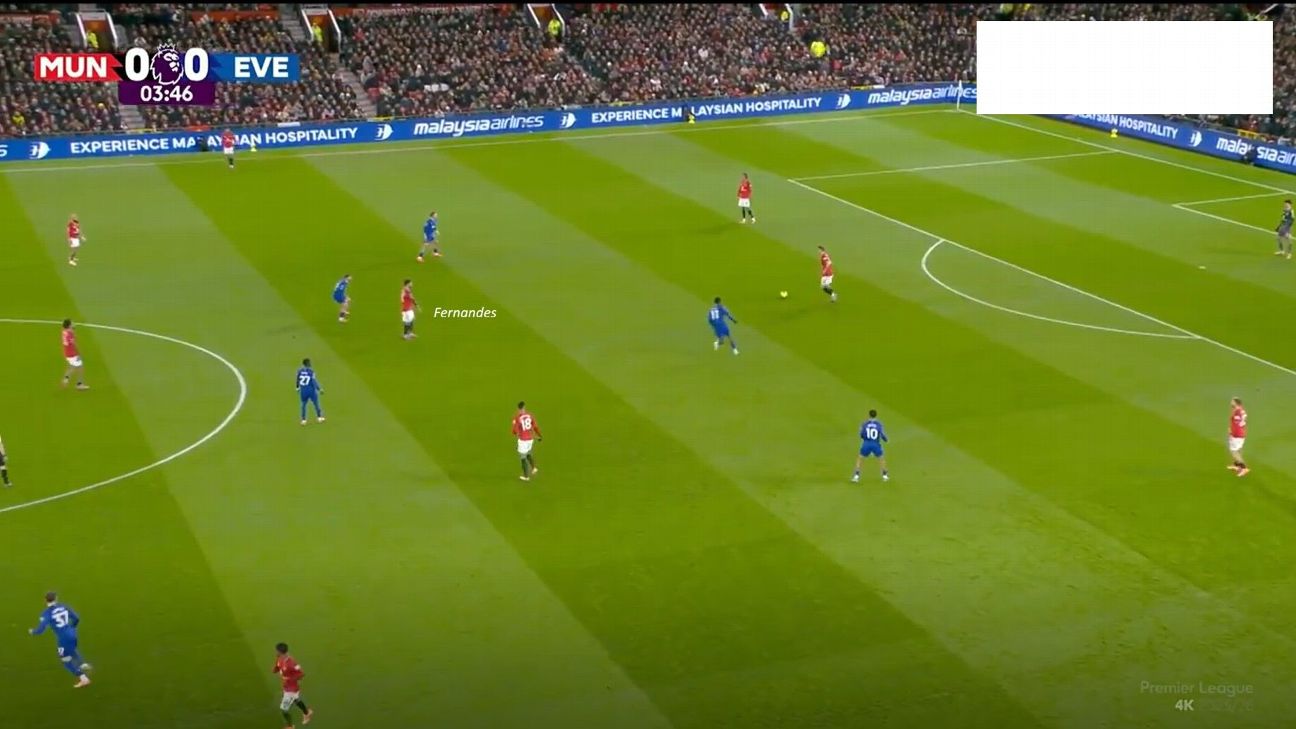
Even if Fernandes receives the ball in the scenario depicted above, he is surrounded by too many Everton midfielders.
In contrast, consider his more advanced position against Bournemouth following Carrick’s appointment. Even in a congested area, his presence draws defenders and creates space for other United attackers. His positioning is crucial because he can utilize his quick decision-making to pass to a teammate. When he operates deeper, the risks outweigh the rewards, and he risks losing possession near his own penalty area.
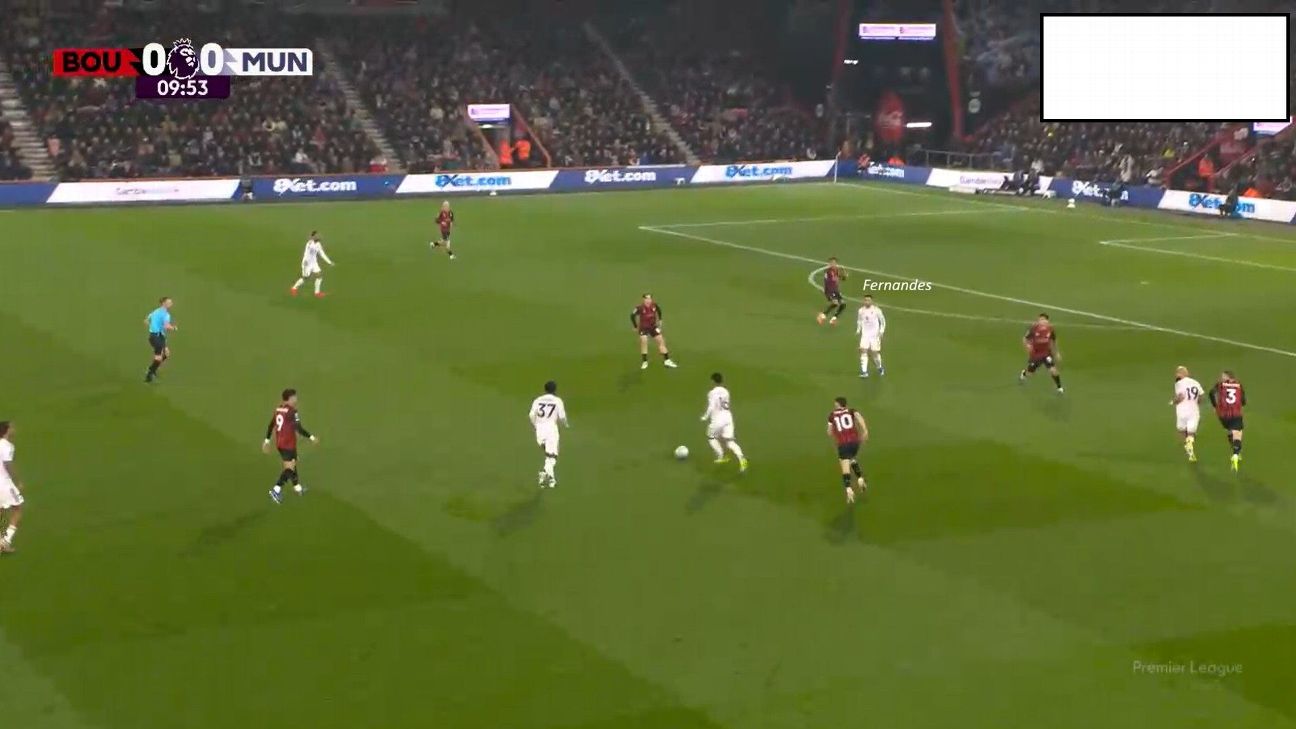
Could Amorim have utilized him further up the pitch? Yes, but as the season progressed, the only adjustment he made to his 3-4-3 formation was to adopt a more direct approach and capitalize on second balls — not particularly aligned with Fernandes’ strengths.
With Bryan Mbeumo, Matheus Cunha, and Fernandes in the attacking lineup, it is common for any of the three forwards to drop back to assist in the buildup. The dynamic rotations in the attack grant Fernandes his desired “free” role.
His assists under Carrick have come from a remarkably similar range. Observing the goals below, both result from him finding Cunha in behind from a very wide position.
This highlights his qualities as a player; opponents often assume that because he is positioned wide and far from goal, he poses no threat, which is far from accurate. It is challenging to defend against because instructing a defender to close him down in such an awkward area is not advisable.
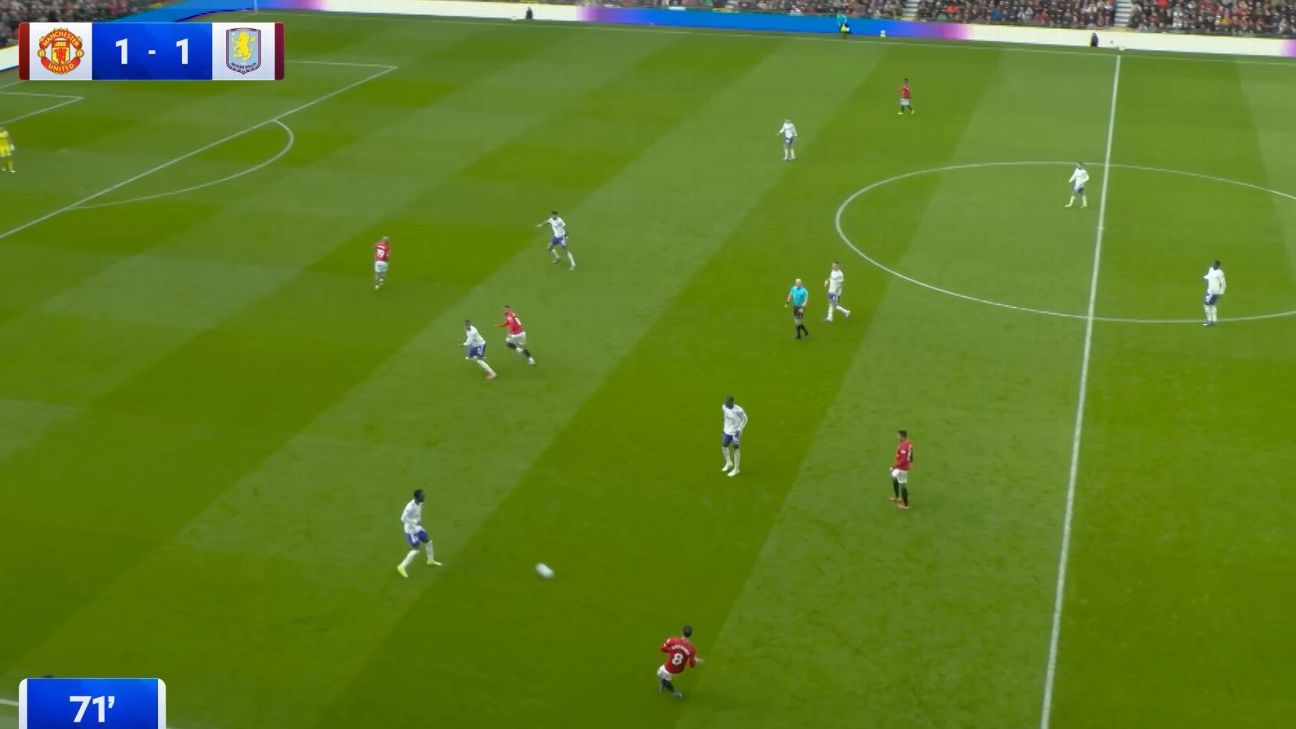
There are numerous players obstructing the Portugal international’s path to his target, yet that does not deter him. This is what United gains by simply positioning him closer to goal: unlocking the unique moments of brilliance that only he can deliver.
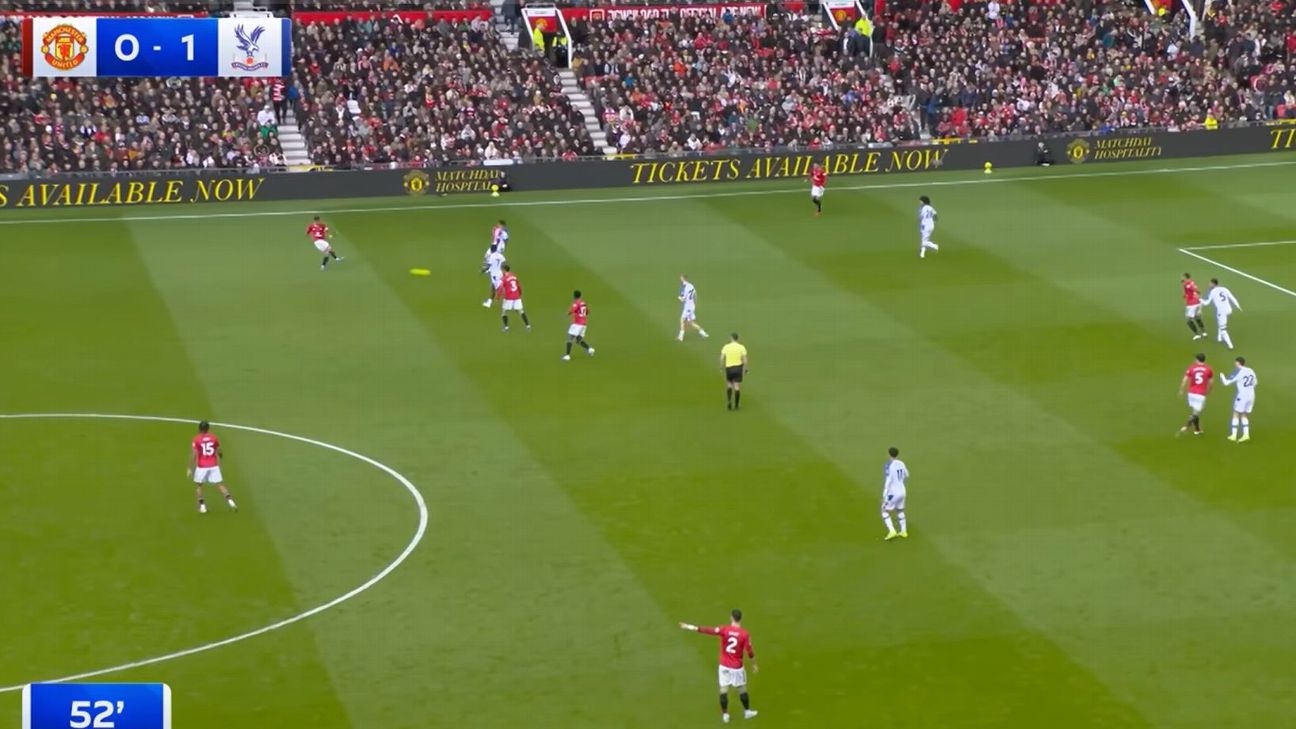
Previously, when the ball reached him in his own half, he might have attempted a quick pass behind the defense. However, after his experience in central midfield, we now see him distributing a pass wide or taking an extra moment to maintain possession.
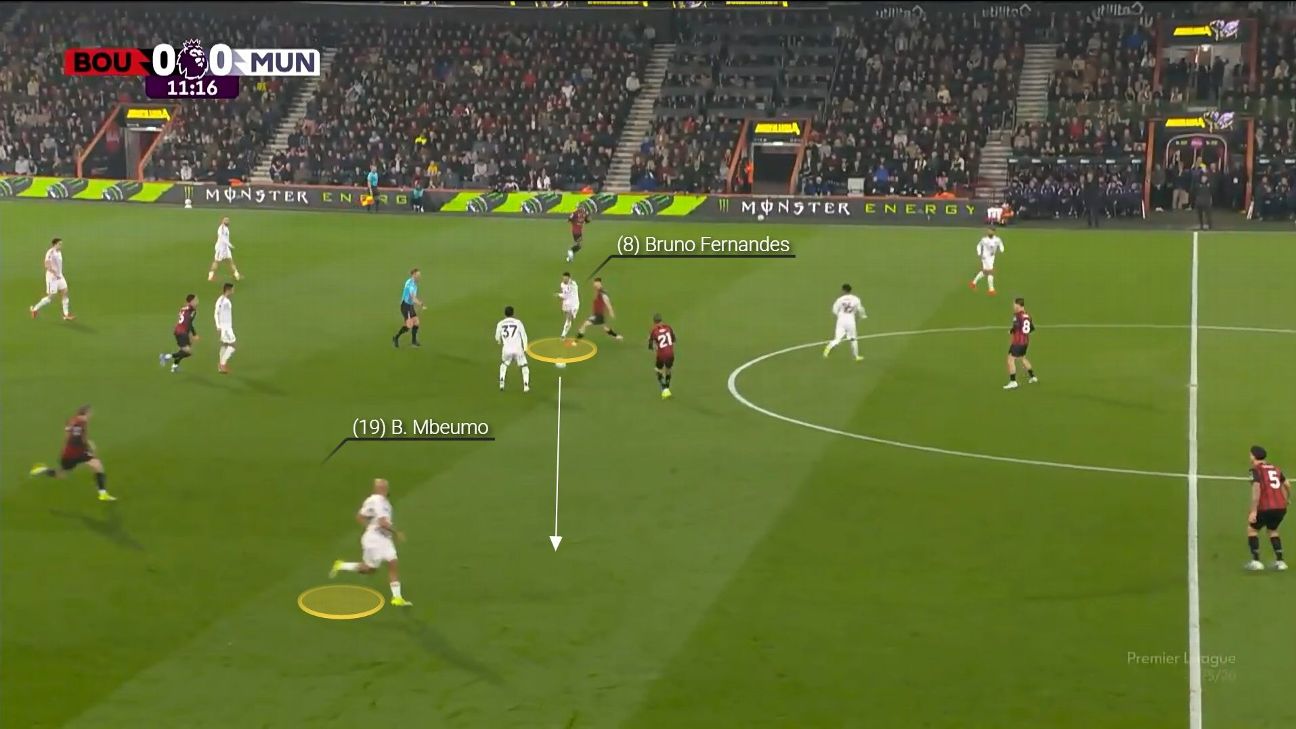
There is a noticeable maturity in his game now, as he effectively combines his skills from both deeper and more advanced positions.
Why Fernandes deserves to be POTY
Having established how he has progressed this season, how has he developed over the years? And is this the pinnacle of his performance?
Some statistics (per Opta) certainly support this assertion.
He is generating a career-best average of 1.3 big chances per 90 minutes and 4.5 chances per 90. This also marks the highest percentage of successful passes reaching the final third he has ever recorded, surpassing his time under former coach Ole Gunnar Solskjaer from 2019 to 2021, which included his 2020-21 season of 45 G+A.
Interestingly, Fernandes is making more passes into the box than ever while having the fewest touches since joining Old Trafford. With the goal-scoring responsibilities resting on the shoulders of Cunha, Mbeumo, and Benjamin Sesko, this trend is understandable.
He continues to deliver a high volume of forward passes, as well as the most through balls he has ever produced. Additionally, fewer touches in the opposition box combined with more assists per 90 (0.59) indicate that Fernandes finally has an attacking setup around him that he can effectively support.
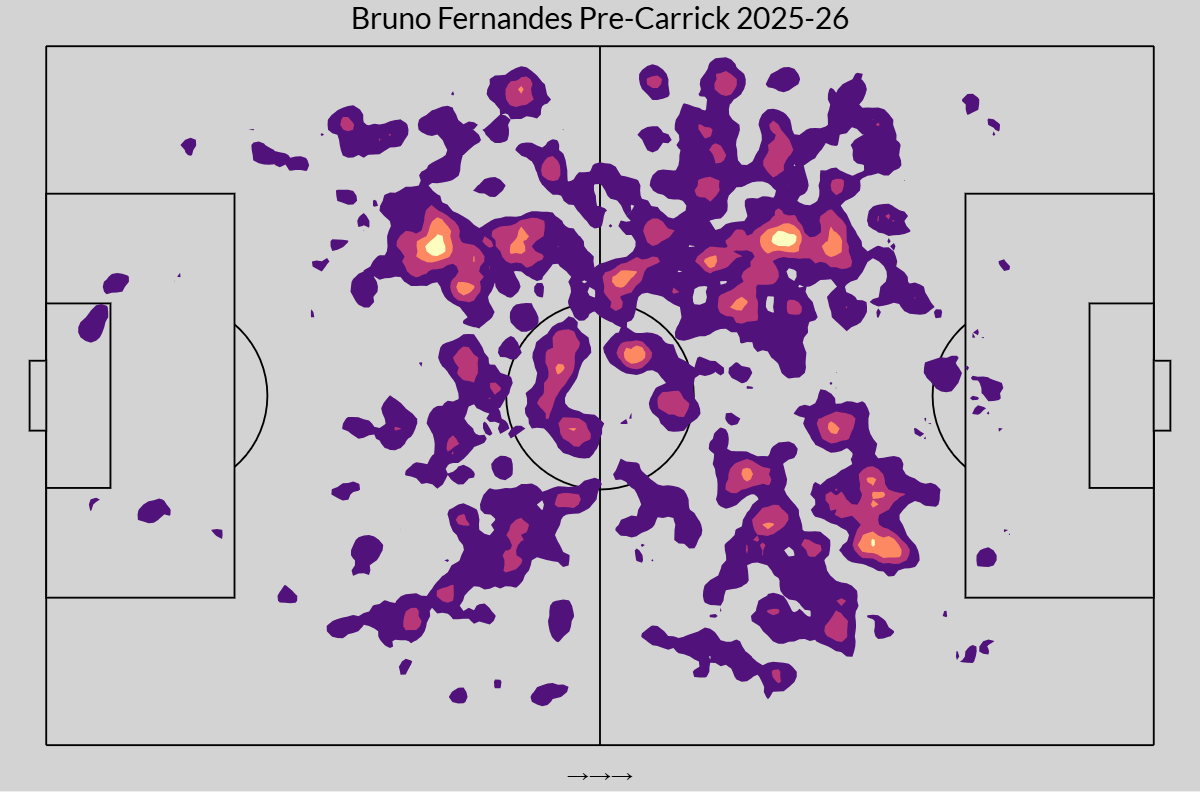
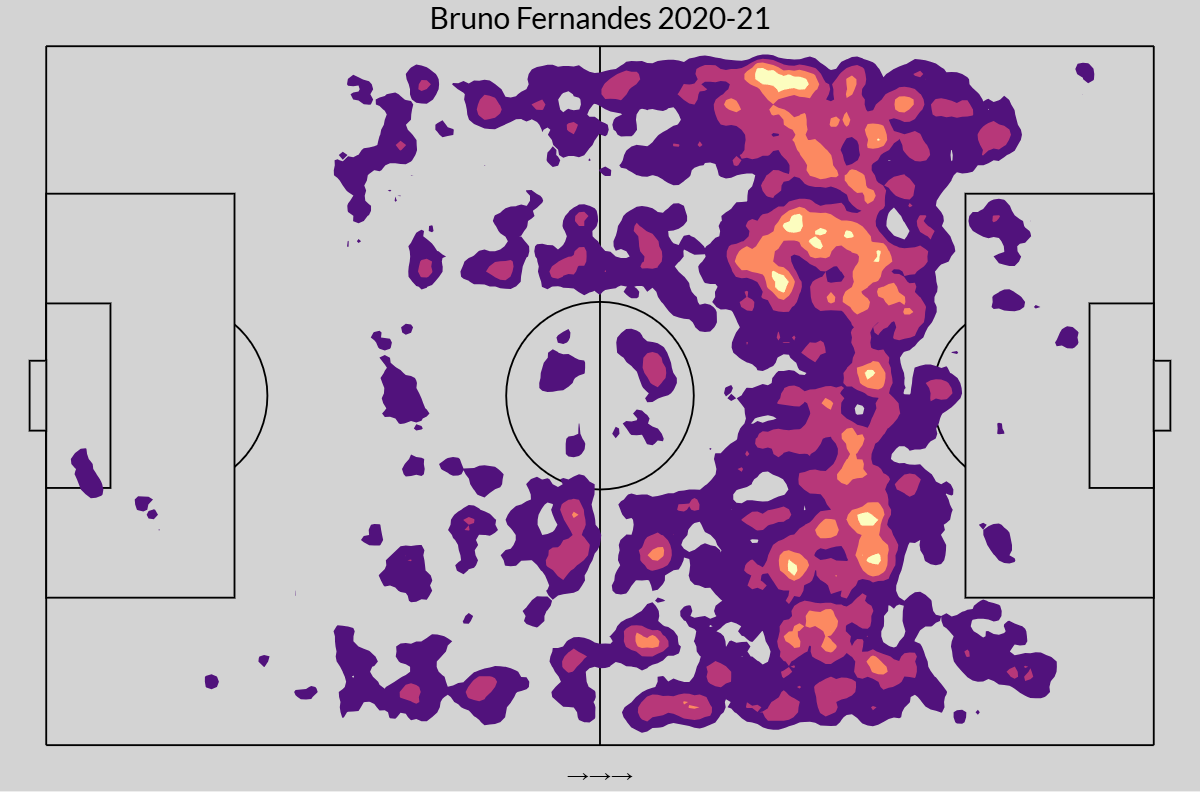
Predictably, his heatmap from this season prior to Carrick’s arrival was quite scattered.
Under Carrick, the areas further up the pitch where he prefers to operate are highlighted more prominently in yellow.
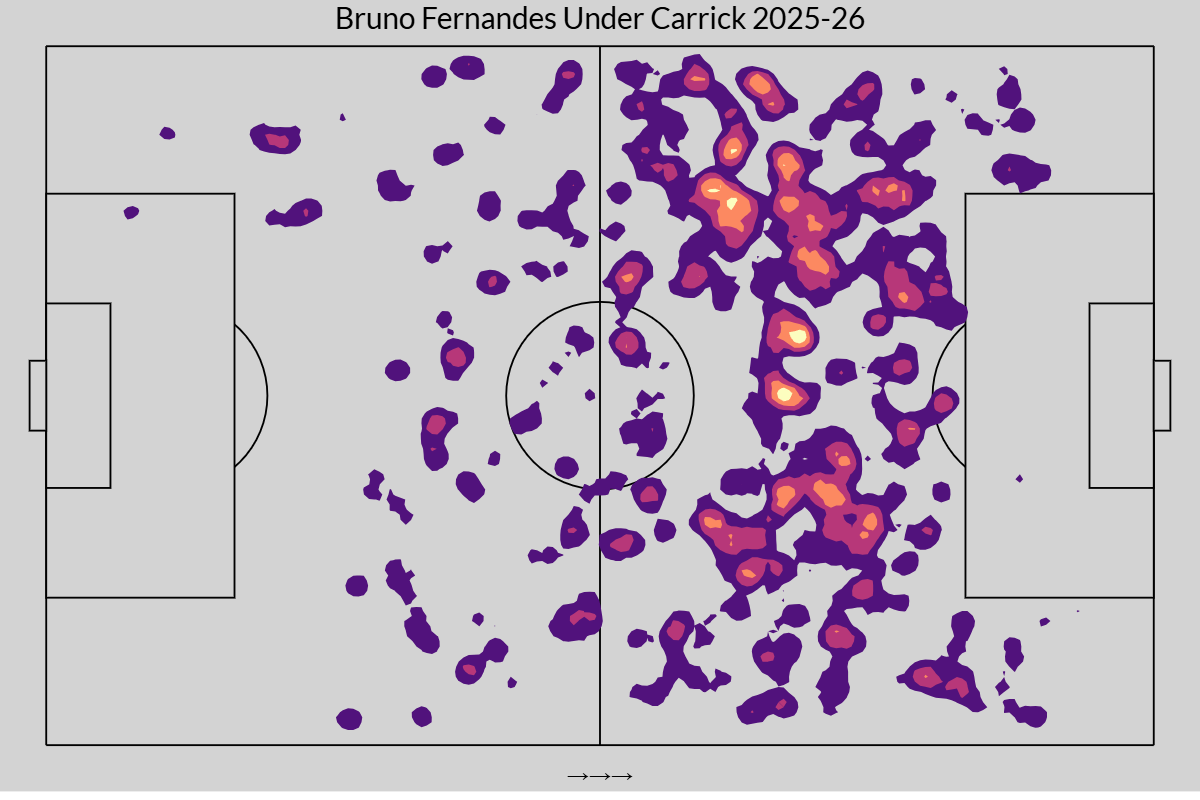
It also illustrates how he frequently drifts left or right, where he can play a forward pass to a teammate from the half-space — strikingly similar to his 2020-21 season.
But how does Fernandes stack up against other POTY contenders? Examining some of the other players considered for the award, such as Dominik Szoboszlai, Declan Rice, and Martín Zubimendi, provides insight into why Fernandes would be a worthy recipient.
In terms of forward passes, chances created, and passes delivered into the box, Fernandes stands out significantly. Only Manchester City forward Rayan Cherki’s creativity statistics come close to Fernandes’, but Cherki has played over 60 minutes in just 10 matches this season — far fewer than Fernandes’ total minutes. It is also important to note that Cherki has often played as a right winger and is not as involved in the buildup as Fernandes.
It is essential to remember that Fernandes was positioned further from goal until January, when Carrick took over. Even then, he is averaging more touches in the opposition box and more passes that reach the final third than any of the other candidates.
The statistics suggest we are witnessing Fernandes at his creative peak: generating more and higher-quality chances than ever while becoming increasingly efficient. He has emerged as the orchestrator of United’s dynamic new attack.
Fernandes has always been a player capable of impacting matches, regardless of the stakes. However, he has now refined his ability to control his precise execution. A feint here, a stepover there, blink twice, and he has created space, followed by a perfectly placed pass to a teammate.
In the past, he might have had three or four “poor” performances in a season, but the addition of a composed elegance to his creativity has made him the standout performer in most of United’s matches.
This season has demonstrated that he can excel in any position on the pitch, which is why he deserves to be recognized as Player of the Year.
