
Soccer coaches find new inspiration on the rugby field.
In early February, a colleague of mine, who is passionate about football but not fond of rugby, entered the office and expressed his frustration, as he does annually. The Six Nations, the leading international rugby tournament in Europe, commenced on February 5 and will continue until mid-March, with England set to compete against Ireland on Saturday in a crucial match. Amidst his complaints, he lamented that his local pub would be broadcasting continuous rugby instead of football for the upcoming weeks. Regardless of his feelings, some of football’s prominent managers are seeking inspiration from rugby.
Prior to England’s match against New Zealand in their November rugby union Test, Brighton & Hove Albion manager Fabian Hurzeler visited the England training camp. The England players are accustomed to football managers attending their training sessions, with figures like Antonio Conte and Gareth Southgate having done so previously. Conversely, rugby coaches also visit football teams for similar purposes. However, Hurzeler was particularly impressed by the position of rugby coaches during matches — situated in the stands.
“The head coach is always observing, not overly emotionally involved on the sideline,” Hurzeler remarked. “It’s more about overseeing the situation, akin to an analyst, and making decisions from the stands. This could be a future direction for football as well.”
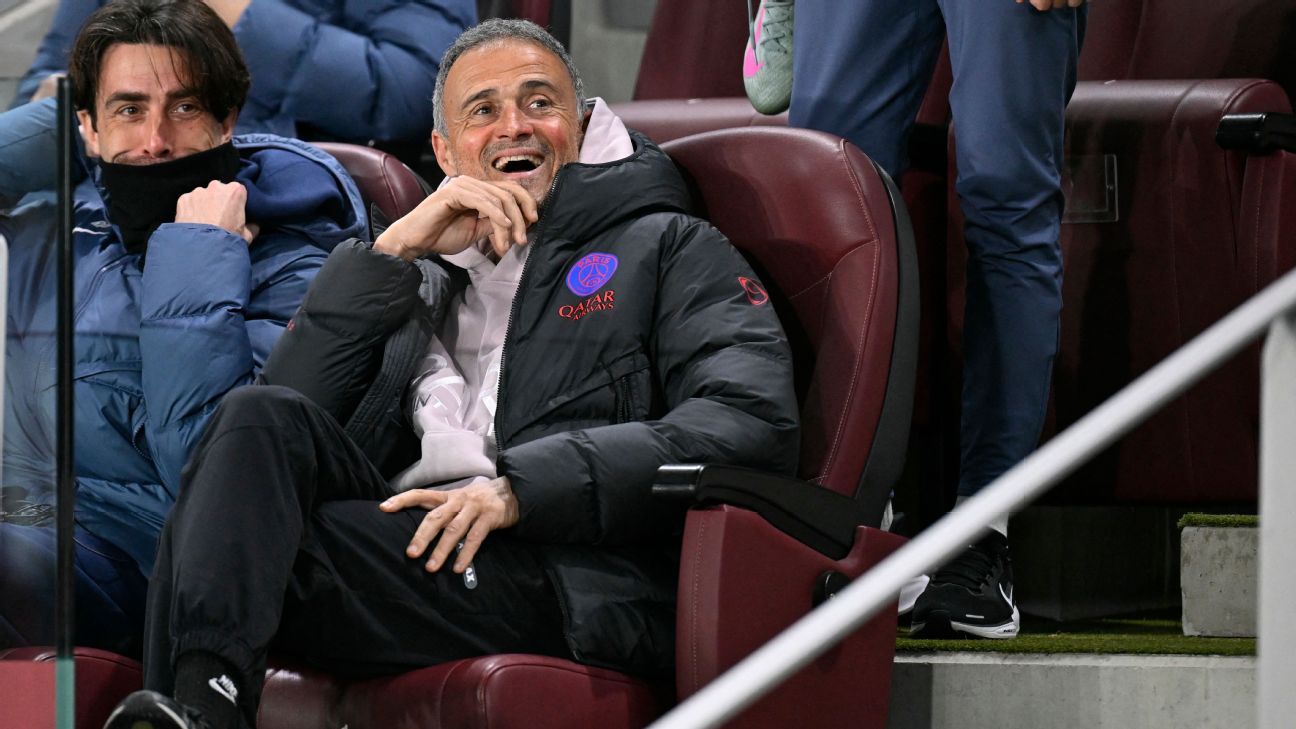
In France, since Paris Saint-Germain’s encounter with Lens in September, PSG manager Luis Enrique has been observing the first half of some home games from the stands. “For a long time, I’ve noticed rugby coaches analyze matches from a distinctly different viewpoint,” he stated. “I appreciate the opportunity to enhance things this way. Watching the first half from the stands is magnificent. It’s a different experience. I can oversee everything.” He noted that this approach made his halftime discussions more impactful as he was able to witness all the analysis in real time.
This practice is more challenging to implement abroad — Spanish regulations require the manager to be in the dugout — but it has influenced how Luis Enrique observes training as well. At the expansive Campus Du Paris-Saint-Germain, he watches some training sessions from atop a six-meter-high scissor lift overlooking the pitch. He mentioned prior to their Champions League final last season that this perspective significantly alters his viewpoint and aids in enhancing his “team’s movement.”
Will this method be adopted in the Premier League? If you notice a manager in the stands these days, it is typically due to a reprimand. However, some managers prefer this approach — Sam Allardyce was doing this around 15 years ago, and there were others before him, such as Walter Smith, George Graham, Steve Coppell, Glenn Hoddle, and Jim McLean, the renowned Dundee United manager who used to issue commands via telephone from a glass box when faced with touchline bans. Leyton Orient’s Richie Wellens has also favored observing matches from the stands in the past, but whenever Luis Enrique’s first-half vantage point is mentioned, Allardyce is recognized as the pioneer. He adopted this practice during his tenures at Bolton, Newcastle United, and Blackburn, only to discontinue it at West Ham.
Since the early 2000s, Allardyce frequently spent time with the England rugby team, examining their strength and conditioning programs, data utilization, and training methods. He also observed with interest how they managed their team. “Our psychologist at Bolton advised, ‘Get in the stand, because all you do on the bench is jump up and down. So we got earpieces and radios, and communicated with the bench along with the individual who coded the game,'” Allardyce explained to ESPN. “We could then present visuals to the players at halftime instead of me verbally guiding them. We had a TV on a 10-second delay so we could review things, which helps remove the emotion from decisions. You simply gain a better perspective up there.”
That said, not all clubs appreciated his absence from the dugout. “They complained about me being in the stand; they insisted I should be down there shouting at players,” Allardyce noted. “You can be assertive and adhere to it, but if it causes friction and is discussed in boardrooms, you might as well return to the bench. If I were managing now, I’d definitely be in the stands. But there’s no definitive right or wrong approach.”
– Olley: How Premier League clubs are looking to the U.S. to raise transfer funds
– Onuoha: What players really think when a manager arrives midseason
– Wright: Is it happening again? Arsenal’s stumble in title race follows familiar pattern
Other subtle influences can also be observed. Some managers are adopting terminology directly from rugby, such as “bomb squad” and “finishers,” to describe players who come on in large numbers to alter the dynamics of a match. Former England rugby coach Eddie Jones preferred not to refer to his bench as “substitutes,” instead coining the term “finishers” for the first time in 2017. Then in March 2023, Arsenal manager Mikel Arteta began referring to his bench as “impactors” or “finishers.” Jones and Arteta previously shared a WhatsApp group that included Green Bay Packers head coach Matt LaFleur, NBA Hall of Famer George Karl, and basketball coach Mike Dunlap. “We all come together to share our challenges, and everyone offers their insights,” Jones remarked. “It’s fantastic.”
Arteta expressed his preference for “finishers” following a 2-0 victory over Athletic Bilbao in September. “I love it, because I dislike other terms to describe the players,” he stated. “And I believe, as the game evolves, they will become increasingly significant. The quality of [their] minutes will undoubtedly influence the quality of our season.”
However, this terminology was not universally embraced, with former Watford striker Troy Deeney labeling the linguistic shift as “childish,” suggesting that those not brought on would feel “confused and annoyed.” It’s a challenging situation.
Meanwhile, the Springboks (South Africa’s rugby union team, champions of the last two men’s World Cups) have what they refer to as the “bomb squad” on the bench, a group that injects fresh physicality and momentum-shifting energy. After the England men’s football team triumphed over Serbia 2-0 at Wembley in November, with Eberechi Eze, Jude Bellingham, Jordan Henderson, and Phil Foden all making significant contributions off the bench, coach Thomas Tuchel was introduced to the term. “I have not labeled [the players] differently, but I find it appealing,” Tuchel stated. “I prefer ‘bomb squad’ over ‘finisher.’
As for other elements, you might attribute some aspects of VAR to rugby’s television match official, as both systems have their flaws and can be time-consuming. Let’s set that aside. But returning to my knowledgeable colleague, when I mentioned this concept and the idea of rugby influencing football, he replied: “What, how to take over a pub and ruin my Saturday afternoon?”
