
Riyad Mahrez bids adieu to AFCON — why doesn’t he get Sadio Mane-Mohamed Salah level love?
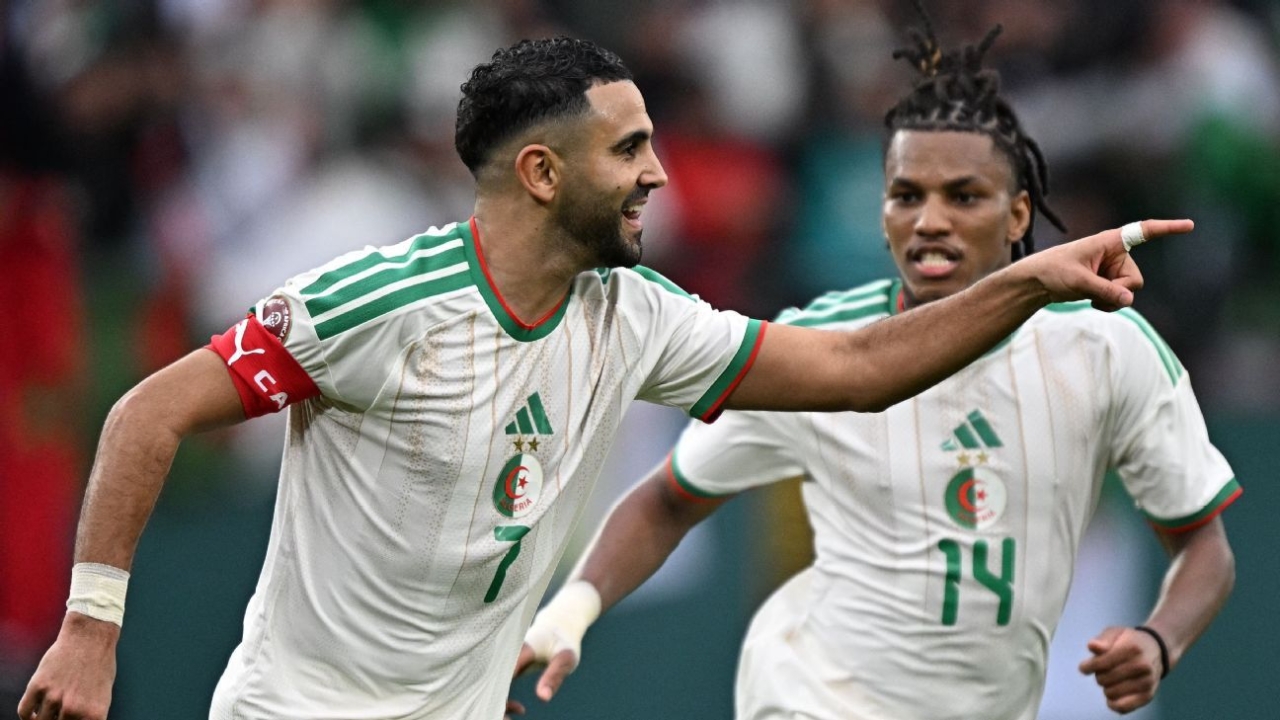
Algeria found themselves in an unexpected supporting role in Saturday’s Africa Cup of Nations semifinal against Nigeria, with the Super Eagles dominating an unpredictably one-sided contest to dump out the Fennecs and advance to a semifinal with Morocco.
The game was notable for the attacking brilliance of Eric Chelle’s side, and of the post-match clashes between the players, not to mention the missed opportunity of a historic semifinal between regional and diplomatic rivals Algeria and Morocco.
However, it also represented the final Nations Cup outing for Riyad Mahrez, one of the finest African players of this — or any — generation, and a superstar whose legacy probably doesn’t get the attention it deserves.
The 34-year-old confirmed, ahead of Algeria’s elimination, that this would be the last we’d see of him at the continental showpiece, even though he will be expected to feature at the World Cup later this year.
“This will be my last AFCON,” he said ahead of the Nigeria match. “I want to win it again with this new generation, I really want this.”
He confirmed in the mixed zone after the loss against the Super Eagles that he was sticking to his decision, and that the limp exit would be the last supporters would see of the veteran at the Nation Cup.
“I confirm, this was my last competition, it’s over,” he told journalists. “It’s sad that it stops at the quarterfinal, as I would have liked to have gone further to try to win a second one.
“Our generation has already won one AFCON and it was incredible,” he added, “but now we have to shake hands and move one.
“The new generation still has time, still has time [to win] the AFCON, and to try to bring home another star to our country. That’s what they need to do.”
Bowing out after the World Cup in five months time would ensure things come a full circle for France-born Mahrez, after the attacker entered the international scene ahead of the 2014 tournament – his inclusion in the provisional WC squad was his first call-up – and made his debut in a pre-tournament friendly against Armenia.
Despite starting the opener against Belgium, he was dropped thereafter amidst accusations from the Algerian media towards head coach Vahid Halilhodzic that the wideman had paid the Bosnian head coach for a place in his Brazil-bound squad.
In time, of course, the accusation became increasingly ludicrous, with Mahrez blossoming not only into a worthy Algeria international, but one of the greatest players the country has ever produced.
Initially used as a left winger for the national side, Mahrez steadily evolved into a right-sided role, cutting onto his preferred left foot to great effect, while also having the quality on his right to go down the outside.
His technique and creativity have rarely been in doubt, while the diminutive attacker compensated for his slender frame with his street-football instincts, speed, dribbling, turn of pace, and balance.
In 2026, almost 12 years on from his international debut, Mahrez has still adopted the same position for Algeria – wide on the right wing – albeit with a modified role to reflect his advancing years.
Still a fine threat in the final third – Mahrez scored three goals across Algeria’s opening AFCON fixtures against Sudan and Burkina Faso – it increasingly became apparent that the playmaker was out of sync with the rest of Vladimir Petkovic’s Fennecs side.
With the ball, Mahrez sought an advanced role for the North Africans, slightly ahead of Ibrahim Maza but aligned with line-leader Mohamed Amoura, although while Algeria imposed themselves with fast interplays, runners off the ball, and an intense rhythm of play, it was a tempo that the veteran struggled to match.
While he would step inside to allow the energetic Rafik Belghali to overlap down the outside, Mahrez was exempt from much of the positional interchanging, as his more methodical, measured approach, as well as declining physical attributes, prevented him from matching the pace and urgency of his fellow forwards.
Against Nigeria, Algeria failed to imposed themselves, failed to dictate the tempo of the contest and failed to establish their rhythm. Petkovic opted for the methodical Mahrez from the start, rather than the more direct, intense Anis Hadj Moussa, or Baghdad Bounedjah, with Amoura shifting wide, and the result was one of the most impotent attacking displays by any team at the Nations Cup.
Algeria only took the first of their three attempts on goal late in the second half, and didn’t force a single direct save from Stanley Nwabali, who ought to have been identified as Nigeria’s weak link before kickoff.
Perhaps Petkovic realised too late in the tournament that playing into Algeria’s youthful vitality could have given the North Africans the edge – as it did against the Democratic Republic of Congo as he turned to his bench.
Perhaps he was seduced by Mahrez’s goalscoring start to the tournament, or his presence as national-team captain, but it was clear that, when Algeria needed extra steam in attack, it was the skipper who was withdrawn; after 61 minutes against Burkina Faso, 70 minutes against the DRC, 60 minutes against Nigeria.
In truth, it’s a sad AFCON adieu for the 2016 African Footballer of the Year, whose departure from the continent’s grandest stage hasn’t received anything like the attention that Mohamed Salah’s quest for a first ever Nations Cup has garnered ahead of his reunion with former Liverpool teammate Sadio Mané and Senegal in Wednesday’s first semifinal.
The three players’ fortunes and fates have intertwined regularly during their careers, as they established themselves as the continent’s pre-eminent players in the post-Yaya Toure era, between 2016 and 2022, and – in Salah’s case – beyond.
Mahrez typically sits in the shadow of the other two, but his legacy in the game will ensure he’s remembered as one of Africa’s all-time greats.
He may not have Salah’s elite numbers or Ballon d’Or podium finishes, not Mane’s sustained influence and longevity of top end output, but he has more career honours than both, while his miracle season with Leicester City in 2015-16 – when he won both the PFA Players’ Player of the Year and PFA Fans’ Player of the Year awards – remains one of the all-time great (and historic) individual campaigns by any player in the history of the English game.
While a move to Manchester City certainly helped Mahrez fill his trophy cabinet while also becoming a more rounded player, with Pep Guardiola refining certain weaknesses in his game as Claudio Ranieri had done beforehand, perhaps his standing in a team crammed with superstars – compared to Salah and Mane’s prominence at Liverpool – meant that his performances and contributions didn’t stand out as much for the Citizens as his contemporaries did over on Merseyside.
Nonetheless, there were plenty of big-game interventions, with Mahrez’s performances in both legs against Paris Saint-Germain in the 2021 Champions League semifinals – scoring three of City’s four goals across both legs – represented the Sarcelles-born winger at the apotheosis of his talent.
Unlike Salah (for now at least), he can bow out of AFCON competition with a winner’s medal, having inspired Algeria to the title in 2019, and a case can certainly be made that his 95th-minute freekick against Nigeria in the semi to send the Fennecs through to face Mane’s Senegal was the greatest single Nations Cup moment by any of the trio during their appearances at the tournament.
Ultimately, he doesn’t bow out of the tournament on the high that he surely would have dreamed of when Algeria embarked for neighbouring Morocco, but when the dust settles on Mahrez’s AFCON contribution, not to mention his broader career, he deserves to stand in the pantheon alongside the very best Africa has produced.
