
Real Madrid undermined Mourinho. He may now challenge them with Benfica.
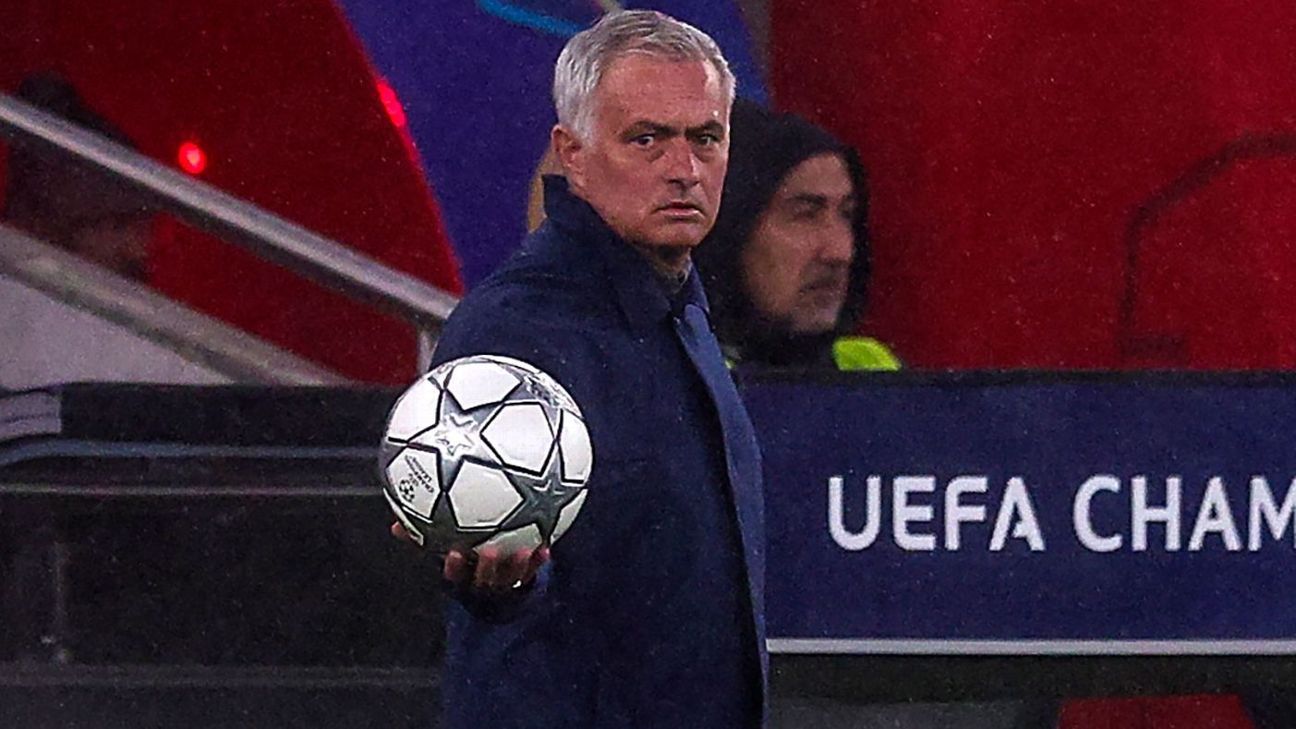
José Mourinho was never destined to disappear quietly. This fact will likely feel like a recurring nightmare for Real Madrid as they gear up to face Benfica, with their UEFA Champions League aspirations at stake.
Having transformed the “Special One” into the “Normal One” during three tumultuous years at the Bernabéu from 2010 to 2013, Madrid is well aware of Mourinho’s tendencies and anticipates a challenging encounter when they clash with his Benfica squad for a spot in the round of 16 over the coming eight days.
Mourinho has already returned to trouble his former club this season, having overseen last month’s remarkable 4-2 league-phase triumph for Benfica—capped off by goalkeeper Anatoliy Trubin’s unforgettable headed goal in stoppage time—which propelled Madrid into the playoffs and kept the Lisbon side in the tournament. The two teams are set to meet again on Tuesday at Estadio da Luz, followed by the second leg in Madrid next Wednesday.
– Everything you need to know about the UCL knockout rounds
– Coaching chaos: Get ready for 2026 manager merry-go-round
– Ranked: The top 25 manager jobs in soccer, from best to worst
With Mourinho rumored to take over from Roberto Martínez as Portugal’s coach after the 2026 FIFA World Cup, every Champions League match could potentially be the 63-year-old’s final one. This matchup presents a fitting opportunity for Mourinho to postpone his Champions League farewell—a contest in the tournament that established him against the club that challenged him.
Is Mourinho the kind of individual who would derive significant satisfaction from exacting revenge on Madrid, 13 years after departing the Bernabéu, by eliminating them from the Champions League? Certainly.
Since concluding his tenure as Madrid’s coach in 2013, where he secured just one LaLiga, Copa del Rey, and Supercopa, Mourinho has amassed more major trophies than many coaches. However, he has consistently measured his success against the elite rather than the rest.
He clinched a Premier League title with Chelsea in 2015, the UEFA Europa League with Manchester United two years later—along with League Cups during his time at Stamford Bridge and Old Trafford—and the UEFA Conference League with AS Roma in 2022. However, the most significant achievements on Mourinho’s resume occurred before he arrived at the Bernabéu, where he faced the dual challenge of managing a skeptical locker room while contending with Pep Guardiola’s Lionel Messi-led Barcelona team.
Prior to his Madrid tenure, Mourinho was a serial victor—winning Champions League titles with FC Porto and Inter Milan (the latter as part of a Treble), numerous domestic cups in Portugal, England, and Italy, and six league titles in eight years with Porto, Chelsea, and Inter.
He collected 17 trophies during those eight years, but only nine in the 16 years since with Madrid, Chelsea (again), United, Tottenham Hotspur, Roma, and Fenerbahce. The decline began at Madrid.
At the Bernabéu, he experienced conflicts with influential senior players such as Iker Casillas and Sergio Ramos, and he also lost his aura of invincibility amid a fierce rivalry with Guardiola. Having previously commanded unwavering loyalty from key players at Porto, Chelsea, and Inter, Mourinho lost that connection at Madrid, which never returned, leading to similar disputes with star players—Eden Hazard (Chelsea), Paul Pogba (Man United), Dele Alli (Spurs)—during subsequent managerial stints at other clubs.
 play2:17Did José Mourinho get lucky with Benfica’s playoff qualification?
Gab Marcotti and Julien Laurens analyze the dramatic conclusion to Benfica’s match against Real Madrid, where goalkeeper Anatoly Trubin astonished everyone by scoring a last-minute header to secure Benfica’s place in the Champions League playoffs.
Sources who collaborated with Mourinho during his two tenures at Chelsea indicate that he was a different person during his second spell. His time at Real Madrid left lasting marks and made him a more abrasive, less popular figure in both the locker room and the boardroom. Mourinho has also struggled to regain his status as a winner of the most prestigious trophies, despite working with elite clubs, resulting in his positions becoming less appealing with each turn on the managerial carousel.
Publicly, Mourinho has stated that his time at Madrid was a pinnacle. He remarked to Portugal’s Channel 11 in 2019: “Real Madrid was my best experience because of what I learned as a coach, as a man, from the lessons I took in my career and in my life. It’s the best memory of my career, it was fantastic.” However, the reality suggests otherwise.
It was the most significant role of Mourinho’s career, yet it concluded with a sense of unfulfillment and the levels of success anticipated by him and Real. His time at the Bernabéu will always carry an air of “what could have been.”
Regardless of his location, Mourinho has never lost the knack for creating headlines, and the 4-2 victory against Madrid last month was quintessential Mourinho. Had he not instructed his goalkeeper Trubin to advance in a final gamble, Benfica would not have scored the pivotal goal to advance to the playoff round, and there would be no double-header with Madrid to anticipate this week.
Mourinho has not managed a team at the Bernabéu since his departure in 2013—he led Inter to Champions League success against Bayern Munich at the stadium in the 2010 final—so his return to Madrid for the second leg next week will evoke a range of emotions for both Mourinho and the home fans.
Thus, there are ample reasons for Real Madrid to be cautious about their reunion with Mourinho. He may very well have one last moment in the Champions League spotlight.
