
Premier League summer signings: A series of failures, or is patience required?

Prior to his injury during warmups on Sunday at Nottingham Forest, it appeared that Florian Wirtz had made significant progress. Considering how poorly Liverpool performed for the initial 85 minutes of that match, his recent improvement in statistics may not fully reflect his value to the team. However, he is not the only one contributing.
Since the start of 2026, many of the top attacking talents in the Premier League have been summer acquisitions. In 2026, Chelsea’s João Pedro, Arsenal’s Viktor Gyokeres, and Manchester United’s Benjamin Sesko are all tied for the league lead in non-penalty goals, each netting five.
Goals can often be misleading: a few well-placed shots, fortunate deflections, or goalkeeping errors do not necessarily indicate a prolific scorer. Nonetheless, Sesko ranks fourth in expected goals, João Pedro is in third, and Liverpool’s Hugo Ekitike, another summer signing, is just above him. Wirtz is currently eighth in xG, and when expected assists are factored in to create a basic measure of attacking effectiveness, Wirtz rises to third, just behind Ekitike.
Even in North London, where Tottenham has already switched managers twice this season (welcome, Igor Tudor) and is now facing a genuine risk of relegation, Xavi Simons has also begun to show improvement. He ranks 12th in the expected goals+assists chart since the beginning of the new year.
With so many summer signings now making an impact for their new teams, and most of them arriving from various leagues, it is tempting to delve into the extensive collection of English football clichés and assert that, indeed, “They just needed time to adjust” — to acclimate to the pace and intensity of the Premier League, to realize that they are no longer in the Bundesliga, Hugo.
However, instead of taking that route, we will challenge the assumption entirely. Let’s review recent history and address the following question: Do new Premier League players genuinely improve once they acclimate to the league, or is that merely optimistic speculation?
– Why is Champions League so easy for Premier League teams?
– Top 50 USMNT players of 2026 so far, ranked by club form
– Ranked: Top 25 manager jobs, from best to worst
How to determine which transfers improved
To find an answer, I examined every significant attacking transfer made by Premier League clubs for players from outside England during the summer transfer window since the 2015-16 season. I set the threshold at €15 million (according to data from Transfermarkt), but also included a few players who seemed to fit the intent of the analysis.
To define “attacker,” I focused on players categorized as forwards, wingers, or attacking midfielders. Why only attackers? And why limit it to summer signings?
I selected attackers because their performances are generally easier to measure. These players are typically considered effective if they are generating numerous shots and creating opportunities for their teammates, while midfielders and defenders have more ambiguous and context-dependent roles.
I opted to focus solely on summer signings because January transfers complicate the analysis. I aimed to determine if players from outside the Premier League improved as their first season progressed. Players acquired in January have less than half a season to adapt, and their “second half” would occur in the subsequent season, after they have had a full preseason to integrate with their new team.
By narrowing the scope, we identified 80 players who played at least 300 minutes in both the first and second halves of their inaugural seasons with their new clubs. To assess the progression of their performances, we will simply compare their statistics from the first 19 games of the season to those from the final 19 games.
This approach naturally excludes players who may not have reached the minutes threshold in either half due to their manager’s assessment of their performance. While this may eliminate players who declined or improved, there is a roughly equal number of players on both sides of that scenario, so I proceeded with the 300-minute criterion.
Why the Premier League’s adjustment period is significant
To evaluate each player’s performance, I analyzed nine different statistics. Here’s how the per-90 performance changed for all 80 players from the first half of the season to the second:
• Goals: 5.7% increase
• xG: 11.9% increase
• Assists: 0.6% increase
• xA: 5.9% decrease
• Chances created: 1.6% increase
• Shots: 4% increase
• Touches inside the penalty area: 6.3% increase
• Passes into the penalty area: 5.1% increase
• Successful dribbles: 3.5% decrease
Overall, nearly every metric shows slight improvement: players are taking more shots, creating higher-quality opportunities, engaging more frequently in the penalty area, delivering more passes into the box, and scoring more goals. These indicators suggest that players are performing better — these are the primary ways attackers contribute to their teams’ success.
Additionally, these metrics serve as signs of players adapting to new systems and leagues. They are increasingly finding space in the most threatening areas of the pitch, leading to enhanced output.
This holds true even for the declining statistic of successful dribbles. If a player struggles to assert themselves within their new team’s tactics and formation, one straightforward method to make an impact is to attempt to beat their opponent with the ball. Perhaps, as they begin to influence play around the box more frequently, they feel less compelled to rely on dribbling. Alternatively, they may start to affect play around the box more often as they reduce their dribbling attempts.
The most puzzling aspect, however, is the drop in expected assists. This does not refer to expected goals assisted, which assigns the xG value for any shot attempted to the player who passed the ball to the shooter. Instead, xA measures the probability that each pass, regardless of whether it leads to a shot, will result in a goal.
Theoretically, xA should be less variable than xG assisted and provide a more accurate reflection of passing ability. However, reconciling a nearly equal decline in xA with the increase in passes into the penalty area is challenging. Research indicates that passes into the penalty area are significantly more consistent than actual assists and xG assisted, so I am inclined to conclude that there is no substantial change in how new players are influencing games through their passing.
 play1:45Has Viktor Gyökeres finally settled in at Arsenal?
Janusz Michallik joins Mark Donaldson to discuss Arsenal’s 3-0 win over Sunderland in the Premier League.
The winter of the summer signings
This past summer, six players transferred to the Premier League from clubs outside of England for fees of €60 million or more: Wirtz and Ekitike to Liverpool, Sesko to Manchester United, Gyokeres to Arsenal, Simons to Tottenham, and Nick Woltemade to Newcastle.
Overall, they have all shown improvement since the season commenced — across every per-90 metric previously mentioned:
• Goals: 52% increase
• xG: 19.2% increase
• Assists: 12.1% increase
• xA: 66% increase
• Chances created: 6.5% increase
• Shots: 27.2% increase
• Touches inside the penalty area: 18.8%
• Passes into the penalty area: 28%
• Successful dribbles: 1.8%
It is important to note that the second-half figures we are comparing are based on a much smaller sample size — eight or nine matches, compared to 19 from the first half — but this should merely temper our expectations regarding the extent of their improvement, rather than raise doubts about whether they have indeed improved.
Wirtz, Ekitike, and Simons have all seen significant increases across nearly every metric — and they have all logged considerable minutes in the second half. Sesko’s passing statistics have declined, but his shot production has been remarkable on a per-90 basis since the season’s midpoint.
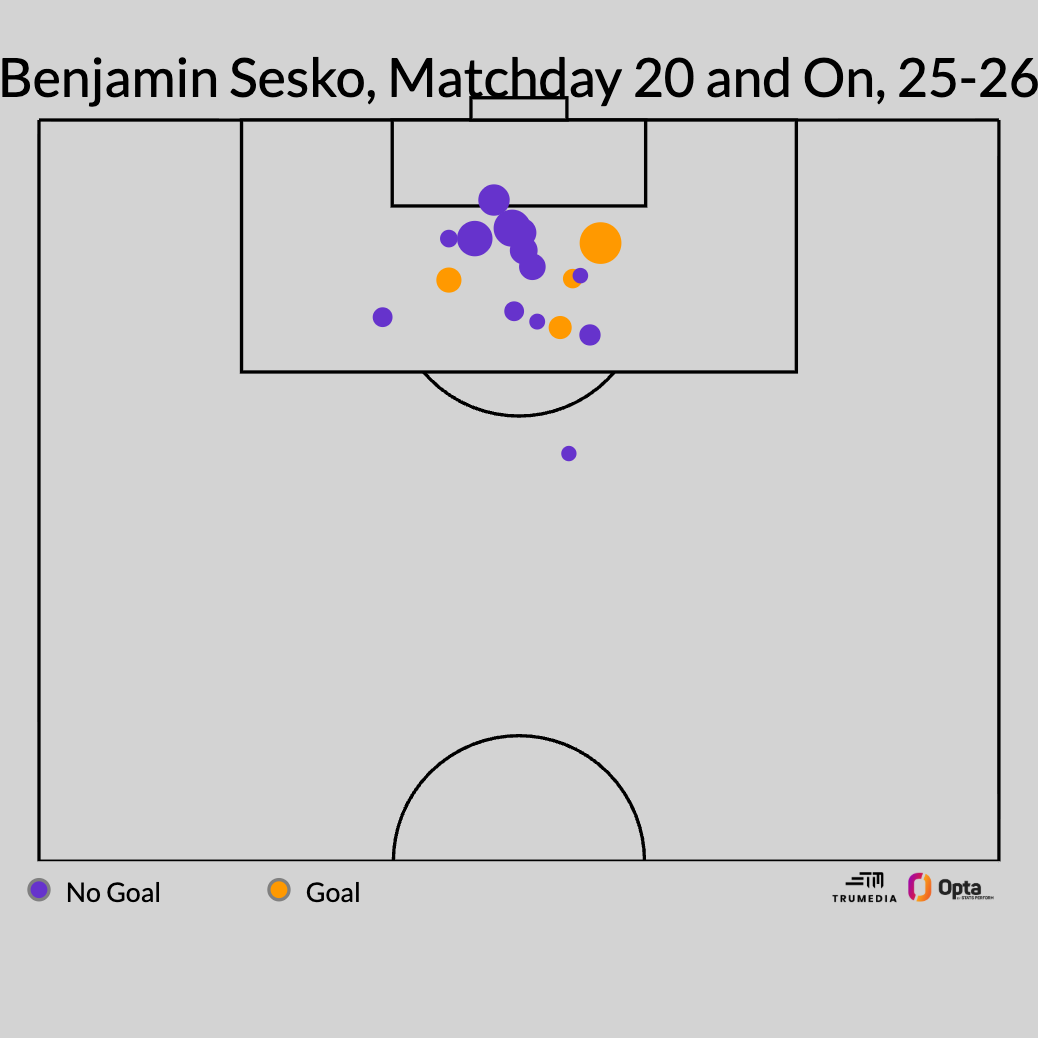
However, he has only started two league matches this year and has seen reduced playing time under interim Manchester United manager Michael Carrick. Nevertheless, in his last four league appearances, totaling around 90 minutes, he has scored three goals and attempted seven shots. There remains considerable potential — Sesko is still just 22.
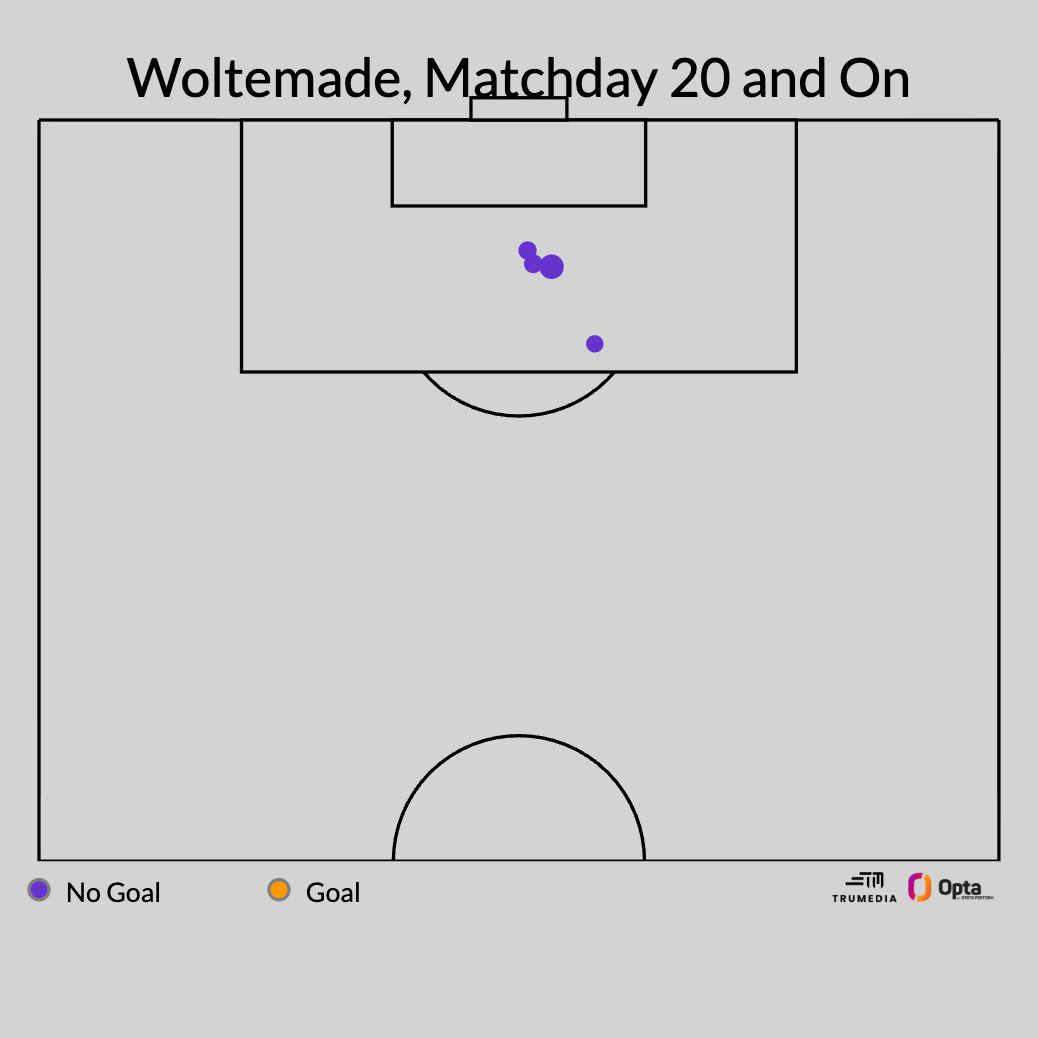
Woltemade, on the other hand, is the only clear exception to the positive trend: His previously limited passing statistics have improved, but he has yet to find the net in the second half, and his xG production has decreased by 76%. This is a summary of every shot he has taken in the second half of the season:
With Gyokeres, the situation is somewhat more complex. After making Tottenham’s defenders appear as if they were playing for Boavista on Sunday, he has scored twice as many goals per 90 minutes in the second half of the season compared to the first, yet his xG production has dropped by 36%, his touches in the opposition box have decreased at nearly the same rate, and his shots per 90 have fallen by over 20%.
Perhaps Arsenal prefers him to be less involved in the box, which could indicate he is making more runs into space, as demonstrated in his performance against Sporting Lisbon? However, this has not been reflected in reality beyond the recent match.
Most players are unlikely to be like Erling Haaland or Mohamed Salah and dominate the league from the moment they arrive. As evidenced this season — and over the past decade — we should exercise more patience with players transitioning from different leagues. There appears to be a “bedding in” or “settling in” period for attackers who arrive in the Premier League from abroad.
Based on historical data, it is not reasonable to expect everyone to improve at the 5% or 6% rates previously established. Instead, we would anticipate that a slightly greater proportion of new attacking signings in the Premier League would demonstrate improvement in the second half of the season compared to those who do not. Some may improve significantly beyond the baseline, while others may decline considerably.
We should indeed allow these players more time to adapt, but that does not guarantee that it will always yield positive results.
