
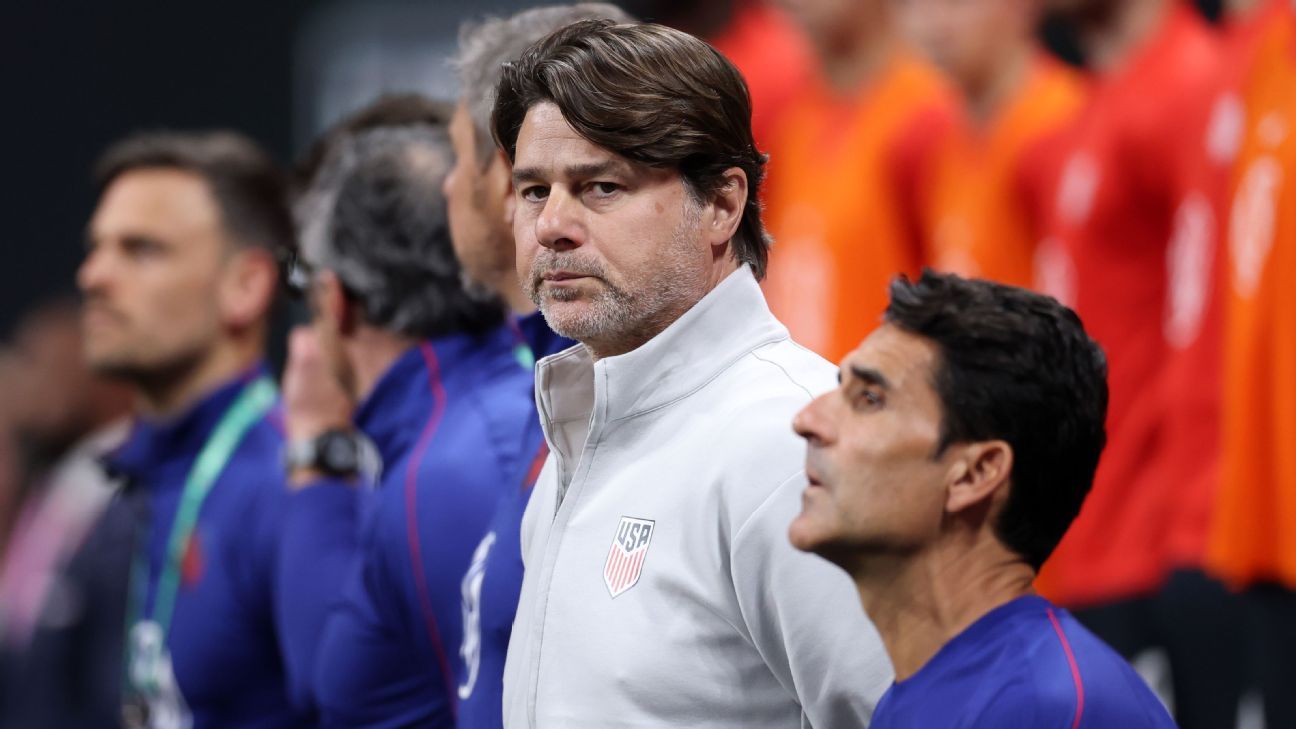
Numerous questions remain, and time is running short for U.S. men’s national team manager Mauricio Pochettino to prepare his squad for this summer’s FIFA World Cup.
The end of the March international window signifies no further camps, friendlies, or experiments before the World Cup roster is revealed on May 26. On that day, Pochettino must finalize his selections for the players who will participate in the World Cup. Following that, he will have a pre-World Cup camp to ideally ensure the team is fully prepared for competition.
Reaching that stage presents its own challenges.
“I believe this marks the conclusion of our cycle, or our trajectory, and preparation for the World Cup,” Pochettino stated after Tuesday’s friendly loss to Portugal. “I think [this] is the end because the next roster will be the one involved. There are numerous aspects we need to evaluate in the upcoming weeks.”
Indeed, there are many factors to consider. The expectation was for greater clarity, but that has not materialized. Here are several issues Pochettino must address.
Get. Pulisic. Going.
Breaking news: Christian Pulisic will score again. This could occur as soon as Saturday, when AC Milan faces Udinese. However, as observed this season, success with Milan does not necessarily equate to success with the USMNT. The last time Pulisic found the net for the U.S. was on Nov. 19, 2024, during a Concacaf Nations League match against Jamaica. While injuries have contributed to this, eight matches without a goal marks the longest drought of his international career.
Regarding Pulisic’s positioning, one decision that should not be repeated is deploying him as a central striker, as he was against Portugal. This not only increases confrontations with center backs but also prevents the U.S. from utilizing Folarin Balogun—the most well-rounded forward the USMNT has had in years.
Pulisic tends to perform better with the USMNT when positioned on the left as one of the twin No. 10s that Pochettino employed for a period, including the friendly against Japan in September. That match also marked the last occasion Pulisic contributed to a goal for the U.S., assisting on a Balogun goal. In that role, he is positioned further from opposing center backs and has more freedom to advance. Against Japan, Pulisic recorded 39 carries and six take-ons in 66 minutes, compared to 20 carries and two take-ons in 45 minutes against Portugal.
While Japan may not be as formidable an opponent, the point remains: Utilize Pulisic as a No. 10, and both he and Balogun will perform at their best.
Choosing his center backs: who and how many?
Chris Richards is a guaranteed starter in defense, assuming he is fit, but who should partner him in central defense? The competition is quite open, which is not ideal with just over two months until the World Cup.
Tim Ream has not been at his best for much of this year, whether at the club or national level. Mark McKenzie and Auston Trusty have also experienced their share of ups and downs. Miles Robinson missed a prime opportunity to impress during the March window, only to be sidelined by a groin injury. This may create an opportunity for Tristan Blackmon—although he has not been called into camp since September due to his own injuries, he is now fit.
The uncertainty raises questions about how this will impact Pochettino’s tactical strategy. The U.S. appeared solid against Japan when employing a five-man defense in a low block, allowing the wingbacks to advance when in possession. This approach minimized the space Ream had to defend. However, since then, Pochettino has utilized a hybrid system with four defenders, allowing one of the outside backs the same freedom to push forward.
During the March window, that outside back was typically Antonee Robinson. While it was encouraging to see the Fulham player return after a lengthy injury absence, his forward runs occasionally left the U.S. vulnerable, with Portugal’s Bruno Fernandes taking advantage of that space in Tuesday’s match. Pochettino noted postgame that Robinson needs to ensure the U.S. maintains secure possession before committing to attack.
In terms of both personnel and tactics, there do not seem to be any straightforward solutions. There are approximately two months remaining to achieve clarity.
Determine whether Reyna is a gamble worth taking
Gio Reyna’s inclusion in the March roster was a significant topic as the window opened, but it became a minor detail once the team assembled, as he played a total of 31 minutes across the two matches with minimal impact. While he was efficient with the ball (completing 21 of 22 passes), only one of those passes reached the attacking third.
Consider it the roaring silence.
Pochettino now finds himself in the same situation he faced prior to the March window. The ideal scenario is that Reyna begins to receive playing time with his club, Borussia Mönchengladbach (his five-minute appearance on Saturday was his first since Jan. 17), and demonstrates that he can contribute in June.
However, if he remains sidelined—an outcome that seems likely—what then? Does Pochettino allocate a roster spot to Reyna in the hope that he might deliver something extraordinary? Or does he consider alternatives like Club América’s Alejandro Zendejas or Real Salt Lake’s Diego Luna? Only one of these three is expected to make the World Cup roster.
This all assumes Reyna will be fit, which, unfortunately, the player has shown is not a certainty.
A lack of chance creation was a concern for the U.S. at Qatar 2022. The choice Pochettino makes regarding who will serve as the attacking spark off the bench could be crucial to the Americans’ prospects for a successful tournament.
Identify Adams’ running mate in midfield
At the core of this question is the assumption that Tyler Adams will be available. He has faced two injury setbacks in the last four months, so Pochettino and his staff will be hoping for his fitness come June.
As for who partners Adams in central midfield, the answer is linked to Weston McKennie’s positioning. The Juventus player has showcased remarkable versatility this season, playing in at least five different roles depending on the formation. For the U.S., the options seem to be either to partner with Pulisic as one of the twin No. 10s or to play deeper alongside Adams.
McKennie appears to be better suited for the former role given his inclination to advance, sometimes at the expense of his defensive responsibilities. However, if Pochettino continues to provide Malik Tillman with playing time, positioning McKennie deeper would be the optimal way to include both players.
 play1:32Gomez: Pulisic has not been good for Milan or the USMNT in 2026
Herculez Gomez states that Christian Pulisic’s performances have not met expectations for club and country in 2026.
If McKennie plays closer to the goal, Lyon’s Tanner Tessmann has a strong chance of making the lineup, although Atlético Madrid’s Johnny Cardoso cannot be dismissed. Tessmann offers a more robust defensive presence, while Cardoso is somewhat more polished on the ball.
Both players seem to be ahead of options such as the Seattle Sounders’ Cristian Roldan, Middlesbrough’s Aidan Morris, and the Vancouver Whitecaps’ Sebastian Berhalter.
Decide which bubble players will be part of his team
Pochettino is already anticipating the difficult task of making the final roster cuts, expressing before the Belgium match, “I’m already suffering two months in advance.”
He certainly faces some challenging decisions.
Reyna, Zendejas, and Luna seem to be competing for one attacking midfield position. In terms of central midfielders, Adams, Cardoso, Roldan, and Tessmann are likely to be included. This leaves space for one of Berhalter or Morris, but possibly neither if Pochettino opts for four forwards. Should he choose set-piece expertise (Berhalter) or a tenacious midfielder (Morris)? Berhalter appears to have a slight edge, but there are still two months for that to evolve.
One selection dilemma may have been resolved for Pochettino.
There was uncertainty about whether to select three or four forwards, leading to a competition among Ricardo Pepi, Haji Wright, and Patrick Agyemang to serve as backups to Balogun. However, on Monday, Agyemang sustained an Achilles injury that Derby County announced on Tuesday would exclude him from the World Cup. Consequently, Josh Sargent may still have a role to play in that discussion.
