
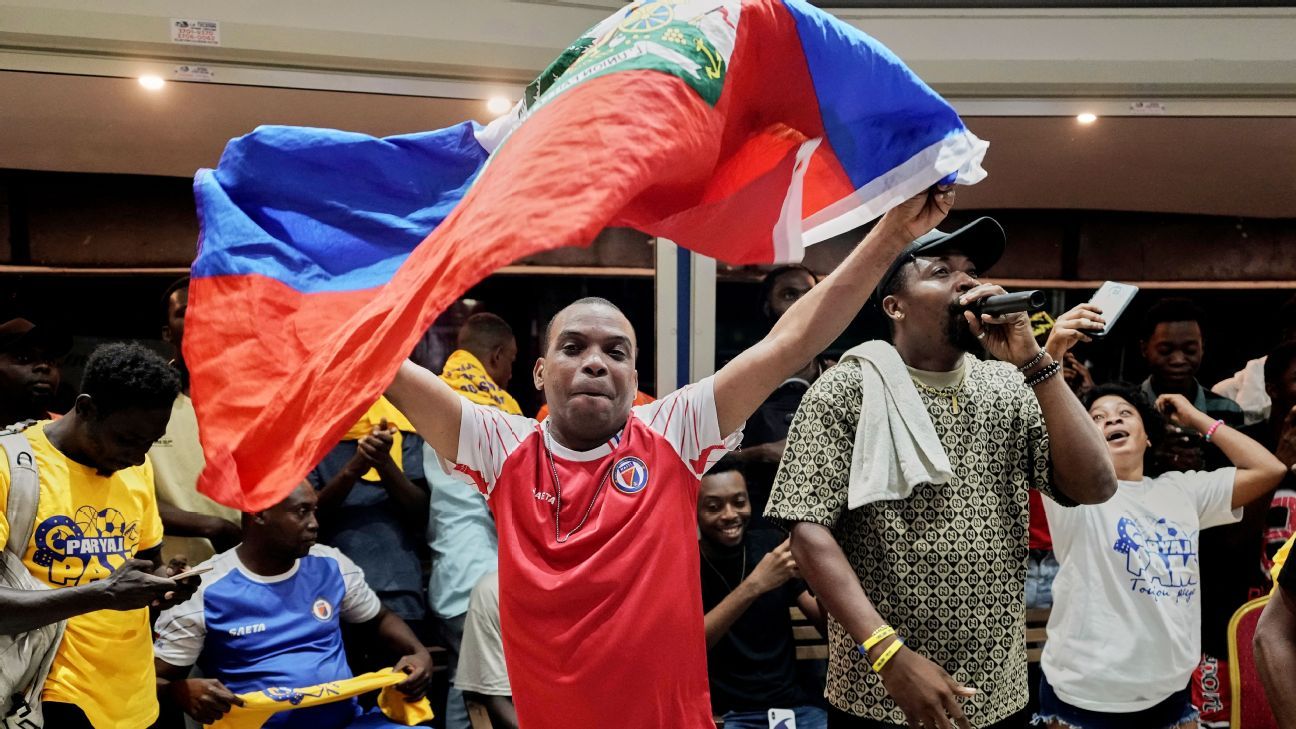
When the Haitian men’s soccer team secured its spot in the 2026 FIFA World Cup, marking its first qualification since 1974, it did so without the ability to utilize its home stadium or train within the struggling nation.
“This makes this accomplishment even more extraordinary. We take great pride in this,” stated Regine Etienne, Haiti’s acting consular general in Boston. “Their journey illustrates that there remains hope for Haiti, and that resolve and skill can prevail despite challenges.”
Qualifying for the World Cup can have a significant impact for a small or troubled nation. The Haitian flag will be displayed alongside those of some of the world’s most influential countries. However, citizens of Haiti will be unable to travel to the United States to support their team, a situation that is disheartening for Haitians both at home and abroad. Haitians, similar to individuals from Senegal, Ivory Coast, and Iran, face nearly a total travel ban under the policies of the Trump Administration. Despite appeals from these nations, there is no indication that President Donald Trump will change his stance, nor that FIFA will urge the U.S. to make exceptions for those wishing to attend the World Cup.
As of January 1, the Trump administration broadened its visa issuance suspensions to nationals from 39 countries, citing concerns over national security and public safety, asserting that these countries could not adequately vet their citizens. Four of the nations on the banned list—Haiti, Senegal, Ivory Coast, and Iran—have qualified for the World Cup, which is being hosted this year by the U.S., Canada, and Mexico.
Under the policy, formally known as Presidential Proclamation 10998, players, team officials, and immediate family members from the four nations will be eligible for visas. While the policy permits some exceptions—such as those that “would serve the U.S. national interest”—a State Department spokesperson indicated in an email that such cases would be “quite rare.”
“A visa is a privilege. Visas are not a right,” the spokesperson stated in an emailed message. “Under President Trump, the Department of State is managing visa operations in a manner that prioritizes the safety of the American populace and our national interests, enhances screening and vetting, and enforces the law.”
The Haitian government “is actively exploring all possible options,” Etienne remarked. However, she noted that “a visa is a sovereign prerogative and remains at the discretion of the relevant authorities.”
One potential ally for the four World Cup nations could be New York City Mayor Zohran Mamdani, a democratic socialist who reportedly had a surprisingly amicable meeting with the Republican president in the Oval Office last November.
Mamdani stated in January that he would appeal to Trump for a travel exception for the World Cup. In a recent interview with ESPN, Mamdani refrained from disclosing whether he had communicated with Trump—”I’ll keep conversations between the president and myself private”—but expressed his intention to advocate for affected communities in any way possible.
“It is an opportunity to be recognized by a world that often overlooks you. And I’ve heard, particularly from Haitian New Yorkers, about the significance of their team participating in this World Cup, as it represents acknowledgment of an entire people,” Mamdani remarked, adding that he will “always make the case” that New York is “a city that the world can visit.”
Mamdani, who is known for his passion for soccer, hosted a viewing party for the Africa Cup of Nations final between Morocco and Senegal last month, marking the first of what he claims will be many events celebrating New York’s immigrant communities.
A White House spokesperson did not comment on whether the president had spoken to Mamdani or would consider an appeal regarding the travel ban, stating in an email, “Thanks to President Trump’s leadership, the FIFA World Cup 2026 will be one of the greatest and most spectacular events in the history of mankind, right here in the United States of America. This event will generate billions of dollars in economic impact and create hundreds of thousands of jobs in our country. The President is focused on making this the greatest World Cup ever while ensuring it is the safest and most secure in history.”
Haiti, Senegal, and Iran will play all their group-stage matches in the United States. Conversely, the Ivory Coast will play its second group stage match in Toronto, where Canada has a strict vetting process but does not impose a blanket ban. It is also possible that teams could progress to knockout rounds in Canada or Mexico, which is a long shot for all but Senegal.
Sheck Wes, a Senegalese-American hip hop artist raised in New York City, stated that the ban not only prevents Senegalese fans from sharing their enthusiasm with World Cup audiences but also restricts other Americans from experiencing a vibrant community eager to contribute to the event.
“If we’re going back to 1776, back to Benjamin Franklin seeking assistance in Paris, we’re a nation known for both asking for help and providing it, and this World Cup presents a great opportunity for us as a country to be exemplary hosts for these individuals,” he remarked.
When the Trump administration announced the bans, it claimed that nationals from the specified countries “have been involved with crimes that include murder, terrorism, embezzling public funds, human smuggling, human trafficking, and other criminal activities.”
“Widely unreliable foreign civil documents and a lack of authoritative criminal information” complicate the U.S. ability to vet applicants, the administration stated, adding that the government must “exercise extreme vigilance” in the visa issuance process.
The policy has faced criticism from Democrats and various civil and human rights organizations as being discriminatory, with Human Rights First labeling it as “racist” and “a sweeping act of collective punishment.”
Jonathan Grode, a notable immigration attorney in Philadelphia, remarked that the rigidity regarding immigration contradicts the Trump Administration’s own business instincts.
“You have (the Department of) Commerce, which recognizes the significance and importance of (sports diplomacy), and you have the immigration hawk faction, which, regardless of the financial benefits to the country or what it signifies as a global leader, is not interested in that if it contradicts their overall approach to immigration,” he stated. “And that is really what’s coming to a head here.”
When asked if FIFA might advocate for an exemption to the ban, a spokesperson for the organization noted that FIFA has collaborated with the Trump administration to establish an expedited visa interview process for anyone holding a World Cup ticket. However, the determination of who ultimately receives a visa is a separate issue: “The U.S. government… decides who gets a visa and who is admitted. FIFA is not involved in host country immigration processes.”
Critics have suggested that FIFA President Gianni Infantino, who has developed a close relationship with Trump and awarded him the inaugural FIFA peace prize, should urge his friend for an exemption.
“It’s very difficult to process,” stated Lionel Lucien, a Haitian-American community leader in Boston, where Haiti will play its World Cup opener. “There are individuals there who would love to come and meet the requirements. The outright prohibition of Haiti from attending the World Cup is entirely contrary to the FIFA mission. It’s damaging and disrespectful.”
A retired veteran U.S. diplomat, speaking on the condition of anonymity, indicated that the U.S. has valid concerns regarding the vetting of individuals from impoverished or unstable nations seeking tourist visas. Haiti and Iran have faced restrictions in prior administrations: “Tourist visas for them are essentially rare, if not impossible, to obtain, and some of it is simply logistical,” the former diplomat stated. However, he added that a total ban is an extreme measure.
“There is a rational and measured way to address this that aims to resolve the issue, and then there is another approach that uses this entirely for an ideological goal, and door ‘B’ is what they’ve chosen,” the diplomat commented.
Senegal may be “a poor country, and there is significant fraud,” the diplomat noted, “but the idea of upwardly-mobile citizens attending to support their teams is not unreasonable.”
Iran has been in its own category since the Islamic Revolution in 1979.
“We’ve never had a functioning consular section there since the ‘Argo’ era,” the diplomat remarked, referencing the film about the 1979 Iran hostage crisis. “And the vetting is quite justified when an Iranian is not an ex-pat or a dissident, someone we already know.
“They’re not just hostile (to the United States) but they’re not sharing information that allows us to trust their identities and their passports. The challenge in confirming that a person holding an Iranian passport is indeed that individual—how can you trust that?”
Trump’s announcement of the suspensions also stated that foreign nationals from the specified countries have “exploited the historic generosity of the United States” by failing to comply with the terms of their visas. According to Department of Homeland Security data, Haitians who have received visas in recent years have overstayed their visa terms at a rate significantly higher than any other country in the World Cup. However, the diplomat argued that this is a reason for thorough vetting, not for a blanket ban.
“For Haiti, this is not merely about soccer; it’s about dignity and visibility,” stated James “Reggie” Colimon, a Haitian American who serves as the director of global affairs and protocol for Boston Mayor Michelle Wu. “Sport is meant to unite the world, yet Haiti cannot participate? We are a nation that supposedly welcomes all, in theory, but what we are witnessing is quite different.
“When you single out one nation while welcoming others, it creates a credibility gap. No one will dispute that security is important, but there is an inconsistency in our approach. The World Cup already operates under the highest security standards.”
