
Messi to Dowman: Identifying the top player globally at each age level.
The question “Who is the best soccer player in the world?” used to have a straightforward answer.
It was Lionel Messi.
Currently, while each year a player from either Real Madrid or Barcelona may act as if they have been unjustly treated for not securing the top spot in Ballon d’Or voting, it has become more intriguing to explore this topic. The identity of the world’s best player is not clear-cut and can shift annually, if not monthly.
However, there will be ample opportunity for discussion, particularly in a World Cup year. As always, we will strive to reconcile two opposing beliefs: (1) that soccer is a multifaceted, evolving sport influenced by the interactions of a team’s 11 players, and (2) that the World Cup champion must feature the best soccer player globally.
For now, though, I wish to pose a different inquiry: Who is the top player in the world at every age?
To provide this analysis with greater depth and consistency, I have categorized players by their birth year. So, from those born in 2009 to those born in 1987, who stands out as the best in each group?
 2009: Max Dowman, winger, Arsenal
This choice may appear obvious because, well, yes …
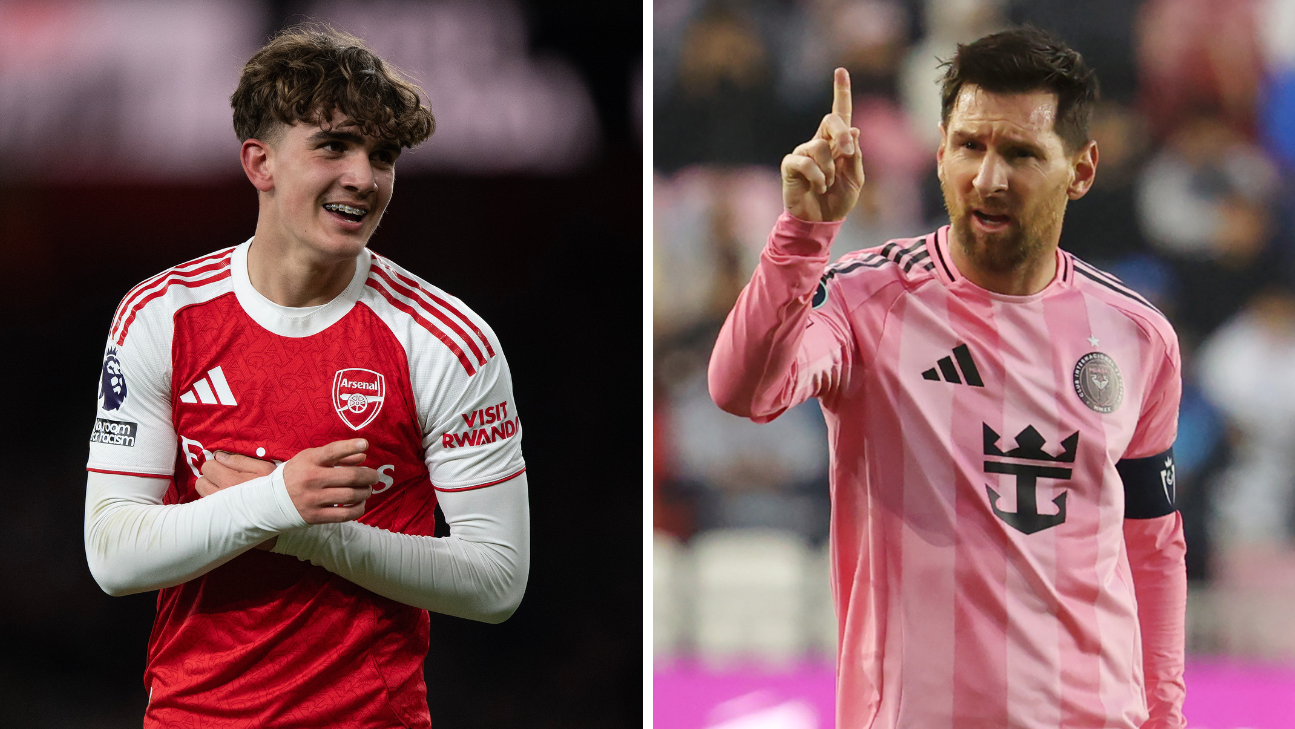
At just 16 years old, Max Dowman is the youngest goal scorer in Premier League history, achieving this milestone with a goal for the top team in England, and arguably the best team in the world. He made a remarkable coast-to-coast run against a team that recently defeated Chelsea 3-0, and he sports the same wispy mustache I had when my father humorously remarked, “Did you just drink grape soda?” which led to years of therapy.
Considering that Dowman is two full World Cup cycles away from entering his prime—he will be 24 in 2034—there shouldn’t be anyone in his age bracket close to his level … right?
However, there is a 16-year-old in Germany named Kennet Eichhorn who has already accumulated 20 times as many first-team minutes as Dowman, and he plays in a significantly more demanding role.
One reason we often see younger players excel as attackers is that errors are less consequential higher up the pitch. Conversely, a mistake in center midfield could quickly result in a counter-attack for the opposing team. While attackers are the most valuable players in the game, the threshold for a coach’s trust is considerably higher the closer one gets to their own goal.
Eichhorn, however, has logged over 800 minutes at defensive midfield for Hertha Berlin this season, despite being sidelined with an injury since January. Perhaps if Dowman were with a second-division team, he would be getting significantly more playing time than he has at Arsenal. Conversely, if Eichhorn had come through the academy of a Champions League club, he might still be receiving more minutes than Dowman.
There’s no definitive way to ascertain this, and it doesn’t particularly matter for the purpose of this analysis. Nevertheless, if there’s one manager who is meticulous about the risks posed by his attackers, it’s Mikel Arteta, and he continues to give Dowman playing time. Therefore, we are slightly favoring Dowman.
 play0:53Mikel Arteta calls for calm around ‘incredible’ Max Dowman
Mikel Arteta discusses Max Dowman following his performance for Arsenal against Everton in the Premier League.
 2008: Lennart Karl, attacking midfield, Bayern Munich
This selection is much more straightforward. Bayern Munich may be the top team in the world, and Karl has started 20 matches across the Bundesliga and Champions League. Recently turned 18, Karl has netted eight goals and provided seven assists.
We don’t require advanced statistics here; accumulating that many minutes at such a young age for Bayern is a strong indicator of future success. Moreover, Karl is averaging 0.79 non-penalty expected goals plus assists per 90 minutes—a world-class figure for an attacking midfielder.
 2007: Lamine Yamal, winger, Barcelona
What more can be said about 18-year-old Yamal that hasn’t already been expressed?
 play1:20How Yamal reached 50 career goals quicker than Ronaldo and Messi
Gab & Juls respond to Lamine Yamal scoring his 50th career goal in Barcelona’s victory over Athletic Club.
 2006: Warren Zaïre-Emery, midfielder, Paris Saint-Germain
The players born in 2006 illustrate just how unpredictable young-player development can be. Numerous factors influence how any individual progresses, as evidenced by several players born two decades ago.
Recall when Endrick was touted as the next Pele? Then, none of the Real Madrid coaches wanted him, leading to a loan to Lyon where he quickly resumed scoring and assisting.
Or consider Myles Lewis-Skelly, who was starting for Arsenal and England at this time last year. After Arsenal acquired a few more towering fullbacks during the offseason, the Premier League suddenly prioritized size, speed, and set-piece scoring, and now Lewis-Skelly has started one Premier League game and is unlikely to make Thomas Tuchel’s World Cup roster.
Conversely, we have Yan Diomande, who was playing high school soccer in Florida four years ago and is now potentially the most sought-after player in his age group globally. In his first year with RB Leipzig, Diomande is doing what everyone desires: outpacing defenders on the wing and converting those opportunities into goals and assists. In a vacuum, he would likely command the highest salary on the open market among those born in 2006.
However, considering all the factors mentioned, I prefer to take a more cautious approach when projecting and evaluating players. Thus, we are selecting the 20-year-old who ranks second in total career minutes played in Europe’s Big Five leagues among all players currently aged 20 or younger:
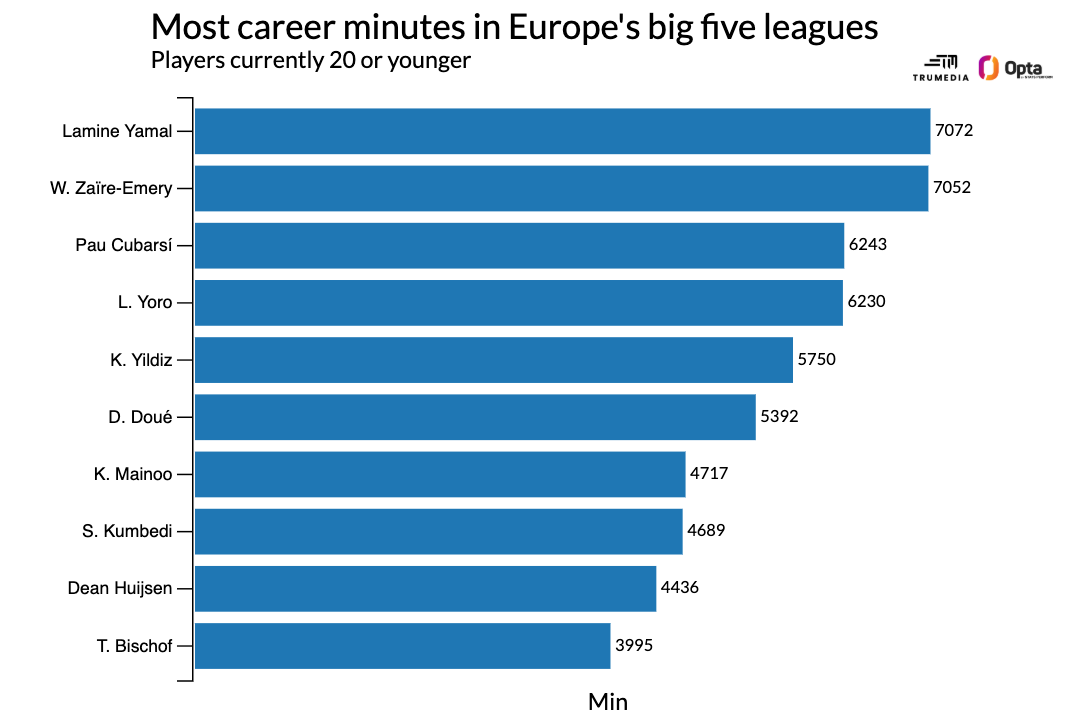
Playing for PSG in Ligue 1 is not equivalent to competing for Real Madrid or Manchester City, due to the general lack of competitiveness in the French league. However, WZE—should this become a trend?—broke into the PSG lineup three years ago and has increased his playing time each season. Perhaps, in some cases, development is indeed linear.
 2005: Désiré Doué, winger, Paris Saint-Germain
I nearly opted against selecting the player who scored two goals and provided an assist in last season’s Champions League final.
Doué, who will turn 21 this summer, has played approximately 900 minutes in Ligue 1 this season and has started just four additional matches in the Champions League. His longer history of production has not quite matched what we witnessed against Inter last year, but he has consistently accumulated valuable minutes over four seasons, and we already know he is capable of starting for a truly elite team.
I’m uncertain if the same can be said for Arda Güler, as I remain unsure of how effective Real Madrid has been at any point this season. However, he is enjoying a breakout year and is already recognized as one of the best passers in the world. Passing is generally a skill that develops with experience, and players who excel at moving the ball at his age tend to have successful careers.
 2004: João Neves, midfielder, Paris Saint-Germain
The 21-year-old Neves joined PSG in 2024 on a five-year contract. A couple of statistics:
• Champions League title win rate for PSG in all full seasons prior to João Neves’ arrival: 0%
• Champions League title win rate for PSG in all full seasons since signing João Neves: 100%
 2003: Jude Bellingham, midfielder, Real Madrid
I am uncertain if he will ever replicate his inaugural season in Madrid. In fact, I doubt he will. Despite functioning as a de facto midfielder, he contributed to a goal every 90 minutes, as Madrid clinched LaLiga and their 15th Champions League title.
In other words, we have witnessed Jude Bellingham perform as the best player on the top soccer team in the world. Only a select few can claim that distinction, and an even smaller group can say they achieved it at the age of 20. Bellingham is now 22, so he still has ample time to attempt it again.
 2002: Pedri, midfielder, Barcelona
Here is the list of players across the Big Five leagues this season who have received a 90-or-better rating from Gradient Sports for passing and carrying:
• Pedri
That’s the complete list.
At 23, Pedri has yet to reach his peak.
 2001: Michael Olise, winger, Bayern Munich
Bayern has entered the PSG territory: they are so superior to everyone else in their league that we must question the performance of all their players in the Bundesliga until we see it translate to success in Europe.
PSG exited this territory last season—largely due to the arrival of Khvicha Kvaratskhelia, who is also a 2001. However, Bayern remains in this zone, partly because they were outplayed earlier this season by Arsenal, led by Bukayo Saka, another member of the 2001 class.
So, why is 24-year-old Olise ranked above both of them? Well, averaging over a goal-plus-assist per 90 minutes places you in the realm of Messi and Ronaldo. Olise achieved that last year and is doing it again this year, at an even higher rate: from 1.04 to 1.28. The latter figure currently leads Europe.
These statistics are undoubtedly inflated by Bayern’s dominance in the Bundesliga, but consider what happened the last time we saw Olise competing in a different league. He averaged 1.06 goals+assists per 90 minutes—while at Crystal Palace in the Premier League. That was over approximately 1,200 minutes, but the last two seasons indicate that it was not a fluke.
A simpler rationale for why I am placing Olise here: There is a possibility that he is the best soccer player in the world at this moment, a claim I would not extend to Kvara or Saka.
 2000: Erling Haaland, forward, Manchester City
There seems to be something amiss with 25-year-old Haaland. His career has been a nearly mechanical progression of effective goal-scoring—unaffected by the skill of his teammates, the challenges posed by his opponents, or anything other than his own body occasionally failing him.
Yet, he has only netted five goals since the beginning of 2026, and the simplest explanation—and the most plausible—is that he is dealing with an injury.
Even with a slight decline in output, he remains far ahead of the competition:
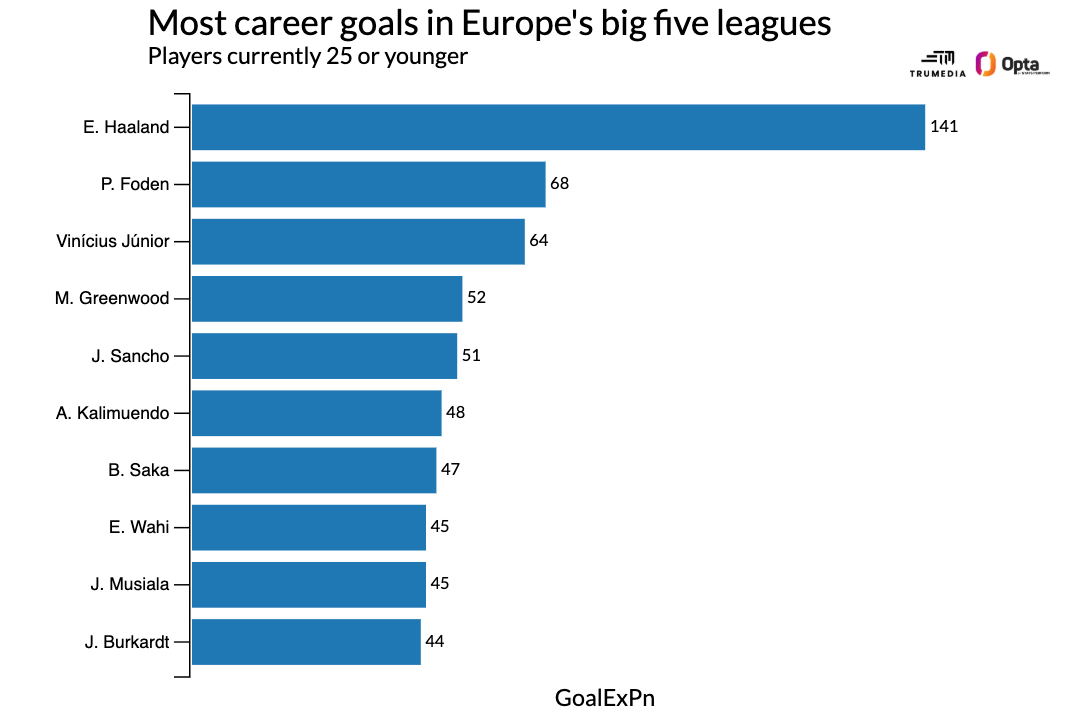
Vitinha, Vinícius Júnior, and Dominik Szoboszlai are all excellent players, but let’s be honest. Goals determine matches, and he is twice the goal-scorer of anyone else his age.
 1999: Declan Rice, midfielder, Arsenal
This could have been an engaging discussion if Alexander Isak had not suffered a leg injury, but this is the simplest choice since Lamine Yamal. No other midfielder excels in every aspect of the position as much as any other 27-year-old:
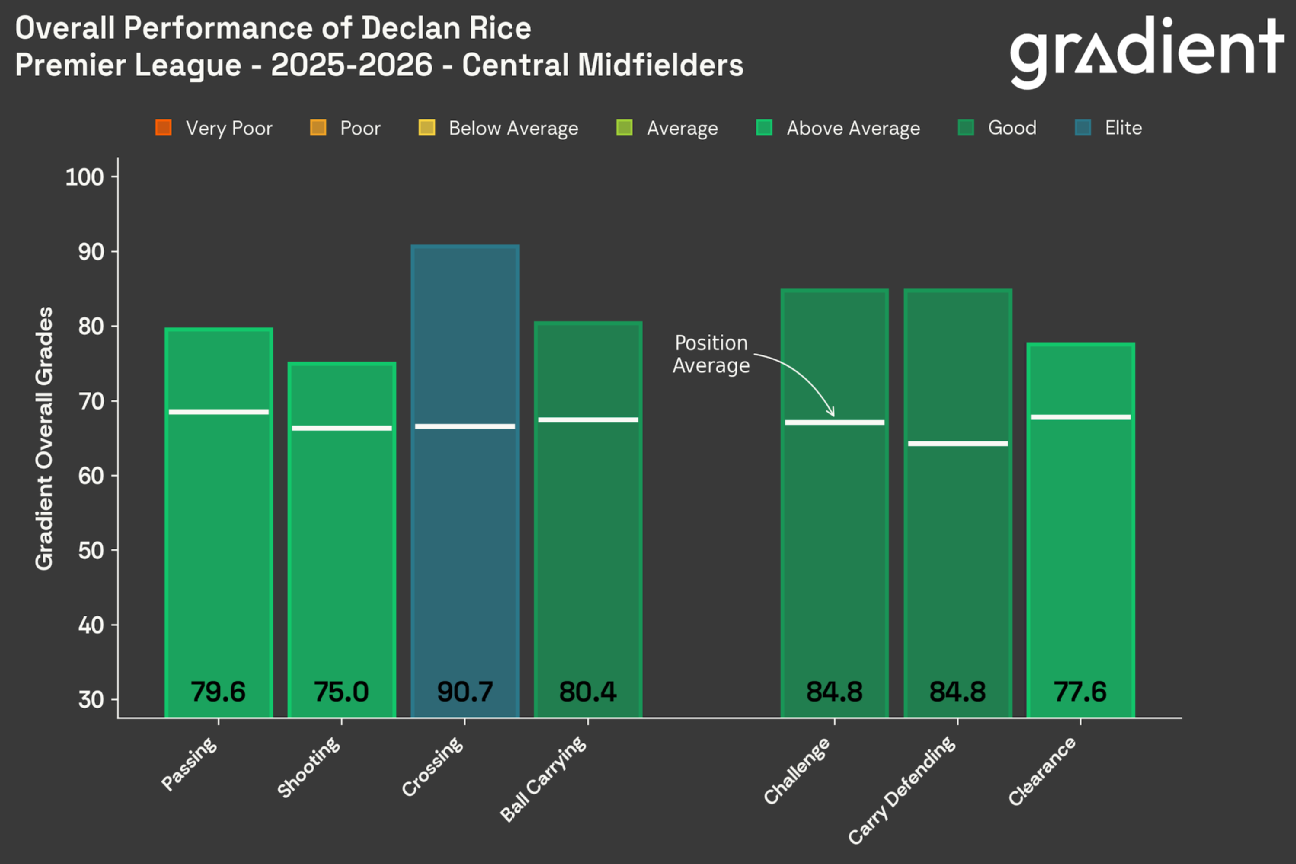
Additionally, he is among the most physically dominant players in his role.
Gradient tracks an “Athleticism” score—a combination of speed, stamina, and explosiveness, adjusted for position and size—and Rice scores a 90.6 out of 100.
 1998: Kylian Mbappe, forward, Real Madrid
Alright, I concede. I appreciate Federico Valverde as much as anyone outside his immediate family, but this choice was simpler than Declan Rice. At 27 years old, Mbappe has been among the top players in the world since his teenage years.
1997: Ousmane Dembélé, forward, PSG
I consistently predict France to win the World Cup whenever asked. A straightforward way to summarize it: Michael Olise, Kylian Mbappe, and Ousmane Dembélé are all French. Dembélé, 28, is the current Ballon d’Or winner, and one could argue that he is the least impressive of the three.
However, I would not make that argument. When fit, he is the best player in the world—an assertion I made last year. He is exceptional with both feet, his off-ball movement, dribbling, passing, and finishing are world-class, and he is relentless in pressing. Unfortunately, he is rarely healthy.
 1996: Raphinha, winger, Barcelona
This largely hinges on your assessment of Rodri’s current form. Let’s compare his Gradient metrics from this season …
 … to his Ballon d’Or-winning season:

That aligns with expectations, right? The passing remains intact, but all the more physical elements of his game have not returned.
Meanwhile, Raphinha is still a 98th percentile athlete according to Gradient’s physical metrics, and he is scoring and assisting at the same rate as last season, when he finished fifth in Ballon d’Or voting.
What I appreciate about 29-year-old Raphinha is his versatility; he can integrate into virtually any team globally: he can serve as the primary scorer and creator, function as the weak-side winger making off-ball runs, and he is one of the best pressers in the world, allowing teams to maintain their structure without significant adjustments.
 1995: Joshua Kimmich, midfielder, Bayern Munich
There is a noticeable decline from 1996 to 1995. This may be due to the fact that we are now discussing players in their 30s, which is typically when athletes begin to experience a downturn in performance. However, it could also be coincidental; sometimes, the highest-level talent clusters in specific years.
