
Man United surprised many by reaching the UWCL quarterfinals, but does this signify advancement?
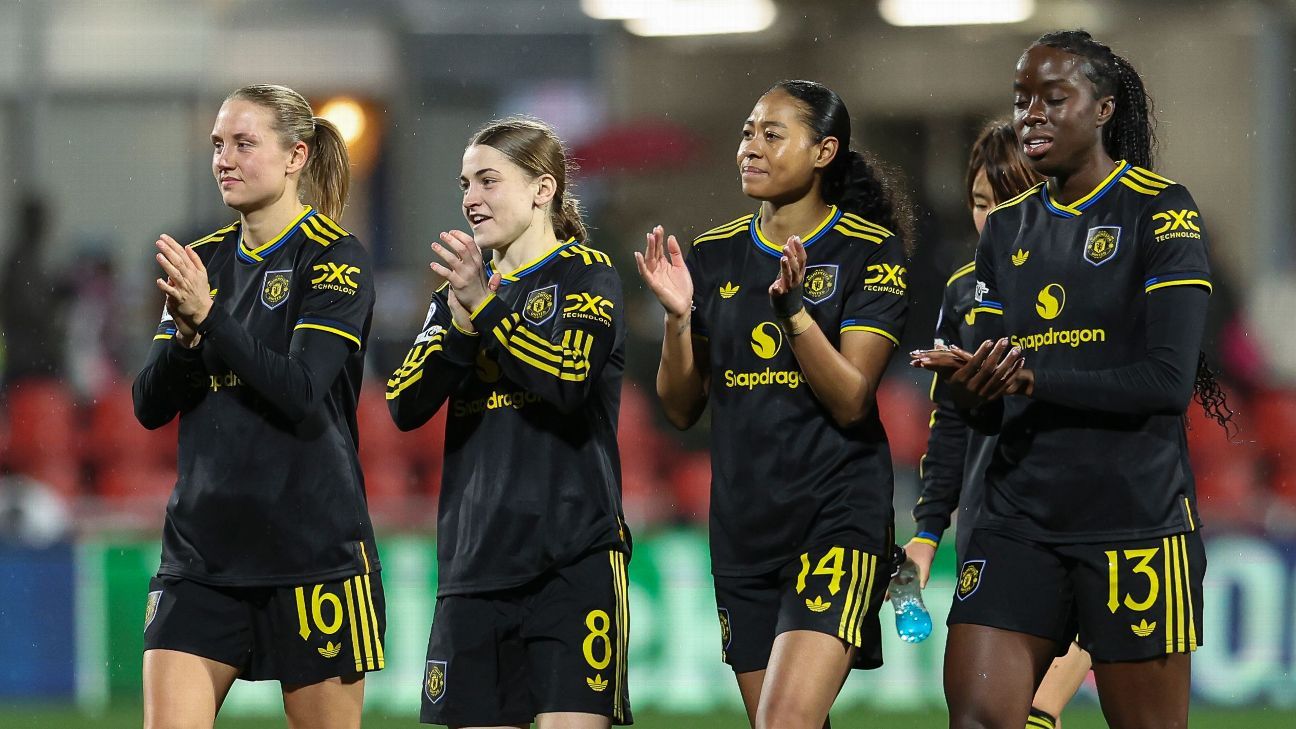
Manchester United’s season has been tumultuous, and it appears likely to conclude without any trophies. An early elimination from the FA Cup (against Chelsea), disappointment in the League Cup final (also to Chelsea), and an eight-point deficit behind local rivals Manchester City with four matches remaining in the Women’s Super League (WSL) title race present a grim outlook. This is especially true if they do not secure a top-three finish to ensure European competition next season.
However, amidst the setbacks lies a significant achievement. In their inaugural season in the UEFA Women’s Champions League (UWCL), United have advanced to the quarterfinals. This European journey has dispelled doubts regarding their capacity to compete at the elite level and will ultimately characterize this season not as a failure, but as an unforeseen success.
Despite facing numerous challenges, including injuries, missing footwear, incorrect kit colors, and a minority owner (Sir Jim Ratcliffe) whose remarks have undermined the team’s progress, United have demonstrated their resilience against Europe’s top teams.
But how far can they advance? And, following their FA Cup victory in 2024, does this season signify progress?
A memorable European debut
Manchester United re-established their women’s team in 2018, after it had been disbanded in 2005. Following Malcom Glazer’s acquisition that year, the team, which was competing in the third tier with limited success, was considered unprofitable by the ownership, leading to the dissolution of the senior team and a shift in focus to their girls’ academy.
Since the team’s revival, United have achieved promotion to the WSL (2019), secured a top-four finish for three consecutive seasons, finished second in 2022-23, claimed their first trophy (FA Cup, 2024), and this season, reached the Champions League knockout stage for the first time.
United are still some distance from regularly contending for the WSL title, with Manchester City holding an eight-point lead at the top of the table, and their other cup campaigns have ended following defeats to Chelsea. Nevertheless, even if this season concludes without a trophy, it would still be regarded as the most successful in the club’s brief history.
The reason? Few anticipated United would progress beyond the newly established “Swiss format” Champions League league phase, let alone reach the quarterfinals.
Before entering the main competition, Marc Skinner’s squad had to navigate two qualifying rounds: they defeated PSV Eindhoven 4-0 and then overcame Swedish side Hammarby 1-0 to reach the third knockout round against SK Brann. However, they faced a setback, losing 1-0 in the first leg in Norway, and made headlines when the team had to purchase 15 pairs of new boots after a bag went missing during transit.
A local shop owner, Andre Gullord, informed the BBC that United spent several thousand pounds replacing the boots. “We are a big store, but they were fortunate we had enough boots in stock that were the right size,” he stated. “They paid between £200 and £230 for each pair, and £30 for the shin guards. We have had the odd player come in because they have left their boots behind, but never the entire team.”
Although they incurred about £4,000 in extra footwear expenses, they returned home for the second leg with all their boots and equipment accounted for, and Elisabeth Terland scored a hat trick to secure a 3-1 aggregate victory and a league-phase spot for the first time.
 play1:41Middleton-Patel reflects on ‘special’ first UWCL game for Man United
Safia Middleton-Patel speaks after making her first start in the Women’s Champions League for Manchester United.
Remarkably, despite never having reached this stage before or faced such high-caliber opponents, United finished sixth in the league phase, with four victories and two losses. They began with two 1-0 wins over Valerenga and Atlético Madrid, but a 2-1 triumph over Paris Saint-Germain—the team that eliminated them in qualifying in 2022-23—underscored their advancement.
However, they faced two heavy defeats against two of the tournament’s top teams, losing 5-2 to VfL Wolfsburg and 3-0 to eight-time champions OL Lyonnes, which highlighted the gap that still exists with Europe’s elite. Nevertheless, United managed to rally in their final match, defeating Juventus 1-0 to secure a place in the knockout round playoffs against familiar adversaries Atletico.
“[The competition has] exposed us to different styles of play, and it’s an experience that has helped us grow quickly,” Skinner remarked.
“That’s probably the aspect I’m most proud of. The challenges… I reflect on when we played Lyon, the first game against Valerenga, all the way through to the last [league phase] game against Juventus, and the growth in our team is remarkable.”
Throughout the league phase, United dealt with disruptions. First-choice goalkeeper Phallon Tullis-Joyce missed the end of 2025 due to a facial injury (forcing backup Safia Middleton-Patel to make her senior debut against PSG), forward Celin Bizet announced her pregnancy and had to withdraw from the squad, while Fridolina Rolfö, Jayde Riviere, Millie Turner, Ella Toone, and Anna Sandberg spent time injured, exposing a lack of depth in Skinner’s lineup.
In previous seasons, United’s tendency to falter after one or two injuries derailed any hopes of success. However, following a more pragmatic and refined transfer strategy, focusing on addressing key gaps with specific player profiles rather than merely expanding the squad, United appeared to maintain their rhythm.
A renewed transfer focus
The increase in matches this season has necessitated squad rotation. However, having been hesitant to do so in prior years, this has turned out to be a blessing for a team still mastering the art of winning. They can now grind out results even when their performance isn’t the most aesthetically pleasing.
The club’s previous approach—or lack thereof—has faced significant criticism for failing to utilize players effectively, not rotating adequately, and witnessing the departures of several key players (such as former captain Katie Zelem, goalkeeper Mary Earps, and England striker Alessia Russo) on free transfers. It wasn’t just the departures that were concerning; in the summer of 2023, United experienced an exodus of 22 players—many initially moved on loan before leaving the club permanently—and they signed nine players in return. Three years later, only five remain.
The following year, they bid farewell to 18 players, although many were academy players moving on, with eight signings in return, all of whom have been instrumental to the current successes. ESPN sources close to the club have commended director of women’s football, Matt Johnson, who took over after Polly Bancroft left the club during the initial phase of minority owners INEOS’ restructuring of the women’s team.
The past two transfer windows have seen a more refined recruitment strategy, sources informed ESPN. United signed fewer players, but the quality of the incoming talent improved, and their squad value, according to player marketplace TransferRoom, now exceeds £2 million.
A significant portion of this season’s success in Europe can be attributed to enhanced recruitment, such as the acquisition of Dominique Janssen, who joined in the summer of 2024 from Wolfsburg, and whose determination this season has become contagious among the squad—though her mistake did lead to the opening goal against Chelsea in the League Cup final. More recent additions have also proven advantageous, with both Julia Zigiotti Olme and Park being contenders for WSL signing of the season.
Engaging in the Scandinavian market has also been crucial for United. While many other clubs have utilized feeder leagues, United have been ahead of the curve. Eight players now come from Sweden or Norway, comprising a third of their squad.
The January transfer window provided an opportunity to add players and address any injuries. Forwards Ellen Wangerheim and Lea Schüller, along with defender Hanna Lundkvist, were brought in, and that added depth proved beneficial as United comfortably won their knockout-phase playoff tie against Atlético 5-0 on aggregate.
Still, even with an improved recruitment strategy and a revitalized team spirit, humorous incidents surrounding United have not been far away. The team was informed at short notice that they could not wear their home jerseys for the second leg after the Spanish side failed to bring the pre-approved kit, and officials deemed there to be a clash, forcing United to play in their black third kit at Old Trafford. Fortunately for Skinner, unlike the boot incident in Norway, this was not enough to prevent them from securing a 2-0 victory on the night.
Now, in a quarterfinal matchup that few could have anticipated, United will face German giants Bayern Munich, with the first leg at home on March 25. Should their dream run continue, they will encounter either Barcelona or Real Madrid in the semifinals. It is an ambitious goal, but the club is hopeful of progressing even further.
“We understand how challenging Bayern will be, but why not? There’s a sense of optimism about the unknown,” Skinner stated at a news conference in February. “Sometimes, newcomers have that… ‘Let’s just go and see what happens.’ We’re arriving, and we believe, and that’s a powerful sentiment in sport. Bayern are an excellent team, but do you [as an opponent] really want to face Manchester United right now? I don’t think you do.”
Are Man United making progress under Skinner?
Not everyone perceives this season in the same manner. While few would dispute the significance of United reaching the Champions League quarterfinals at their first attempt, the absence of a domestic title challenge has led some to view their campaign as somewhat disappointing.
“Honestly, I think Skinner’s time is up,” United supporter Olivia Gibson told ESPN. “I don’t see what more he can do for the team. We should be further ahead and not constantly saying ‘oh we’re getting closer.’
Although United have narrowed the gap with Chelsea, drawing this season 1-1 in the league instead of suffering heavy defeats as in previous years, it has been “jarring” for Gibson and her friends as it “still feels like [the club is] making excuses rather than addressing the issues.”
She adds: “We spend money; we have enough resources to spend like one of the wealthiest clubs, so it’s not that we can’t pursue those players, but we can’t match what other clubs are doing… The club keeps going in circles, and we need a new manager because things won’t suddenly change with the same manager.”
The reality is more complex. No WSL team has successfully balanced competing for the league title while making a deep run in the Champions League; even Chelsea, who have dominated domestically for the past six years, have yet to win Europe’s top prize; while Arsenal lifted the Champions League last season, it came at the expense of their league performance, with damaging losses to Brighton and Aston Villa effectively ending their WSL title aspirations as their focus shifted toward the final in Lisbon.
Moreover, in the clearest indication yet that European competition can impact a domestic campaign, this season’s WSL leaders Manchester City have capitalized on their absence from European football to establish a seemingly insurmountable eight-point lead at the top of the table.
This is not an issue unique to United; it is a challenge that English clubs have grappled with for years. No team has completed the quadruple since Arsenal in 2007-08, and United were never going to comfortably compete on multiple fronts in their inaugural Champions League campaign. However, while much of the progress the club has made this season reflects Skinner’s efforts, the fanbase remains divided regarding his future.
The contract extension he signed in 2024 was met with skepticism by some supporters, particularly following a disappointing fifth-place finish in the league that year (although they did win the FA Cup), and some interpreted the decision to retain him as a sign that the club lacked ambition for the women’s team. Some believe next season will be pivotal for the manager, while others argue United should already be planning for the future and identifying a potential successor who can transition smoothly when his contract expires at the end of next season.
“He’s performed better than I anticipated this season, given all the issues with the owners and spending,” United fan Keiran David told ESPN. “But I still don’t believe he will last beyond next year.”
Yet this season has highlighted how crucial Skinner has been to the team’s growth. It is difficult to envision United being in this position had they opted to replace him instead of extending his contract two years ago. Amid budget constraints at that time, continuity was the path they wisely chose.
Skinner has done enough to ensure that even a trophyless season would still signify genuine progress. However, for many, that does not feel sufficient without tangible rewards. The League Cup final defeat seemed to trigger another wave of frustration towards United. While Skinner appeared to be gaining some support this season, losing their best opportunity for a trophy this season to Chelsea (again) has sparked further discontent among fans.
United have won only one of their last 19 encounters against Chelsea, with the sole victory occurring in the FA Cup semifinal in 2024. Perhaps if the loss had come against a different opponent, the sting would be less? “I can’t keep watching them collect losers’ medals whenever they face Chelsea,” David adds. “We keep saying we’re getting closer, but we are clearly not.”
What do Man United need to take them forward?
 play1:34Marcotti: Ratcliffe has to give a reason to miss Man Utd Women’s FA Cup final
Gab Marcotti criticizes Jim Ratcliffe for not providing a reason for his absence from Manchester United Women’s FA Cup final defeat to Chelsea.
This season, United have demonstrated that input from absentee minority owner Ratcliffe is far from essential to the women’s team’s success, as long as the squad is financially supported.
There has been considerable criticism directed at Ratcliffe following remarks made about the women’s team since they assumed control of football operations in February 2024. The 73-year-old has previously labeled the men’s team as the “main issue” and “what moves the needle,” a comment that suggested the women’s side is not among the club’s priorities. He also referred to the women’s team as “girls” and “an opportunity.”
Ratcliffe has notably missed the last two FA Cup finals: the 2024 victory and 2025 loss to Chelsea—yet he still attended the men’s FA Cup final in 2024. To date, he has not been present at a women’s match during either their domestic or European campaigns.
When asked in 2024 about his plans for the team, Ratcliffe acknowledged he had been focused on “first-team issues,” indicating that decisions regarding the women’s side were still pending. This stance was further emphasized by the choice to relocate the women’s squad from their purpose-built training facility to temporary accommodations while the men’s team occupied the space during a £50 million renovation of their Carrington base.
These decisions collectively undermine the notion of a genuine “one-club mentality” and indicate a clear prioritization of the men’s side. However, it also raises an intriguing question: what might United achieve if the same level of respect was afforded to the women’s team? Could they become true contenders for the Champions League? Might they finally mount a serious title challenge in the WSL?
Given the history of disrespect, continued distance from Ratcliffe may actually benefit the women’s team; a so-called “silent partner” who provides financial support but rarely engages in operations.
Gibson expressed that she does not want Ratcliffe involved any more than he has been thus far. “We’ve managed well without him,” she states. “I don’t really want someone so opposed to women’s football and the team involved in the club, anyway. He’s said enough already. I don’t think anything will change our minds that he is detrimental to the [women’s] team.”
As long as investment continues to enable the club to recruit effectively and remain competitive both on and off the pitch, Ratcliffe’s hands-off approach may ultimately be the most advantageous path forward. Nevertheless, the club could certainly benefit from fewer negative headlines regarding the development of their women’s team.
Their journey to the UWCL quarterfinals has already contributed positively to that. For a club that was competing in the second tier just seven years ago, this season has established an impressive foundation. The challenge now is to transform this breakthrough into the norm.
