
Is the current USMNT forward lineup the strongest in World Cup history?
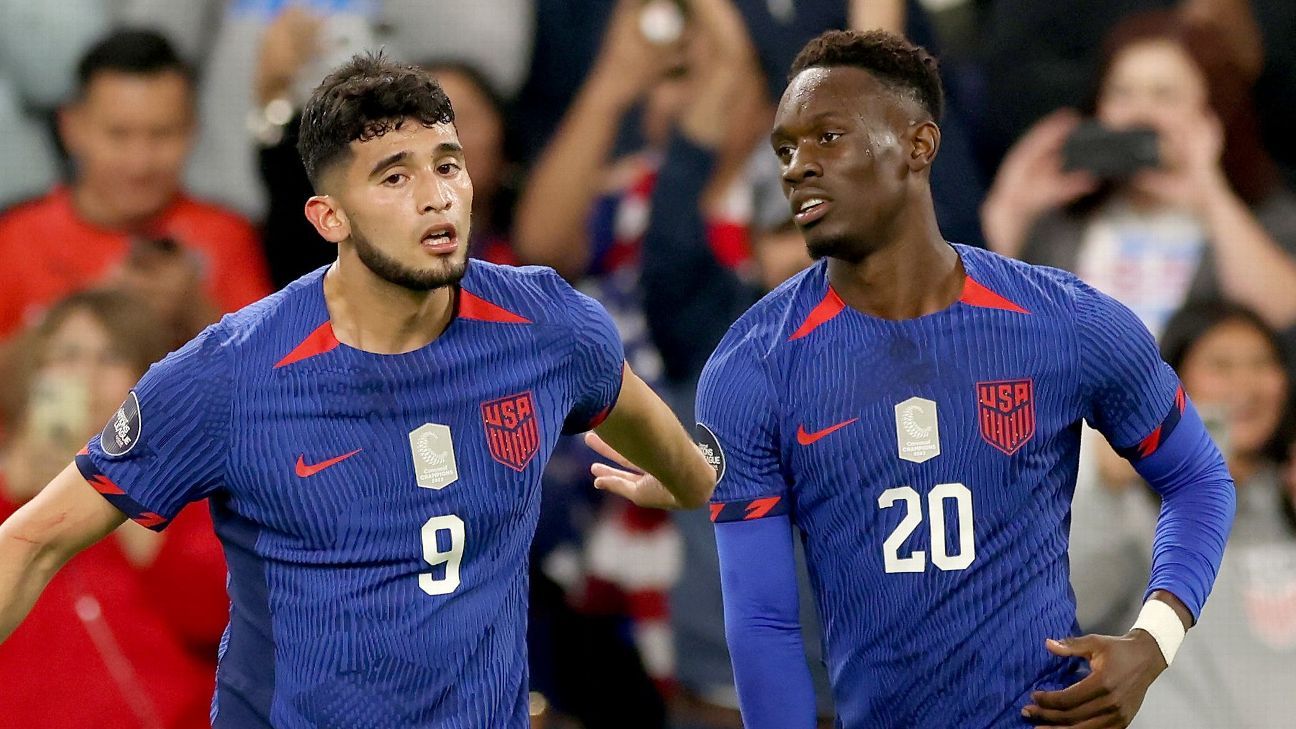
With less than three months remaining until this summer’s FIFA World Cup, which will be jointly hosted by the United States, Mexico, and Canada, U.S. men’s national team coach Mauricio Pochettino faces significant decisions.
Pochettino will soon need to reduce his extensive list of players to 26 for the prestigious tournament, a challenging endeavor. While the U.S. may not possess the same depth of talent as World Cup frontrunners like Spain, France, and England, the American player pool has certainly progressed over the years, with more skilled players making their mark abroad.
In the striker role, it is noteworthy that several Americans are scoring in competitive European leagues. Folarin Balogun of AS Monaco, Ricardo Pepi from PSV Eindhoven, Haji Wright of Coventry City, and Patrick Agyemang of Derby County have not only become key players for their clubs but have also earned chances with the USMNT as the World Cup approaches. Additionally, Josh Sargent, who recently joined MLS’ Toronto FC after a stint in Europe, brings valuable international experience.
Given that consistent goal scoring from the No. 9 position has been elusive for the U.S. since Brian McBride’s retirement from international play in 2006, this development is encouraging for Pochettino and U.S. soccer supporters. However, how do these players compare to those from earlier generations?
– Pochettino’s USMNT roster reflects a more lenient view on club performance
– Ranked: Every USMNT World Cup kit from 1990 to 2026
– USMNT 2026 World Cup big board 5.0: Predicting squad for March camp
With insights from TruMedia/StatsPerform on the statistical front and input from McBride himself, let’s examine the current state of the nation’s top strikers.
Before we proceed, here are the statistical parameters. We are focusing on season-long (or 2022’s yearlong) performances at the club level for strikers leading up to a World Cup. While some players, like Clint Dempsey, may not fit the traditional definition of a pure striker, they have been included due to their experience in that role.
All clear? Let’s continue!
State of U.S. strikers
When evaluating efficiency across the four groups (2014, 2018, 2022, 2026), Pepi is posting impressive numbers in the Netherlands. Although his total of 10 goals in 2025-26 matches Agyemang’s tally and falls short of Wright’s 16, the Texan leads in two overall categories: goals per 90 minutes and non-penalty expected goals per 90 minutes.
“Pepi, [his] movement is very good in the penalty area,” McBride, general manager of USL Championship team Brooklyn FC, stated to ESPN. “A really good finisher of the ball.”
It is important to note that some of these statistics might differ if he were a guaranteed starter rather than a player who occasionally comes off the bench against fatigued defenses in a league not particularly known for its defensive strength. Nevertheless, the statistics are telling, and there is a reason why Premier League club Fulham is reportedly interested in acquiring the player this summer.
Second in goals per 90 minutes and non-penalty expected goals per 90 is Jozy Altidore, based on his performances in MLS from 2017 to 2018, with Wright closely following from the current generation. With more regular-season goals than any of the 2026 group and the ability to play wide, the Coventry City standout is a strong candidate for this summer’s roster.
“Wright can play winger at the same time,” McBride noted. “Not necessarily someone that you’re going to have hold up the ball, but he’s got versatility.”
That said, the most complete striker and likely candidate to be the USMNT’s starter this summer is Balogun. The Monaco player shares the top spot on our list for big chances created per 90 minutes with Dempsey from 2017-18, while also netting eight goals in Ligue 1.
In all competitions this season, including the prestigious UEFA Champions League, that figure rises to 14. When considering assists per 90 minutes, he is just behind Dempsey and former Eredivisie star Aron Jóhannsson.
The sample size is limited, but among the 2026 group, no player boasts a better assists-per-90 ratio than the New York City-born striker. Combined with his scoring ability, Balogun stands out as the most versatile No. 9 in the USMNT player pool.
“Probably the most complete striker,” McBride remarked. “He’s good with the ball at his feet, he’s good at making runs in the penalty area, he’s good at running behind. He also connects well and involves his teammates.”
Then there is Agyemang. The 6-foot-4 player from Derby County has the same number of regular-season goals as Pepi and has made the most consistent appearances at club level in 2025-26 with 34 to his credit.
His underlying metrics for xG per shot, goals per 90, and big chances created per 90 may not impress many fans, but he offers a different dimension with his physical presence. Among the current generation of strikers, Agyemang has the highest aerial duels win percentage, making him an appealing backup option for Pochettino.
“Agyemang’s hold-up play is strong,” McBride stated. “He provides us with quality in the air and aerial duels in the penalty area, both offensively and defensively.”
Looking at additional statistics, it is reasonable to conclude that the 2026 generation features above-average U.S. strikers, with potential for further development. Pepi, Wright, Sargent, and Balogun rank among the top seven for xG per shot, while Pepi and Wright are also in the top six for shot-conversion rate. The 2026 class ranks lower in passes attempted per 90, but distribution is not the primary responsibility at the club level for these players.
As previously mentioned, these strikers are still honing their skills. Wright is the oldest at 27 years, while Agyemang, Balogun, and Pepi are all 25 or younger. Sargent, also vying for a World Cup position, turned 26 last month. The statistics also highlight how exceptional Altidore and Jóhannsson were during two specific periods leading up to the World Cup.
Jóhannsson, who leads in xG per shot, ranks second in shot-conversion rate and assists per 90. Before his 2014 World Cup debut, the forward entered the tournament with 17 goals and seven assists across 34 matches in the 2013-14 Eredivisie season. However, he did not fulfill his potential, earning only 19 caps for the USMNT.
Altidore’s time in the Premier League with Sunderland did not go as planned, but he revitalized his career in Toronto. During his run from summer 2017 to spring 2018, he topped the list for shot-conversion rate and ranked second in goals per 90, xG per shot, and non-penalty expected goals per 90, while placing fourth in big chances created per 90.
The USMNT ultimately failed to qualify for the 2018 World Cup, the same year in which the now-retired Altidore dealt with injuries, but it is reasonable to suggest that if he had been fit and still playing in 2026 at his peak, he would have been the starting striker.
It has been two decades since the USMNT has had a reliable No. 9 over an extended timeframe. McBride pointed out various factors that influence production from this position, including injuries, availability, and the sheer number of players utilized up front in recent years.
“Those things are challenges, and they’re real challenges,” said the two-time Fulham player of the year, “[but] there’s some talent there, there’s some goal scorers.”
The World Cup, along with the opportunity to become the next dependable No. 9 for the USMNT, awaits one of these players. Will it be the versatile Balogun? A precise finisher like Pepi? The adaptable Wright? Sargent, who has something to prove in MLS? Or the imposing Agyemang?
“Someone can take that position and make it their own,” McBride stated.
