
How will Kinsky and Tottenham proceed following the incident at Atlético?
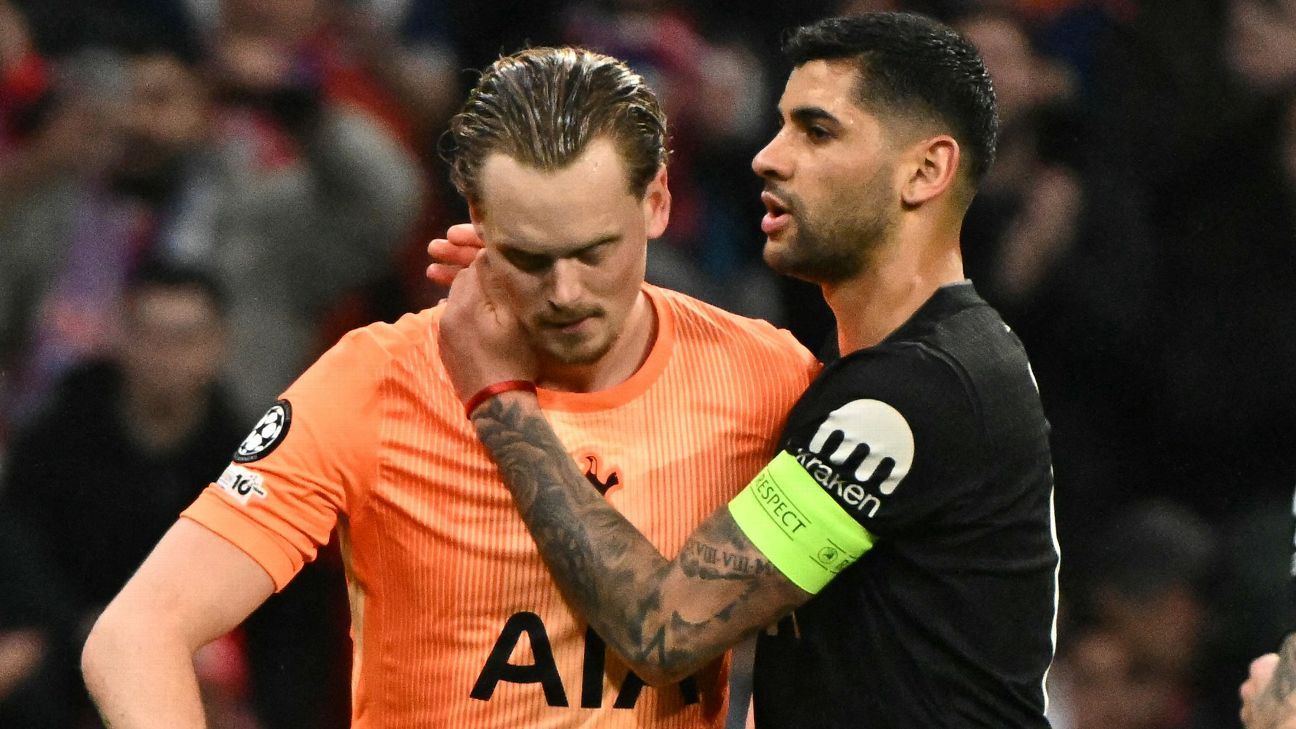
Antonín Kinsky’s error-prone display during Tottenham Hotspur’s 5-2 defeat in the UEFA Champions League against Atlético Madrid, which saw the goalkeeper substituted after just 17 minutes with his team already trailing 3-0, highlights the harsh realities of football.
When the 22-year-old’s name was listed on the team sheet for his European debut in Madrid, many Spurs supporters and observers may not have viewed it as a poor decision, considering that first-choice Guglielmo Vicario, along with other experienced players, has not consistently performed at his best in recent months. The situation can change rapidly.
Kinsky’s initial error occurred six minutes into the match when he slipped while attempting to clear the ball, resulting in Spurs conceding the opening goal almost immediately. This caveat is necessary because, while it was an unfortunate incident, it is something that can happen to any player. (Indeed, Micky van de Ven also slipped, contributing to Atlético’s second goal, and several players from both teams struggled for footing throughout the match.)
– Spurs’ unprecedented collapse felt like rock bottom
– The statistics behind Kinsky’s difficult night for Tottenham
– UCL Talking Points: Spurs falter as all English teams lose
In such circumstances, it is rare to find teammates who would question your actions. They may feel disappointed that it has impacted the game, but there is little to say other than, Let’s keep pushing forward.
However, Kinsky’s second mistake, where he attempted and failed to make a first-time pass with his weaker left foot, allowing Julián Álvarez to score into an unguarded net, is a clear technical error. This was not due to the pitch or the ball; it was a failure in execution that left his team down 3-0 within the first 15 minutes.
After his first mistake, Kinsky placed his hands on his head. Following his second, he was face down on the pitch, seemingly not even watching as the ball entered the net. This is when the human aspect comes into play, and one might think, This is a lot to handle. Moments later, he was substituted.
I cannot recall a time when a goalkeeper was substituted so early due to performance issues. Spurs interim manager Igor Tudor, who made the decision to start Kinsky in such a significant match, appeared to conclude that the goalkeeper was struggling so much and lacked confidence that he could not continue. For any professional, this is a challenging reality to face.
When you make a mistake that draws attention to you, you hope that your teammates will support you by continuing to play well and that the manager will show confidence by keeping you on the field to contribute positively. One of the reasons you reach a professional level is that you have encountered adversity and managed to overcome it—sometimes with great success. Thus, for your coach and perhaps some teammates to decide that you cannot handle the pressure? This can be one of the most difficult moments for a player. As Kinsky walked down the tunnel, he must have been deeply reflecting on himself. It is a challenging place for any professional to find themselves.
It was notable that Tudor did not seem to acknowledge Kinsky as he passed by. However, if I were Kinsky leaving the pitch, I might not want the manager to explain why he felt it necessary to replace me immediately with the player he initially did not trust to start the match.
Early substitutions are uncommon, particularly a change in goalkeepers. Despite Kinsky’s struggles, this still feels unprecedented—so much so that a handshake from the manager would not alleviate the situation.
The uniqueness of this situation is underscored by the fact that it occurred in the first half. When the Spurs players returned to the dressing room at halftime, trailing 4-1, there were emotions and frustrations regarding the team’s poor performance and the game’s direction, but there was also a young goalkeeper sitting in the corner, potentially as distressed as any player could be. However, if you focus on the goalkeeper, it seems as if the game itself does not matter; conversely, if you emphasize the game, it appears the goalkeeper’s situation is overlooked.
Did Kinsky say anything during halftime? If so, what could he have said? This would have been the first time the manager had seen him since the substitution. Tudor might have only a few minutes to speak at halftime. How much of that time would he dedicate to addressing Kinsky? The other players are observing everything Tudor does, and while they may be uncertain about how to react to that moment, they are still looking to the manager for guidance on how to improve in the second half. Meanwhile, there is significant frustration and anger regarding the performance.
I have been sent off before, and if it was undoubtedly a red card that negatively impacted the team, I would start by apologizing. However, this can create awkwardness because if teammates believe it was an incorrect decision, they may say there is no need to apologize, yet the game’s outcome still needs to be addressed. Contrary to popular belief, every professional player possesses a strong desire to win—these individuals detest losing. In the aftermath of matches, numerous conflicting emotions make it challenging for players and coaches to process.
 play2:25Laurens: Tudor should have resigned after Atletico Madrid defeat
Gab & Juls criticize Igor Tudor’s decisions in Tottenham’s 5-2 defeat to Atletico Madrid in the Champions League.
Tottenham faces little relief as they prepare to visit Liverpool on Sunday, still in urgent need of results to avoid relegation from the Premier League. If the manager selects Kinsky for the match at Anfield, observers will be questioning (fairly or not) whether he is mentally and physically equipped to recover from the events in Madrid. However, the nature of football, especially at this point in the season, is ruthless. There is no room for sentimentality, as everyone is fighting for results and will do whatever it takes to win. If that involves putting pressure on Kinsky during the match or encouraging the crowd to target him every time he has the ball, they will do so.
Does Tudor still have faith in him to handle what could be the most high-pressure situation Tottenham has faced in recent history?
One of the most appealing aspects of football is the exhilaration of being in the spotlight for positive reasons. It can make you feel invincible. However, when the focus is negative, there is nowhere to hide. You must strive to step up and move forward, which is much easier said than done—especially when you are uncertain if you will have another opportunity to play and rectify your mistakes.
Kinsky’s teammates at Tottenham now face the decision of whether to publicly show their support or to give him the time and space he may need. There is no definitive answer, as the mistake has already occurred. As I observed the incident, I felt that his error did not necessarily reflect his abilities as a goalkeeper, but rather represented a moment in time for both him and Tottenham.
No one would wish to be in his position at that moment, and even though the match has concluded—the second leg in north London is scheduled for Wednesday—many eyes remain on all those involved, from Kinsky to Tudor and the rest of the Tottenham squad. After all, it was a moment that will be remembered for a long time.
Nedum Onuoha was speaking to ESPN senior editor Tony Mabert
