
How Tottenham transitioned from Europa League champions to a battle against relegation
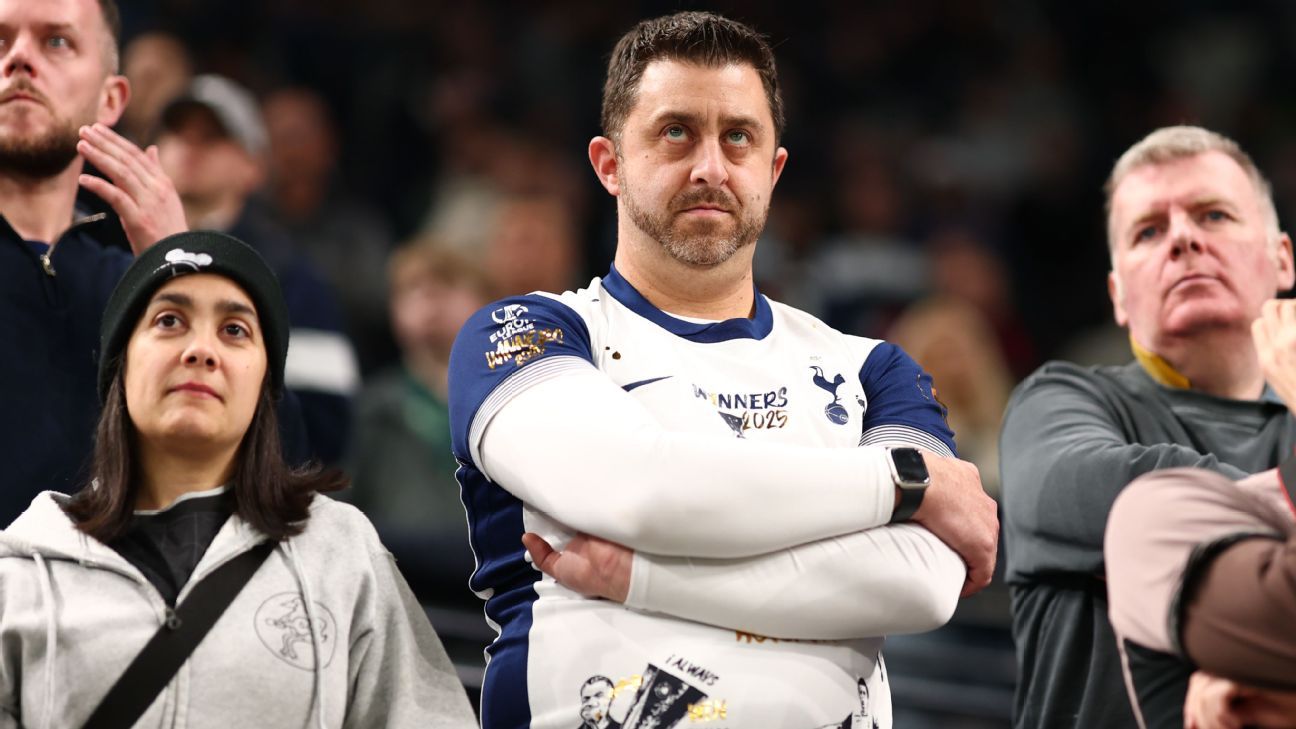
LONDON — The Champions League anthem resonated at the Tottenham Hotspur Stadium on Wednesday. Atletico Madrid visited, and Spurs were competing in football’s top club tournament, with a quarterfinal matchup against Barcelona on the line.
Despite a 3-2 victory in the second leg for Igor Tudor’s squad, Spurs faced a 7-5 aggregate loss that dashed their Champions League aspirations. As they approach the weekend, they are now embroiled in a relegation struggle to maintain their Premier League status.
It is uncertain when the Champions League anthem will next echo around Tottenham’s £1 billion stadium. Currently, it feels like it could be a long time. If Spurs lose at home to Nottingham Forest on Sunday — with Spurs (16th) just a point above the relegation zone and Forest (17th) above it on goal difference — next season’s schedule may feature Championship matches against Preston North End and Lincoln City rather than Champions League encounters with Europe’s top teams.
“Nottingham Forest on Sunday is the most significant game for the club in a long time,” former Spurs goalkeeper Paul Robinson, who experienced relegation from the Premier League with Leeds in 2004, told ESPN. “It would be a complete disaster for the club from top to bottom if they were to be relegated.”
– Lauren’s predictions: Will Tottenham save their season against Forest?
– Premier League Power Rankings: Arsenal down, Man City up on performance
– Messi reaches 900 goals … can he get to 1,000?
Spurs last faced relegation in 1977. They returned to the top flight after just one season, but during those pre-Premier League times, dropping down a division did not carry the financial repercussions it does today. Clubs could often endure it, maintaining their squads with minimal impact, but in the current landscape, relegation can result in an immediate £100 million loss and a mass departure of players. For a club of Spurs’ stature, the consequences would be significant.
But how did it come to this? Spurs were Champions League finalists under Mauricio Pochettino in 2019, they secured the Europa League title with Ange Postecoglou less than a year ago, and their position as one of the Premier League’s ‘Big Six’ — alongside Arsenal, Chelsea, Liverpool, Manchester City, and Manchester United — should render them too prominent and too affluent to ever face relegation concerns.
However, they are not immune to relegation. Spurs have not won a Premier League match in 2026 — their last league victory was a 1-0 win at Crystal Palace on December 28 — and since the beginning of last season, they have lost twice as many league matches (36) as they have won (18). Tudor, who was appointed head coach until the end of the season last month, is the club’s sixth manager since Pochettino’s departure in November 2019, and he has managed to secure just one point from four league matches in charge.
Off the field, there has been upheaval as well, with Daniel Levy’s 24-year tenure as chairman ending abruptly last September. Sporting director Fabio Paratici also departed in January.
All the signs of a club in distress are present. Poor results, underperforming players, managerial changes, instability in the boardroom, and fan dissatisfaction. But still: could Spurs genuinely be relegated?
Where did it all go wrong?
The prevailing view among many associated with Spurs is that the 2019 Champions League final loss to Liverpool in Madrid marked a pivotal moment, with the club ultimately choosing the wrong path.
Pochettino’s squad featured Harry Kane, Christian Eriksen, Son Heung-min, Hugo Lloris, and rising star Dele Alli. The coach aimed to elevate Spurs to the next level, transforming them into winners rather than mere contenders, but the summer transfer window brought in potential rather than established talent, with the arrivals of Jack Clarke, Tanguy Ndombele, Giovani Lo Celso, and Ryan Sessegnon. By November, Pochettino was dismissed, and Jose Mourinho took over, a change that initiated the downward trend.
“By the time Mauricio left, it was evident he had to go,” a boardroom source informed ESPN. “He and Daniel [Levy] were not on good terms; I think they were both exhausted by each other.
“However, Daniel was influenced by too many people, the wrong people, and I believe he was enticed by the idea of having Jose as his manager. Jose is a talented manager, but he inherited a squad designed for Pochettino — young players who require encouragement and development — and he is simply too volatile and aggressive for a youthful team. Spurs needed another manager in the mold of Pochettino after Mauricio’s departure, but they opted for a different direction, and it has never been the same since.”
Ricky Sacks, host of the “Last Word on Spurs” podcast, shares this viewpoint, asserting that the failure to nurture Pochettino’s team is the root of the issues the club is currently facing.
“The club has been going in circles since 2019,” Sacks told ESPN. “There has been no clear vision or identity; nobody knows what they want to achieve, as they have transitioned from one coaching style to another.
“They dismissed Mourinho just four days before the 2021 Carabao Cup final against Man City, failed to support Antonio Conte, and then moved from Ange [Postecoglou] to Thomas Frank, who, while a decent individual, was never prepared to transition from Brentford to a club like Spurs. It’s just been chaotic.”
In addition to the managerial instability, Spurs have consistently struggled to compete at the upper end of the transfer market. Tottenham’s largest-ever signing — forward Dominic Solanke, who joined from Bournemouth for a £65 million fee in August 2024 — is significantly smaller than the record transfers of the ‘Big Six’, all of whom have spent over £100 million on a player, with the exception of United, whose record signing is the £89.3 million deal for Paul Pogba from Juventus in August 2016.
Spurs have also gained a reputation for being conservative with player wages. In their most recently released accounts for the 2023-24 season, Tottenham’s wage bill was £222 million — nearly half of the £413 million paid by City during the same timeframe — but this figure meant they allocated just 42% of their revenue to wages. In contrast, Aston Villa’s latest wages-to-revenue ratio was 71%, while Newcastle United’s was 68%, indicating that Spurs are also falling behind clubs outside the ‘Big Six’ in the competition for new signings.
Spurs’ owners, ENIC, led by the Lewis Family Trust, injected £100 million of new capital into the club last October, but ongoing speculation regarding a potential sale persists despite ENIC’s denials of any intention to sell what is, at least off the pitch, a significant football club.
The impressive 62,000-capacity stadium, the club’s century-long history, and their vast fanbase, both locally and globally, secure Spurs’ position in the ‘Big Six’, but former manager Postecoglou recently questioned whether they deserve to be labeled a “big” club.
“Clearly, they’ve [Spurs] constructed an incredible stadium and training facilities,” Postecoglou stated on “The Overlap,” a well-known podcast. “However, when you examine the spending, particularly in the wage structure, they’re not a big club.
“I noticed that when we were attempting to recruit players, as we weren’t in the market for those individuals. I was considering Pedro Neto, [Bryan] Mbeumo, and [Antoine] Semenyo, and Marc Guéhi, because if we’re going to progress from fifth to competing for trophies, that’s what the other major clubs would do at that moment.”
Instead, Spurs opted for Archie Gray, Wilson Odobert, and Lucas Bergvall — players for the future rather than the present, similar to Ndombele, Sessegnon, and Lo Celso in 2019.
Despite the inadequate recruitment and managerial changes, former Spurs goalkeeper Robinson believes that Levy has been unjustly blamed as the primary reason for the club’s decline.
“Daniel receives a lot of criticism and has faced considerable pressure, but when things are going well on the pitch, attention doesn’t shift to the director’s box,” Robinson remarked. “Spurs have an excellent stadium and training ground — and Daniel Levy was instrumental in that — but the fans are tired of hearing about it because the football aspect has been neglected.
“I think Daniel was poorly advised at times, perhaps listening to too many voices as the club expanded, but to his credit, he responded to the fans’ calls for trophies and hired two ‘win-now’ managers in Mourinho and Conte. He simply didn’t support them sufficiently with win-now players to achieve their goals.
“It’s undeniable that recruitment has been quite poor in recent years, but Spurs have also said goodbye to their top scorers — Kane, Son, and Brennan Johnson — from each of the last three seasons.”
 play0:41Tudor: Tottenham’s win vs. Atletico Madrid important for morale
Igor Tudor reflects on Tottenham’s Champions League exit after their 7-5 aggregate loss against Atletico Madrid.
Tottenham’s inability to secure the players desired by the manager at the time has remained an issue right until the conclusion of Levy’s tenure. Last summer, Frank sought Crystal Palace forward Eberechi Eze, Forest midfielder Morgan Gibbs-White, and his former Brentford striker Bryan Mbeumo, but the club failed to acquire any of them. They also attempted and failed to sign Antoine Semenyo in January, with the Bournemouth forward choosing to move to City instead.
One source informed ESPN that a talent drain of senior figures within the organization has also negatively impacted the club — “they’ve never been adept at retaining personnel,” the source stated — with Victoria Hawksley (LIV Golf), Michael Edwards (Liverpool), Paul Barber (Brighton), Damien Comolli (Juventus), and former chief scout and technical director Steve Hitchen all mentioned as staff who have departed Spurs during Levy’s era.
However, with Levy gone and CEO Vinai Venkatesham — who joined from Arsenal less than a year ago — informing Tottenham’s Fan Advisory Board earlier this month that “significant change” is necessary after criticizing Levy’s management of the club, further upheaval is likely in the coming months, regardless of the division in which Spurs find themselves.
Can Spurs really go down?
Wednesday’s 3-2 victory against Atletico, following last Sunday’s 1-1 draw at Liverpool, has improved the atmosphere around Spurs, but the Forest match continues to create tension among the club’s supporters.
“It feels like a genuine relegation six-pointer, and the momentum from winning or losing will be substantial,” Sacks stated. “The last two matches have boosted morale, but they were somewhat inconsequential.
“Forest is different. The pressure is on, and we must win, so the players need to fight and scrap, and we are uncertain if they can do that. Let’s not forget that they have only secured two home league victories all season.”
Despite Spurs being perceived as a sensible, well-managed, yet cautious club — a trait for which Levy has received both praise and criticism — the financial disaster of relegation cannot be overstated.
According to UEFA’s 2025 European Club Finance report published last month, Spurs recorded the third-largest pre-tax loss (£129 million) in Europe last year, following Chelsea and Lyon, despite achieving a club record turnover of £580 million. Revenue ranked ninth-highest in Europe due to the stadium’s commercial activities, including NFL events and concerts, as well as participation in European football. The club’s net debt, resulting from borrowings for the new stadium, stood at £772.5 million, while reserves decreased from £198 million to £79 million.
Tottenham’s losses prompted CEO Venkatesham to caution the fan advisory board about the necessity to monitor the club’s adherence to Financial Fair Play regulations, so it is clear that relegation would create severe challenges for the club.
Last season, Spurs earned £127.8 million in Premier League prize money despite finishing 17th. Relegation would be mitigated by three years of parachute payments, but these would decline from £48.95 million in the first year to just £17.8 million in the third year; concurrently, they would receive only £5.7 million per year from the EFL’s broadcasting agreement. Villa, Sunderland, and Leeds United were compelled to close entire sections of their stadiums after relegation due to the costs of maintaining them without fans to fill the seats. Could Spurs face a similar fate?
They would be the largest club to be relegated since Leeds in 2003-04, and relegation resulted in a financial collapse at Elland Road and a mass exodus of players. It took the club 16 years to return to the top tier.
“I believe it would be more alarming and an even bigger story than Leeds if Spurs were to go down,” stated Robinson, who was part of the 2004 Leeds team. “Spurs have been a consistent European team, reached the Champions League final seven years ago, and won the Europa League last year, so it would be much more significant.
“When a team is relegated, players are aware they will be leaving. At Leeds, you would arrive for training uncertain if someone would still be there or if the club had moved them on for financial reasons. That’s what relegation brings — the initial devastation, followed by the struggle to return. It’s not an easy task.”
 play2:17Gibbs: Tottenham draw Liverpool’s ‘story of the season’
Kieran Gibbs explains what’s going wrong at Liverpool this season following their late draw vs. Tottenham in the Premier League.
The relegation threat has, however, fostered unity among the Spurs fan base. Plans for a protest against the owners ahead of the Forest match have now been set aside in favor of a concerted effort to create an atmosphere of support and positivity, with supporters intending to greet the team bus with flares and large crowds on Sunday.
“Given the gravity of the situation, nobody wants to be responsible for adding more negativity, so the focus is now on supporting the players and being completely united in that,” Sacks stated. “There are still significant issues with the ownership, and the majority of fans desire new owners, but that is a matter for another time. The top priority is remaining in the Premier League; the team needs our assistance — the club needs our assistance — so we want to demonstrate our support, and Tudor is encouraging us to do so.
“He has instructed all players — even those injured — to travel on the coach this weekend, so we can give them a proper welcome and show our support.”
The worst-case scenario of rivals Arsenal winning the league — and potentially achieving the quadruple — while being relegated by Chelsea in the penultimate game of the season at Stamford Bridge is keeping Spurs fans awake at night, as is the possibility of next season’s derby being against League One promotion-chasing Stevenage.
Richarlison’s equalizer at Anfield, along with Xavi Simons’ match-winning display against Atletico, has provided Spurs with hope, suggesting that perhaps the season is not destined for disaster. However, this is Spurs, and their supporters have grown accustomed to anticipating the worst and often being proven correct.
