
How the Absence from the Champions League Can Benefit Premier League Clubs: Insights from Data
At the time, many ridiculed him, but Arsene Wenger had a valid argument.
In 2012, following Arsenal’s defeat to Sunderland in the FA Cup and while they were trailing 4-0 against AC Milan before the second leg of their Champions League round of 16 tie, Wenger emphasized the importance of focusing on the remainder of the season. He stated: “The first trophy is to finish in the top four.”
Although this lack of ambition appeared to some as a reason for Arsenal’s then-seven-year trophy drought, that was not entirely accurate. The financial burden of constructing Arsenal’s new stadium had limited their capacity to invest as heavily as Manchester United, Manchester City, and Chelsea — Wenger was simply acknowledging the economic circumstances he faced.
To have a chance at competing with those clubs in the future, the Gunners needed to secure the additional millions in revenue that come from qualifying for the UEFA Champions League by finishing in the Premier League’s top four.
While finishing in the top four does not yield any trophies, it is far more likely to lead to a Premier League or Champions League title than winning the FA Cup or the League Cup. If a top-four finish holds more significance than two competitions that award trophies, it effectively serves as its own trophy.
It is not as if we do not regard it as such — the race for the top four is one of the three narratives that enrich each season, alongside the title race and the relegation struggle. (I do not believe it was intentional, but I commend our collective mindset for avoiding the term “race” to describe a competition among teams striving to evade, rather than achieve, something.)
Even with the added assurance of a fifth Champions League spot for the Premier League, this season has been no different. Moving forward, Manchester United, Aston Villa, Liverpool, and Chelsea will primarily be evaluated based on whether they secure one of the five spots. As Liverpool manager Arne Slot remarked back in February: “If we don’t have Champions League football, it’s definitely not been an acceptable season. … That does have an enormous impact on the way this club is run.”
The financial implications are significant, but in an era of fixture congestion and player fatigue, could there be an unforeseen advantage to missing out on the world’s most prestigious tournament for a season? After all, Manchester United and Aston Villa, two of the teams currently in the top four, are not participating in the Champions League this year.
Perhaps missing the Champions League is not as detrimental for Premier League teams as once thought?
• Premier League without set-piece goals: What would the table look like?
• Tracker: Champions League qualification, Premier League relegation
• 2026 World Cup squads ranked: All 48 national teams
The economic impact of missing out on the Champions League
Let’s consider Liverpool as a case study.
After nearly achieving a quadruple in the 2021-22 season, the following year saw a decline. Jurgen Klopp’s squad finished fifth — the first and only instance in his eight full seasons at the club where they did not qualify for the Champions League.
The consequences here are quite clear. According to data from Kieron O’Connor’s insightful Swiss Ramble, here is the club’s broadcast revenue from European competitions during all of Klopp’s full seasons at the club:
• 2016-17: none
• 2017-18: €81 million
• 2018-19: €111 million
• 2019-20: €80 million
• 2020-21: €88 million
• 2021-22: €120 million
• 2022-23: €84 million
• 2023-24: €27 million
In 2016-17, Liverpool did not participate in European competition, and in 2023-24, they were in the Europa League. As Slot mentioned in February: “When I arrived here and only signed Federico Chiesa, it was after a Europa League season.”
This is accurate, and reduced revenue translates to less financial capacity for team improvements. However, what is intriguing is that Slot suggests the financial repercussions of missing the Champions League may actually manifest a year later. The club’s transfer spending supports this notion as well.
The €12 million acquisition of Chiesa was Liverpool’s sole permanent transfer in the summer of 2024. However, following the disappointing 2022-23 season, Liverpool invested €172 million in total (according to Transfermarkt) on the signings of Dominik Szoboszlai, Alexis Mac Allister, Ryan Gravenberch, and Wataru Endo ahead of a season without Champions League fixtures.
Additionally, they had reached an agreement for a nine-figure, Premier League-record deal with Brighton for Moisés Caicedo, who ultimately opted to join Chelsea — another club that failed to qualify for the Champions League after four consecutive top-four finishes.
It is worth noting that I am not entirely convinced that Liverpool solely reduced their spending in 2024 due to the absence of Champions League revenue from the prior season. They also signed current backup goalkeeper Giorgi Mamardashvili from Valencia on a deal to be finalized the following season. They had also agreed to sign Martín Zubimendi from Real Sociedad, only for him to change his mind at the last moment and remain in Spain for another season before joining Arsenal this past summer. Furthermore, they needed to address the contract situations of their three top and most expensive players: Mohamed Salah, Virgil van Dijk, and Trent Alexander-Arnold.
Unlike in 2012, when clubs like Arsenal were financially competing with the top four teams in all of Europe’s major leagues and added European revenue could mean signing a player who might have otherwise gone to AC Milan, the largest Premier League clubs are now primarily competing with Real Madrid, Bayern Munich, Barcelona, and Paris Saint-Germain for talent. The remainder of the Premier League is now contending with the top-four teams across all of Europe’s major leagues.
The combined commercial and broadcasting revenues generated by the top tier in England indicate that losing out on Champions League revenue, on average, is not as painful as it once was. In 2022-23, Liverpool and Chelsea ranked seventh and ninth, respectively, in global revenue among all clubs. In 2023-24, with neither club in the Champions League, they ranked eighth and tenth.
The potential benefit of not being able to win the Champions League
In 2016-17, with Liverpool returning to the top four after an eighth-place finish and Chelsea winning the Premier League title following a 10th-place finish the previous season, a new theory appeared to take shape: Not participating in the Champions League could actually enhance your Premier League performance.
To investigate this, a trained astrophysicist and Harvard professor authored a blog post examining the correlation between the seasonal changes in European matches played by a team and the seasonal changes in Premier League points earned.
“[For] each additional game a team plays in Europe, they can expect to lose half a point relative to the previous season,” he wrote. “Thus, if a team plays 12 more games, it will be 6 points worse off [on average] than the prior season.”
The author, amusingly, was Laurie Shaw, who now holds the position of “chief scientist” at Liverpool. At the time Shaw wrote the article, several other analyses had concluded that there was no “hangover effect” for teams participating in Europe. In other words, teams that had just played a European match did not perform worse than expected in their subsequent Premier League match. Shaw’s research indicated that there is a cumulative effect from allocating additional resources — energy, strategy, travel, etc. — to European matches.
Last month, the blogger Markstats examined the past three seasons and found no clear hangover effect in the Premier League. Since we cannot ask Shaw to simply rerun his analysis for every season since 2016-17, I opted to do it — but only with Champions League matches.
This is how it appears when you plot all pairs of seasons where a team participated in the Champions League in at least one of them:
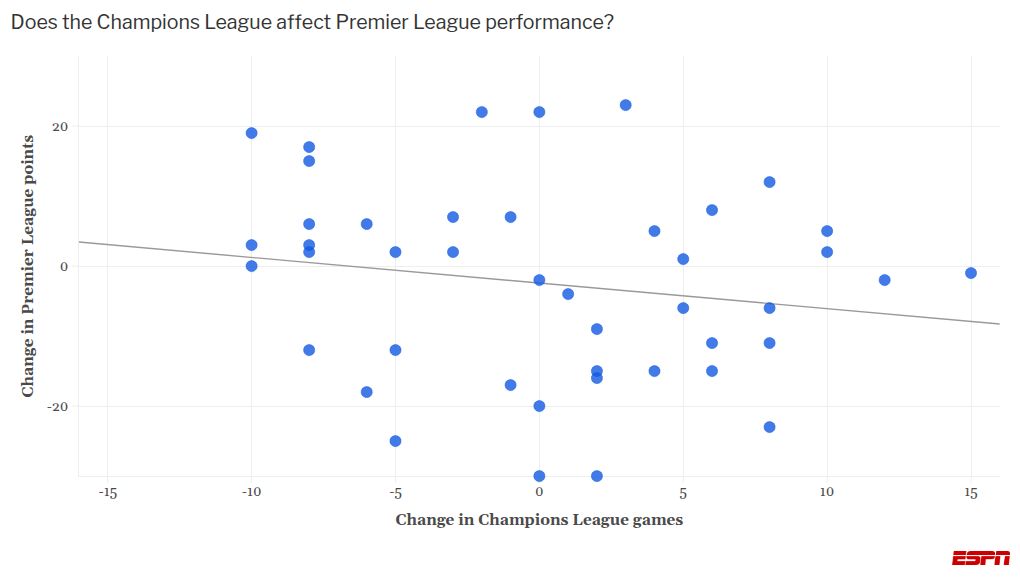
While it is not a strong correlation, it closely resembles the relationship that Shaw observed in 2016. This is evident in the downward slope of the trendline.
Based on this data: For every additional Champions League match a team plays, they lose slightly more than a third of a point on average. Therefore, every three extra Champions League matches equate to approximately one point in the Premier League standings. If we exclude last season, when the total number of Champions League matches increased for everyone, the figures align with Shaw’s — a point lost for every two additional Champions League matches played.
There are numerous confounding factors at play. When some teams miss the Champions League, they have often been unluckily affected to an unsustainable degree. The reverse is also true: Sometimes teams qualify for the Champions League due to unsustainable hot streaks. How much of this is inevitable regression to the mean? And how much of this is a genuine decline in performance linked to the additional demanding matches on your schedule?
However, there is at least something to consider. It seems reasonable to anticipate that the best teams will indeed play more matches in the Champions League, so the fact that, on average, teams perform better in the Premier League while playing fewer Champions League matches suggests to me that there is a tangible negative impact from the added strain of extra high-level games.
I also analyzed the total number of matches played from season to season across all competitions, and there is essentially no correlation to changes in points, indicating that there is something specific about the Champions League that influences domestic performance.
Of course, it would be absurd to claim that it is preferable not to be in the Champions League. We do not engage with or care about sports solely for the financial outcomes they generate — the finances facilitate the results and are produced by the results. The objective of all this is to strive for victories in competitions like the Champions League and the Premier League. The means to achieve that is by, you know, actually participating in the Champions League.
Nevertheless, I believe we may have entered a phase in the Premier League’s evolution where the teams are so affluent, and the competition is so intense, that there exists the potential for a one-year exponential advantage for a club that steps away from the competition. They will still have ample funds to invest in their squad due to the European revenue from the prior season, they are likely to experience better fortune moving forward, and they will benefit from a full season without the potentially detrimental effects of all those midweek Champions League fixtures.
Whoever misses out on the top five this season could logically be expected to rebound into the Champions League spots next year. Therefore, Liverpool or Chelsea supporters: There is something that might help you rest easier at night.
