
How Shakhtar Continues to Acquire Numerous Brazilian Players During Ongoing Conflict in Ukraine
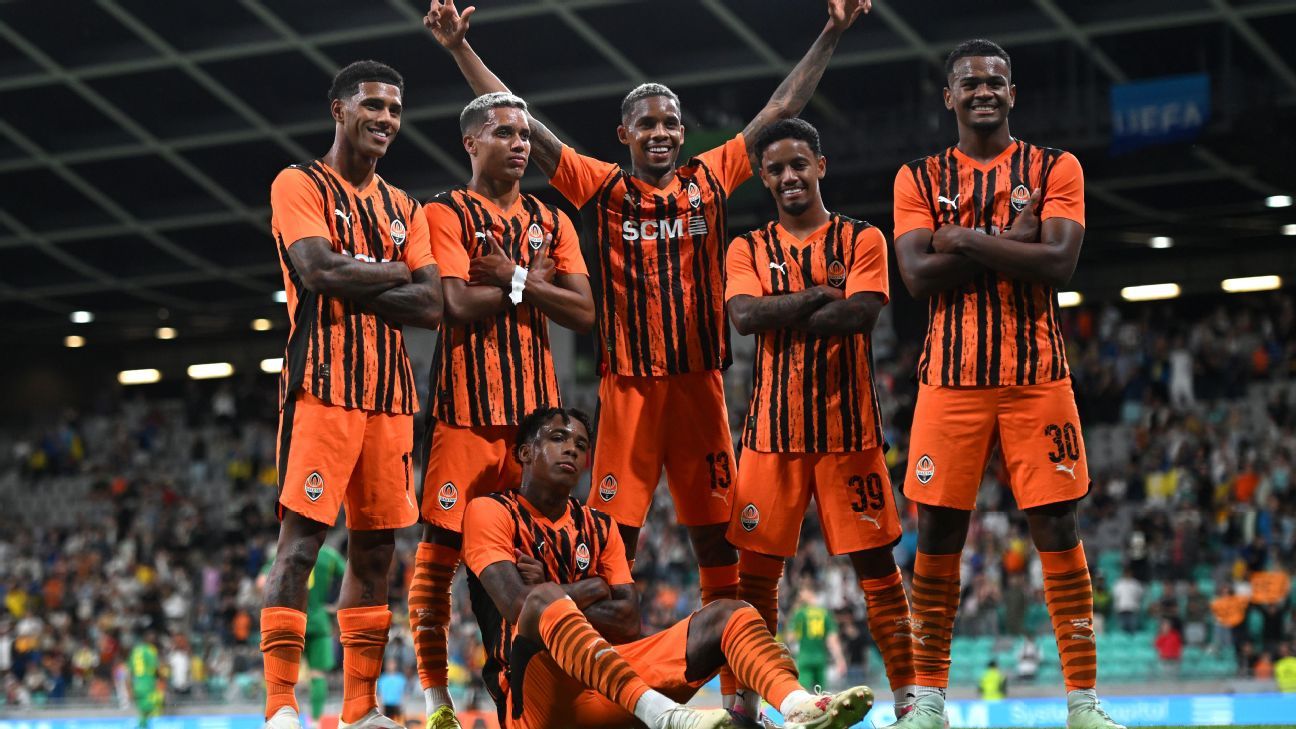
Shakhtar Donetsk’s sporting director Darijo Srna reflects on “a few occasions” when the players and staff of the Ukrainian club had to gather in their hotel lobby, alerted to an impending drone strike, waiting for the signal to move to the air-raid shelter. This occurred once on matchday. “We all stayed in the lobby until 6 a.m. but did not go, and afterwards we slept until noon, then had a meeting at 2 and a match at 4 p.m.,” Srna informs ESPN. “We lost, but this is part of our existence.”
Tuesday marks four years of this ongoing situation. Russia’s large-scale invasion of Ukraine commenced on February 24, 2022, and The Center for Strategic International Studies (CSIS) considers it the most lethal conflict since World War II. Estimates differ, but the CSIS reports that as many as 140,000 Ukrainians have perished, alongside 325,000 Russians. The UN High Commissioner for Refugees estimates that 5.9 million Ukrainians have fled the nation.
It is particularly noteworthy that amid this context, Shakhtar’s approach for survival as a club continues to heavily depend on the transfer market beyond Ukraine, particularly focusing on acquiring young talent from Brazil.
– Shakhtar Stalevi: The ‘made of steel’ soccer team in Ukraine
– Story of Shakhtar Donetsk to be made into Hollywood movie
– Ukraine chief criticizes FIFA president Infantino for Russia comment
This strategy was initiated over 20 years ago, stemming from Shakhtar president Rinat Akhmetov’s appreciation for the country’s vibrant football style. The club developed a comprehensive network of connections in Brazil and over time, established a lineage of players who would join Shakhtar and subsequently move to elite European clubs.
Notable players such as Willian (Chelsea), Fernandinho (Manchester City), Douglas Costa (Juventus), Fred (Manchester United), and Luiz Adriano (AC Milan) have followed this trajectory. Most recently, winger Kevin transferred to Fulham last September for a record fee of €40 million for the Premier League club.
In total, club sources informed ESPN that Shakhtar has signed 47 Brazilian players, who have collectively scored over 1,000 goals since 2002. (Luiz Adriano, who played from 2007 to 2015, remains the club’s all-time leading scorer with 128 goals.) However, the revenue generated from outgoing transfers has become crucial. Club officials indicate that the transfer of Brazilian players has generated more than €350 million, and this income stream is increasingly essential during wartime.
“The two primary sources of income now are UEFA competitions and player sales,” Shakhtar chief executive Sergei Palkin tells ESPN. “That’s it. We have nearly no sponsorship, no matchday revenue, no TV revenue, nothing. To endure here, you must adapt the ways to develop the club.”
Shakhtar’s narrative serves as a reminder that the conflict has persisted for a much longer duration. Russia occupied and annexed Crimea in 2014, displacing the club from their home in Donetsk. They have conducted European ‘home’ matches in six different cities — Krakow, Poland is their base for this season’s UEFA Conference League campaign — and have completed domestic fixtures in Lviv, located in western Ukraine. The team cannot fly to Poland due to airspace restrictions, necessitating bus journeys to the border for European away games, with travel times reaching up to 16 hours, depending on the destination: in last season’s Champions League, they traveled extensively across Europe for matches at Arsenal and PSV Eindhoven.
Ukraine is enduring one of the harshest winters on record, worsening the debilitating impacts of Russian assaults on the country’s infrastructure, which have left over a million citizens without electricity, water, and heating. The European Union has supplied Ukraine with nearly 10,000 generators since the invasion began in 2022.
“If anyone had told me at the start of 2022 that the war would last four years, I wouldn’t have believed it,” Palkin states. “Four years is a significant portion of your life.”
“Our players reside in a hotel, and adjacent to the hotel, we have a pitch for training. In Europe, maintaining pitch quality is straightforward, but in Ukraine, it is not feasible due to one issue: light. When you experience blackouts lasting one, two, or three days, how can pitches endure in these circumstances, especially after this severe winter with temperatures reaching -25 [Celsius, -13 Fahrenheit]?
“In my lifetime, I don’t recall such temperatures. We have a training camp in Kyiv and we maintain pitches there because they need to be prepared for training before matches. You must completely reorganize pitch management because no one had experience doing this during wartime.
“And in modern medical history, you will not find experience like this where players can fully recover after 16 hours of travel to play again.”
Yet, Brazilian players continue to join Shakhtar in significant numbers. There are 12 listed in their first-team squad, most of whom arrived at the club within the last four years. Palkin remarks: “You know why they come? Because they recognize that we create an incredible platform for the development of those players to bridge to top European football.”
“They see all the examples. The latest is Kevin. When the war began, we sold David Neres [for €15m]. He didn’t play a single match for our club, but we sold him to Benfica for more than we paid [€12m]. Even if it is risky for life, to achieve something in top European football, they should come to us.”
“We are currently signing many deals. I spend 70% of my time in negotiations persuading players to come during this challenging time because we are at war. I need to demonstrate where a player lives, what occurs, for instance, when we have air raid sirens, and all the security concerns.
“I must be transparent and explain, but the most significant explanations come when players contact our current players. They clarify everything, and it assists.”
Marlon Gomes was able to take it a step further. The 22-year-old joined Shakhtar from Vasco da Gama in January 2024 and consulted his experienced teammate Alex Teixeira, who made the same move in 2010. Teixeira spent six years in Ukraine and later returned to Vasco in 2022 before joining Greek side Panserraikos last month.
“Shakhtar has always been a renowned club, especially in Brazil,” Gomes tells ESPN. “Among young players with promising talent, it is well-known as a platform to transition to higher-tier leagues.”
“Alex Teixeira is a good friend of mine. During my time at Vasco, we communicated frequently. He also shared numerous insights about Shakhtar — their interest in young Brazilian players.
“When I learned about the history [of Brazilian players who have moved to Shakhtar], I have been contemplating and dreaming about the same [journey and] the trophies they won. I was truly inspired by those examples. Alex advised me that Shakhtar would be a wonderful option. There is not a single day I regret that decision.”
Gomes’ family, including his seven-year-old daughter Maite, remains in Brazil, where his mother anxiously follows news reports of the ongoing conflict.
“She watches TV and reads all the articles as well, and she is becoming increasingly worried,” Gomes states. “From my side, I try to keep her calm and explain that not everything is as dire as portrayed in the media. Yes, some attacks may occur even in the western part of Lviv where we currently reside, but despite that, the club is doing everything possible to ensure our safety.
“During the season, we spent some time in Lviv and some in Kyiv. Whenever people from Brazil inquire about Ukraine, I only respond with positive remarks. I truly love the city of Kyiv; I believe it is one of the most beautiful cities I have ever seen, and even amid all those challenging moments, I enjoy my life in Ukraine.
“Sometimes you can hear or see the drones attacking Ukrainian cities, unfortunately, and indeed all the TV, all the media depict part of life in Ukraine, but they cannot accurately represent what is happening within the country. Of course, those events are entirely tragic, and I am deeply concerned about that, but the country continues to live, continues to move forward day by day, and that can be a true inspiration for everyone.”
The adaptation process is crucial, Palkin explains: “When a new Brazilian player arrives, we connect them with each other; they explain everything that is occurring here, how we treat everyone, what is happening, where we live, how we travel.
“When they relocate here, they may face personal issues, especially during wartime, so we have dedicated individuals involved in all adaptation processes, and they understand what they need, remaining in contact with players and available to assist at any time.
“We establish a structure that enables them to adapt very quickly, and in wartime, this adaptation is even expedited because we have no time. Fifteen years ago, we could wait two years for Brazilian players to reach the top level. Today, we have one or two months for adaptation, and they move directly to the main squad.”
However, Shakhtar’s established model of attracting promising players from Brazil and subsequently transferring some to Europe’s elite is being challenged as those top clubs are increasingly willing and able to go directly to the source. Chelsea, for instance, secured a deal to sign Estêvão from Palmeiras in 2024 and Andrey Santos from Vasco a year earlier, while Denner will join from Corinthians this summer.
“Chelsea has altered the market in Brazil,” Srna notes. “They are acquiring players not only in Brazil but also from Argentina and Ecuador who are 16 or 17 years old. Manchester City is also looking.
“For us, it is more challenging than before, but there is still a wealth of talent in Brazil. Estêvão, for instance, was on our radar, but it is difficult to compete with Chelsea.”
Palkin elaborates on how Shakhtar has adjusted. “What this means for us is that if we previously signed players who were 18, 19, or 20 years old, we now need to focus on 16- and 17-year-olds,” he explains. “And we must act swiftly. If you are not quick, you lose. Speed is the most critical factor for success in the Brazilian market.
“Our president makes decisions very rapidly. He is unafraid to invest significant sums in young Brazilian players. He believes in his strategy, and thus, even considering the war, we remain competitive in this market. Chelsea, City, and other clubs are present and could disrupt the Brazilian market for clubs like Shakhtar, Benfica, and Porto, etc., due to financial constraints. They offer substantial sums, making it challenging to compete with them.”
Financial considerations are more pressing for Shakhtar as they are not participating in the Champions League this season. Revenues are considerably lower in the Conference League, but simultaneously, there is something more significant at stake: the pride of a nation.
“It serves as a crucial humanitarian platform to maintain international focus on Ukraine and provide positive emotions for the people of Ukraine and our supporters,” Palkin states. “Individuals living in Ukraine, 90% of all news is negative. Every day, morning, evening, and throughout the day. Emotionally, it places a significant burden on our people. When we compete in European tournaments and achieve victories, it generates positive emotions.
“All our coaches who have remained during these four years, whenever they prepare a team for Ukrainian or European competitions, include messages about the people living in Ukraine in all their speeches.”
Srna articulates it even more starkly. “When you compete in Europe and achieve victory, the people feel joy because you are conveying a message to the entire world: we are here, we fight until the end,” he states.
 play2:06Vitali Klitschko honored to receive Arthur Ashe Courage Award
Vitali Klitschko expresses gratitude for receiving the Arthur Ashe Courage Award and emphasizes the importance of achieving peace in Ukraine.
Shakhtar continues to feel overlooked by FIFA. The dispute over Article 7 — an annex to the game’s regulations that permitted foreign players in Russia and Ukraine to unilaterally suspend their contracts following the onset of war in the region. The club estimates this resulted in approximately €60 million in lost revenue. Earlier this month, FIFA president Gianni Infantino suggested that he supports lifting a ban preventing Russia from participating in international sports.
“I propose Infantino visit Ukraine to witness the devastation firsthand rather than making such irresponsible statements from a distance,” Palkin asserts. “Reintegrating Russia while Ukraine endures this war is a betrayal of the sport’s ‘one family’ claim.
“He should not contemplate reintegrating Russia; he should focus on creating a fund to finance the reconstruction of sports infrastructure in Ukraine. We face unbelievable challenges. Our football is in a very, very critical state. Infantino should prioritize this, rather than considering the integration of a country that has fully invaded Ukraine and attempted to harm our people, our children.”
Shakhtar, like the rest of Ukraine, simply perseveres. Akhmetov has contributed over $300 million to the government since the war began. He has provided 13 million food kits since 2014 and 700,000 units of medicine to Ukrainians affected. The club offers treatment and rehabilitation for severely injured soldiers, established an amputee team for veterans, and opened a shelter for refugees. Shakhtar matches serve as 90 minutes of distraction.
“Each time we have a domestic match, we are pleased to see people in the stands enjoying the game,” Gomes states. “That provides them with an opportunity to escape for those two hours from the harsh reality surrounding them.
“If I leave Ukraine, whether to another club or back to my homeland, I will carry all the experiences and lessons I have gained here. I will always hold them in my heart and take them with me wherever I go in the future.”
