
How Premier League teams are turning to the U.S. for transfer funding
Does your Premier League team require external financial assistance? It is likely that they are already receiving it without your knowledge.
Starting next season, the league will transition from Profit and Sustainability Rules (PSR) to Squad Cost Ratio (SCR) regulations, representing the latest evolution in the financial framework of English football. Enhancing off-field revenue to positively influence on-field performance has thus become increasingly vital.
While PSR concentrated on a club’s profit or loss across all revenue over a rolling three-year timeframe, permitting a maximum loss of £105 million, SCR requires clubs to limit their squad expenditure—primarily transfer fees and salaries—to 85% of their revenue. This model mirrors UEFA’s Financial Fair Play, which restricts spending for clubs in European competitions like the Champions League to 70%.
– Why is the Champions League currently more accessible for Premier League teams?
– Could Rayan emerge as the next Brazilian talent in the Premier League at Bournemouth?
– Barça transfer inquiries: Should Lewy and Rashford be let go? Is there a need for a new striker or defender?
SCR is a component of a significant shift.
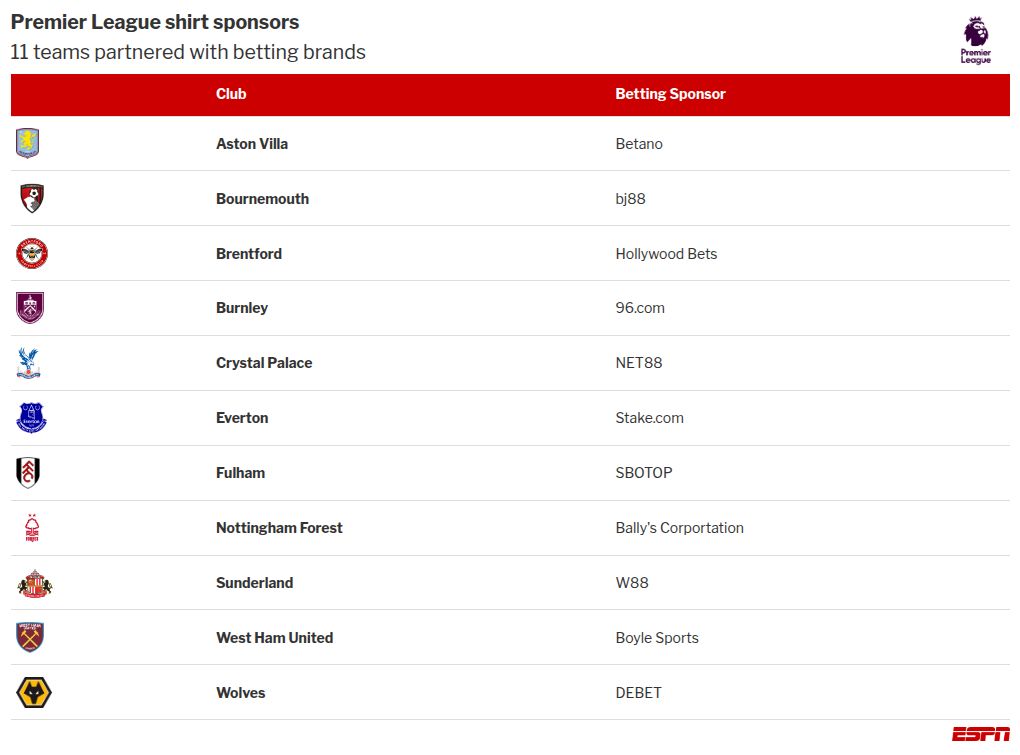
From next season, the Premier League will prohibit front-of-shirt advertising from betting companies. Consequently, 11 out of the 20 clubs will need to secure new primary sponsors for the 2026-27 season when the ban takes effect. West Ham United vice chairman Karren Brady stated in a House of Lords debate in November 2024 that the ban on front-of-shirt gambling advertising “will result in a reduction of approximately 20% of their total commercial revenues.”
So, where can clubs seek assistance? One solution lies in utilizing external agencies to identify new commercial growth avenues. This practice is common in U.S. sports but has been relatively uncommon in England until recently.
‘The first question is where do I fill that gap in revenue?’
Exactly half of England’s top 44 clubs—the Premier League and the second-tier Championship—are predominantly owned by American investors. This surge in U.S. ownership has prompted teams to look to the United States for innovative ideas in securing creative sponsorship agreements.
The U.S. market remains largely untapped regarding commercial growth for the Premier League. Industry data suggests that American brands currently account for 61% of global sports sponsorship spending, yet only one in six European soccer sponsorships involves U.S. brands.
Playfly Sports is at the forefront of this transformation. The sports marketing, media, and technology firm positions itself as the “leading revenue maximizer of the sports industry.” The Premier League has now partnered with Playfly to enhance and monetize its audience in the U.S. Sources within the industry have informed ESPN that approximately half of the clubs in England’s top division now collaborate with retained commercial agencies in some form. In 2023, this figure was around 10%.
Dan Lipman, Playfly’s co-managing director for Europe, stated to ESPN: “American owners involved in the Premier League also own other teams in various sports. Playfly collaborates with every team in the NBA, MLB, and NHL, and these American owners have observed the sophistication with which we approach those commercial revenues: the strategies we employ, the multitude of brands, and the connectivity we offer.
“It is not coincidental that as these owners invest in European football, they are seeking assistance from agencies. Many American sports executives visit U.K. sporting events and comment on the limited number of brands advertised and the restricted activation. In the U.S., the scenario is entirely different. With SCR being implemented and betting removed from shirts, the primary question for stakeholders is how to address that revenue gap?”
Until recently, commercial agreements at most Premier League clubs were primarily driven by personal connections, with chief commercial officers leveraging their networks to secure sponsorship deals. Similar to the modernization of player recruitment, which has evolved from traditional scouting to data-driven approaches, data is now becoming integral to commercial strategy, and clubs are increasingly open to seeking external assistance for this purpose.
Football finance expert Kieran Maguire told ESPN: “Some Premier League clubs with substantial budgets have developed a tendency to engage external agencies to effectively outsource their efforts to diversify income streams.
“For instance, Tottenham Hotspur hosts more non-football events at full capacity than football matches, so how can they optimize these for revenue generation? Guidance on pricing, catering, and merchandise sold by third parties—areas where the club may lack experience—are increasingly important as they represent a relatively new addition to their revenue-maximizing toolkit.”
‘The biggest brand checks are going to come from the U.S.’
Last August, Crystal Palace announced SunExpress as an official airline partner, marking the club’s first such partnership since 1991. The agreement was facilitated by Playfly, mirroring a strategy employed in the U.S. of integrating airline brands with professional and college teams. In college football, Southwest Airlines provides additional flights for game days as part of its collaboration with the SEC, while Alaska Airlines serves as the official airline for the Big Ten’s four West Coast teams.
The U.S. model is attractive because the figures continue to rise. Last October, the NFL reported a 14% revenue increase for the previous fiscal year. MLB revenues reached a record $12.1 billion in 2024, while NBA sponsorships increased by 8%, according to data firm SponsorUnited.
“When a U.S. owner takes charge, they typically hire a U.S. chief commercial officer who has experience in the U.S. market, who then engages a U.S. agency to assist with media sponsorship, TV-facing signage, and there is a level of trust,” Lipman explained. “This is how the evolution is occurring.”
Tottenham recently joined this trend by appointing Alex Scotcher—formerly with U.S.-based sports agency Elevate—as their new commercial director last month. Chelsea’s commercial president, Todd Kline, briefly held a similar position at Spurs after working with the Miami Dolphins; Liverpool’s Kate Theobald was previously associated with the New York Yankees.
 play0:51Pep Guardiola: Man City are 7th in the Premier League net spend table
Manchester City manager Pep Guardiola has responded to assertions that his team only secures trophies due to their spending in the transfer market.
The new SCR regulations present a significant challenge. Maguire stated: “The rule change allows clubs to allocate 85% of revenues to player costs, thereby increasing the pressure to generate additional revenue since 85% can be directed towards player expenses.”
Lipman noted: “The commercial revenue for the Big Six clubs surpasses their broadcast revenue, constituting about 40-60% of their total income.
“Every team is exploring external sponsorship support because this represents the most substantial influence they can exert. The largest brand checks are likely to originate from the U.S., and ultimately, this is a relationship-driven matter.
“SCR is certainly more connected to commercial revenue as it emphasizes recurring income; PSR focuses on individual years’ profit and loss. When evaluating revenues, what is sustainable and predictable? That is commercial revenue—multi-year and long-term partnership agreements.
“When we collaborate on a project with a team that could generate tens of millions in gross top-line revenue annually, it significantly impacts their budget for player salaries and ultimately affects their recruitment capabilities.”
‘More ads in more places’
The Premier League’s enhanced profile and global visibility position its clubs favorably compared to rival European leagues in accessing the U.S. market. Within England, a commercial competition is emerging.
Arsenal is charting its own course, currently in the third year of what they term a new commercial strategy, which includes efforts to double revenue from secondary sponsors. Last year’s financial results underscored the renewal and extension of their Emirates partnership and the rebranding of their training facility as the Sobha Realty Training Centre, but their American ownership under billionaire Stan Kroenke will likely consider additional opportunities in the U.S. as they arise.
Industry experts anticipate that the U.S. and agency-focused commercial appointments at Chelsea, Tottenham, and Liverpool will alert those clubs to developments in that area.
How might fans observe this evolution in the future? Playfly Sports executive chairman Mike Schreiber told ESPN: “More opportunities for advertising—availability of inventory, whether within broadcasts or inside stadiums. More ads in more locations. This is a trend in the U.S. that is beginning to take hold here. Additionally, premium experiences for fans.
“This has proliferated in the U.S. and is starting to gain traction in the U.K. You can reduce the number of seats in the stadium and increase revenue. It may seem counterintuitive, but creating larger and more comfortable seating, offering food directly to your seat, or establishing hospitality areas are all changes where commercial agencies can thrive.”
Watch this (ad) space.
