
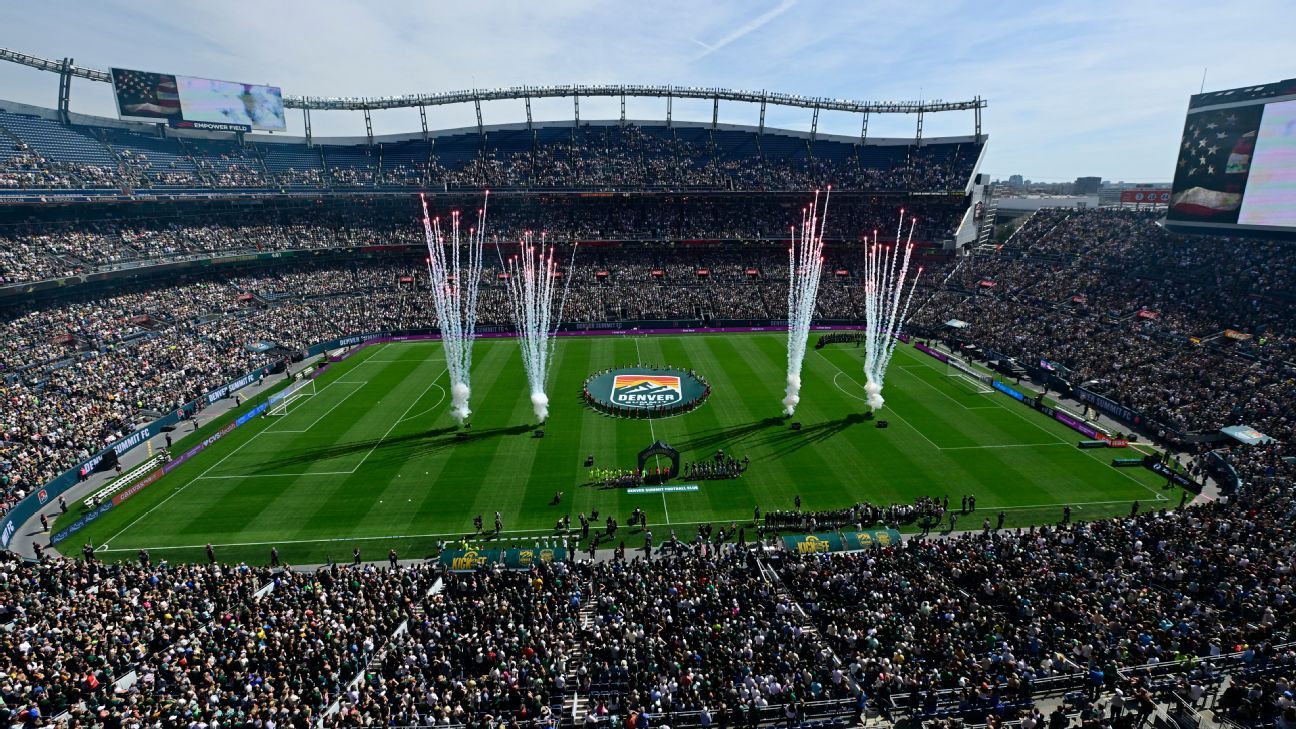
DENVER, Colo. — The queue for merchandise on the west side of the main concourse extended hundreds of people deep as kickoff approached on Saturday at Empower Field and Mile High. The crowd that had flowed in from morning tailgating was dressed not in Denver Broncos blue and orange, but in the distinctive forest green of the city’s new NWSL team, Denver Summit FC.
Among the 63,004 attendees, Lindsey Heaps’s No. 10 jersey was prominently displayed in anticipation of the USWNT captain’s arrival this summer. For at least one day, Denver’s new NWSL team established a national standard for club soccer, achieving a league attendance record and a standalone women’s soccer game attendance record in the United States.
As fighter jets flew overhead and smoke from the on-field pyrotechnics filled the press box and luxury suites just before kickoff, it was evident against the clear Colorado skies that the significance of Saturday’s event was unrecognizable compared to the NWSL of a few years prior, and unimaginable even to the most optimistic supporters of the league. A new standard for ambition has been set in the NWSL, continually elevated by the league’s new franchises.
“We couldn’t have envisioned that this could become a reality for the NWSL,” commissioner Jessica Berman stated pre-game, high above the field. “I believe that’s what expansion teams contribute to a league; they redefine what is achievable and challenge all of us who are either established teams or have been around for a few seasons to elevate our standards. And that’s precisely what this team has accomplished in the NWSL.”
– USWNT Transfer Grades: Evaluating, rating all the significant moves
– UWCL Talking Points: How can VAR, refs enhance their performance?
– Predicting the USWNT’s 2027 Women’s World Cup starting lineup
An estimated half a million individuals were anticipated in downtown Denver on Saturday for events ranging from various professional sporting games to March Madness viewing parties, a “No Kings” political protest, and several Disney on Ice performances, yet the city’s new, untested NWSL team still asserted its position as a must-see event. Defender Kaliegh Kurtz mentioned in the lead-up to Saturday’s match that she cannot wear her team gear around town without being approached by fans. In contrast, during her time with the North Carolina Courage, she could walk around unnoticed even in team apparel, she noted.
A fan festival took place downtown on Thursday night, further building excitement for what the team referred to as “The Kickoff.” The Summit adorned an entire city block with signage in the team’s green. Local coffee shops offered Summit-themed drinks, and billboards promoting the game were scattered along the busy freeways encircling the metro area.
“When we first entered this league, it was nothing like this,” Smith, who has played for seven NWSL teams over a decade, remarked after the match. “Some of us veterans experienced an emotional moment because the growth of this league has been remarkable, and the support that Colorado has shown us is incredible.”
Regarding Saturday’s event, the game itself lacked a significant, defining moment. The 0-0 draw included a few near-chances for both teams, including a second-half attempt by Summit forward Natasha Flint that some fans believed was a goal. Ultimately, fatigue was evident among both teams, each playing their third match within a week.
Equally significant as Saturday’s festivities are the indistinguishable plots of land to the south of Mile High, which will shape not only the long-term future of the Denver Summit franchise but also the rising expectations of Berman and her colleagues back in the New York City league offices.
On those plots, Denver Summit plans to construct a 14,500-seat stadium at Santa Fe Yards, located a few miles south in a developing neighborhood on the edge of an arts district. It will be reachable via an existing light rail stop.
Further south, through the interstate traffic and into the suburbs, lies the team’s training complex and temporary stadium in Centennial, Colo. Summit FC intends to move into the 12,000-seat temporary venue later this year, slightly behind the original timeline. Some grass for the fields has already been laid next to that performance center, and a few steel beams are visible, rising from the acres of dirt nestled between office parks, apartments, and a government building.
A Denver Summit spokesperson indicated that the team’s total investment in infrastructure will approach $350 million, in addition to the $110 million expansion fee paid by the team to join the league. All of this progress has occurred since the team was officially announced by the NWSL in January 2025.
“Attempting to achieve what we’ve accomplished in 15 months is nearly impossible for a team, to be honest,” Denver Summit controlling owner Rob Cohen stated ahead of the match. “I tell people: 15 months ago, we didn’t have a single staff member, we didn’t have designs for our performance center, we didn’t have a single player, and we didn’t have a coaching staff.
“To be at this point 15 months later, having already played a few games — we’re 1-1-1, we’re competitive in the league, we’re playing in front of 60,000 fans — is somewhat difficult to even grasp.”
This sentiment is echoed by many. Not due to a lack of belief in the demand for women’s professional soccer, nor because there aren’t numerous untapped markets for the expanding 16-team (soon to be 18-team) league to explore. It’s because the level of ambition and investment has surged dramatically.
Five years ago, the expansion fee was only $2 million, and franchise valuations were only marginally higher. Many teams were — and still are, which remains an ongoing challenge for the league — secondary or tertiary tenants in their home venues. They also lacked their own training facilities for daily operations.
Of course, Saturday’s attendance of 63,004 fans will not be the standard in the NWSL. That number is offset by the harsher realities in other markets that struggle to attract 5,000 fans per game. However, it will serve as a new standard not only for attendance at future major events but also for what NWSL players, owners, and fans can envision as achievable.
“Portland has consistency, LA has consistency,” Summit forward and NWSL veteran Ally Brazier, who grew up locally, told ESPN. “If we had our stadium, we could likely achieve that consistency right now. So, I think it’s just a projection of our future; moving into a temporary stadium and then to our actual stadium in 2028 will demonstrate that we will attract that kind of crowd. We will be like LA or Portland.
“It’s going to be a lot of fans, and it’s going to create an atmosphere that people are eager to play in.”
