
Congo DR has the opportunity to overcome the FIFA World Cup challenges from 52 years prior.
Few cities globally celebrate like Kinshasa, and on Tuesday night, the city hosted one of its largest celebrations.
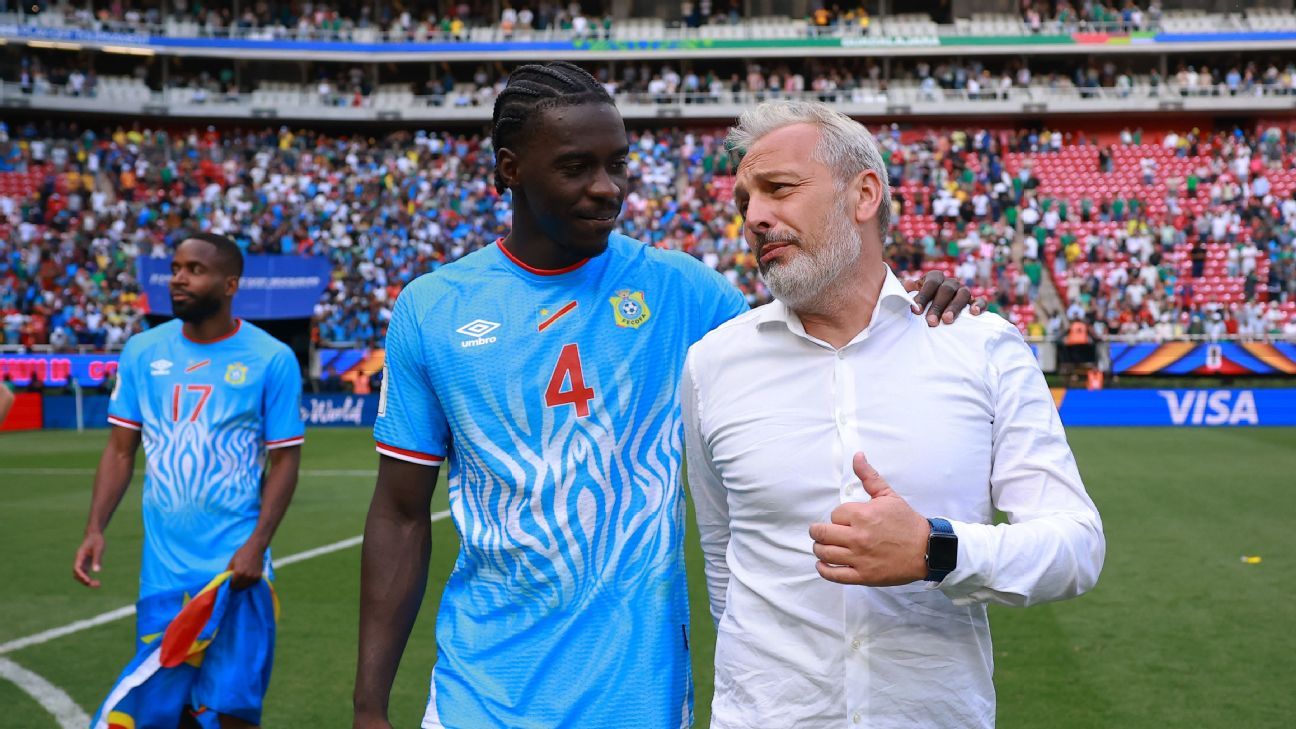
The festivities did not commence immediately; the confetti awaited the final whistle as the Democratic Republic of Congo fought until the end, achieving a narrow 1-0 victory in extra time against Jamaica to secure a spot in the FIFA Inter-confederation playoff, earning one of the last places for the 2026 World Cup.
The final whistle triggered a nationwide celebration. The sounds echoed on shortwave radios from Kananga to Kisangani, from Lubumbashi to Likasi, celebrated from balconies and toasted with lotoko across the ngandas and buvettes of the capital.
As the rhythms of Congolese rumbas and ndombolos accompanied the nationwide festivities, no one in the DRC was unaware that the national team had succeeded. The Leopards were back in the spotlight, becoming the tenth African nation to compete in June.
The Congolese triumph over Jamaica represented more than mere qualification; it was a chance for this nation, once a powerhouse in African football, to revisit its history and, hopefully, reshape it.
Waiting 52 years to rectify a past injustice is a lengthy period.
Sports teams can be haunted by their past, as any Congolese football supporter would attest. These are not ghosts in white, but rather figures clad in green, adorned with giant leopards, known as Zaire, wandering through the fields of West Germany in 1974.
The world recalls the humiliation; the scoreline, the chaos, and the caricatured naivety of that team have become synonymous with DRC football at the highest level.
The freekick incident involving Brazil, when Mwepu Ilunga impulsively cleared the ball before Brazil had taken the set piece, has been replayed so often that it has detached from its original context and now exists solely as a farce.
Zaire, the first sub-Saharan representatives from Africa at the World Cup, have become not trailblazers, but a cautionary tale.
What is often forgotten is what transpired before the ’74 World Cup. In the late 1960s and early 1970s, Zaire was no laughingstock; they were a formidable force.
They were champions of the Africa Cup of Nations twice — in 1968 and 1974 — and produced players of exceptional talent, discipline, and creativity, from the ‘Black Beckenbauer’ Tshimen Bwanga to Kazadi Mwamba, from Lobilo Boba to AFCON ’74 top scorer Ndaye Mulamba.
Aside from the great Ghana team of the 60s, this was the finest African national side up to that time, filled with players who grasped the rhythm of the game, transforming this former Belgian colony into a true continental powerhouse.
However, football was merely a pawn in a larger power struggle, rather than an end in itself. Mobutu Sese Seko’s regime demanded more than victories on the pitch; it sought symbolism, as the country’s first president aimed to forge an identity for the new nation, distinct from and in opposition to Belgian colonial rule.
Under his doctrine of authenticité, the nation formerly known as Congo-Léopoldville turned inward, renaming itself, its people, and its reality. Identity became a performance dictated from above, with Mobutu instructing citizens to abandon their European-Catholic first names in favor of African names.
Football inevitably became intertwined with this effort to construct a top-down ‘indigenous’ and ‘authentic’ national identity for the new state.
The national team represented more than just a squad; they were evidence that Zaire could stand independently, compete, and excel. They demonstrated that nothing else was needed from Belgium or Europe; they stood on their own, a new and legitimate nation, equal to any other.
Yet, isolation can be a lonely and precarious structure. Reaching the pinnacle of African football was one thing, but facing three strong teams at the World Cup in ’74 proved to be another challenge entirely.
They arrived with expectations — if not demands from Mobutu — that were too heavy to withstand the reality of competing against Brazil, Scotland, and Yugoslavia.
Preparation was disorganized, promises made to players went unfulfilled, bonuses were not paid, allegations of corruption surfaced, morale dwindled, and when the matches commenced, Zaire faltered.
These defeats were not merely losses; the Central Africans were ultimately exposed. Scotland comfortably won 2-0 in Dortmund, with the match concluding shortly after the half-hour mark.
Against Yugoslavia, they were overwhelmed; 5-0 down within half an hour, ultimately succumbing to a 9-0 defeat in Gelsenkirchen. At that time, it was the joint-largest defeat in the tournament’s history, equaling Hungary’s 9-0 victory over South Korea in Zurich two decades earlier, and only surpassed by Hungary’s 10-1 rout of El Salvador in 1982.
Next came Brazil, the defending champions, and while a 3-0 loss is not a humiliation, the match was overshadowed by Ilunga’s decision to leave the defensive wall and clear the ball upfield before the Selecao could take a freekick.
Jaizrzinho and Roberto Rivelino looked on in confusion, and the moment entered World Cup lore.
The world favors a straightforward narrative and does not hesitate to judge; context was irrelevant, as were the pressures and threats from Mobutu and his officials surrounding the camp in the event of poor performance.
It became easier to belittle and mock Zaire, for Ilunga’s impulsive clearance, for their 0-14 record, and to laugh at the unfortunate Congolese on the grandest stage.
However, Zaire was grossly misrepresented by that Yugoslavia defeat and that singular incident against a legendary Brazil side. It did not matter. What followed was a slow and insidious decline.
The team that had become Africa’s first at the World Cup, embodying continental ambition during this post-colonial era, became a relic of a misunderstood peak. Infrastructure deteriorated, administration fractured, the Golden Generation faded, and the country lost any sense of momentum it once had as Mobutu’s reign descended into a familiar spiral of nepotism and corruption.
The nation was renamed and reoriented again, but it never recaptured the magic of that double-AFCON-winning team. Zaire’s spiritual successor, the DR Congo, became Africa’s ultimate fallen giant, once dignified, now disordered, and undeniably in decline.
Occasionally, stars emerged, but rarely enough to form a competitive team. The influence of the country’s club teams — once continental champions during the same era as the national team conquered the continent — diminished in African club competitions, and the nation stalled amid a significant talent and brain drain to Europe and beyond.
Thus, the ghosts in green persisted.
Each unsuccessful AFCON campaign, each failed qualification, and the years between Zaire 1974 and redemption continued to accumulate. Congo never managed to shake off that enduring first impression, an identity imposed from the outside that became internalized.
This should have been a glorious legacy, a team that should have inspired its successors; instead, it became a joke to be discarded, and one day rewritten.
However, as the Lingala proverb states, ‘It doesn’t matter how long the night is, the morning will always come. ‘Butu atako ewuneli suka tongo eko tana’.
Now, they have the chance to do just that, but it is not only the country’s name — or the fact that they now wear blue — that has changed since the nation’s golden era.
Under French head coach Sebastien Desabre, the DRC has embraced its diaspora, significantly enhancing and strengthening its ranks in the process.
While Mobutu turned inward in his quest to shape history with Zaire, Desabre has looked outward to craft a new chapter with the DRC. Desabre’s Congo has welcomed multiplicity and acknowledged that the country’s narrative is no longer confined to its borders.
Players have come from Belgium, France, and Switzerland. Some speak Lingala fluently, while others have never set foot in Kinshasa. Some understand the significance of 1974, while others perceive it merely as a distant echo.
What mattered to the Frenchman was connection, a team formed from diverse locations, not ‘just’ from one, forged from various experiences, and different interpretations of how to play football and represent Congo.
Despite a run to the semifinals of the 2025 AFCON, there has not been the dominance or flair of the early 70s; the match against Jamaica was a struggle, but with that extra-time victory, there has been a return to prominence and a chance to create new history.
In ’74, expectations distorted reality; now, there is a sense of balance, both in the team’s measured and humble approach — currently ranked 46th in the world — and in the vibrant enthusiasm of Tuesday’s street celebrations.
It was one of the diaspora players, a recent addition since Desabre’s appointment, who secured their World Cup berth; Burnley’s Axel Tuanzebe, a former England youth international, was raised in Rochdale, in the foothills of the English Pennines, after emigrating from the DRC with his family as a child.
When the final whistle blew, it did not erase the past; nothing can, but it provides the Leopards with the opportunity to correct the misconceptions that have persisted for 52 years.
Now, the DRC returns to the World Cup not as a symbol imposed from above, nor as an isolationist state striving to prove itself, but as a nation reconnected to itself and to its sons and daughters around the globe.
The injustice of 1974 was never solely about the results — appalling as they were — but about the reduction of a complex footballing narrative to a single, distorted, racist image. It was the erasure of what the team had been and the neglect of what they could have achieved had the context been different.
Now, this resilient nation, the fallen giants of African football, have the opportunity to present their true, renewed identity for the world to acknowledge.
