
Arsenal’s actions are negatively impacting football, even with Dowman’s memorable achievement.
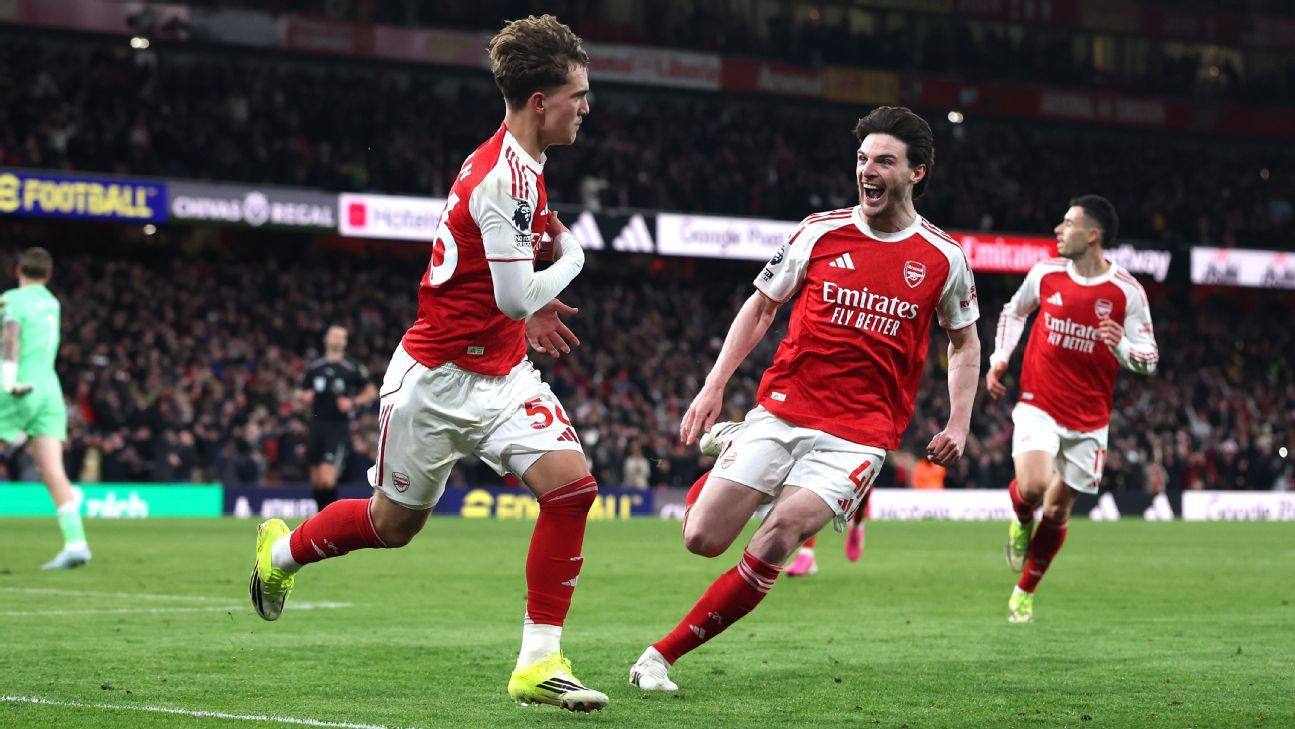
Max Dowman may have accomplished more than just netting a historic and potentially pivotal goal in the Premier League title race, securing Arsenal’s 2-0 victory over Everton this past weekend. The 16-year-old prodigy might have also achieved the unlikely: endearing Mikel Arteta’s squad to the public.
Describing them as ‘lovable’ might be an exaggeration, given the negativity that has surrounded a team still on track to achieve an unprecedented quadruple this season.
Brighton & Hove Albion manager Fabian Hurzeler criticized Arsenal’s strategies and “time-wasting” during a 1-0 loss earlier this month, while former Manchester United midfielder Paul Scholes remarked that the Gunners would be the “worst team to win the league.” Peter Schmeichel, a five-time title winner with United, stated that Arsenal plays an “ugly brand of football that is frustrating to watch.”
– Arsenal turned to teenager Dowman, and it paid off tremendously
– VAR review: Why Arsenal should have had a penalty vs. Everton
– Predicting who wins Champions League based on past winners
However, even the most vocal detractors of Arsenal would find it challenging to overlook the positive energy surrounding a teenager who returned to school on Monday morning after scoring the stoppage-time goal — shortly after assisting Viktor Gyökeres for the opener — which secured a vital win for the Premier League leaders and made him the youngest-ever scorer in the competition.
Dowman’s late contribution embodied the essence of football. His goal represented risk, adventure, individuality, and the freedom to play spontaneously. Perhaps that is why it generated such excitement.
The goal highlighted all the qualities that Arteta’s Arsenal have not only been lacking this season but may have even intentionally suppressed as they have simplified their game to one of percentages — a style where risk and individuality are seen as liabilities rather than essential components for a trophy-winning team.
This presents a significant contradiction within Arteta’s Arsenal. His team could be less than three months away from becoming the first English club to achieve a clean sweep of trophies by winning the Premier League, UEFA Champions League, FA Cup, and Carabao Cup in the same season, yet they remain unpopular outside the Emirates Stadium.
When Arsène Wenger’s 2003-04 squad earned the title of “Invincibles” by finishing champions without a single league defeat, their captivating style garnered global admiration. An Arteta quadruple would surpass Wenger’s team as the pinnacle of the club’s history. They would also eclipse the Treble-winning sides of Manchester United and Manchester City from 1998-99 and 2022-23, respectively.
However, if they secure all four trophies this season — even if they only clinch the Premier League — Arsenal’s triumph would be perceived as a regression for football and even detrimental to the sport due to the manner in which Arteta’s team plays. Success often leads to imitation. Everyone aspires to win, and the shortcut to victory can frequently involve emulating the best.
Consider how many teams globally have adopted a model based on Pep Guardiola’s philosophy of possession and control initiated by a ball-playing goalkeeper. Guardiola has evolved his approach numerous times, and his City side now features a keeper in Gianluigi Donnarumma who would not have fit into Guardiola’s greatest Barcelona, Bayern Munich, and City teams.
Yet, the Guardiola influence has become entrenched because his philosophy yielded success, and if Arteta’s direct style brings silverware to Arsenal, it will have a similar effect. Indeed, we have already observed ‘Artetaball’ taking root in the Premier League, with rival coaches placing greater emphasis on set-pieces — particularly corners — due to the success Arteta, supported by set-piece coach Nicolas Jover, has had in making Arsenal one of the most consistent teams in Europe.
Arsenal has netted 21 goals from set pieces in the Premier League this season — more than any other team in Europe’s top five leagues. This accounts for 34.4% of their league goals. Before this season, Blackburn Rovers (1994-95) and Manchester United (2007-08) recorded the highest set-piece goals as champions with 35% each.
Sir Alex Ferguson’s United won the Premier League and Champions League that season with a forward line featuring Cristiano Ronaldo, Wayne Rooney, and Carlos Tevez, demonstrating they were not overly reliant on set-piece goals. Arsenal, however, lacks a player of Ronaldo, Rooney, or Tevez’s caliber, which may explain why Arteta’s team emphasizes set-piece goals so heavily.
The most successful teams in recent years have all featured prolific scorers and attacking players capable of reaching double figures in goals. City has secured trophies with contributions from Erling Haaland, Sergio Aguero, Kevin De Bruyne, and Phil Foden. Liverpool achieved similar success with Mohamed Salah, Luis Díaz, Sadio Mané, and Roberto Firmino.
In Europe, over the past decade, Real Madrid has boasted Ronaldo, Karim Benzema, Vinícius Júnior, and Kylian Mbappé, while Paris Saint-Germain won the Champions League last season with Ousmane Dembélé, Gonçalo Ramos, Khvicha Kvaratskhelia, Désiré Doué, and Bradley Barcola combining for 99 goals across all competitions.
The dazzling attacking football exhibited by Luis Enrique’s side last season was evident again last week when PSG overwhelmed Chelsea with three goals in the final 20 minutes of their 5-2 Champions League round-of-16 first-leg victory in Paris.
Before Dowman’s late heroics against Everton, it would have been difficult to recall any comparable Arsenal moment this season, as their forwards have been less prolific and lack the fluid flair and freedom of the PSG stars or the attacking players in those illustrious Real, City, and Liverpool teams.
Only Gyökeres (16) and Gabriel Martinelli (11) have reached double figures for Arsenal this season, yet Arteta’s side remains the top scorers in the Premier League. The aesthetic of Arsenal and their goals makes them challenging to embrace, but Arteta has undeniably discovered a successful formula by narrowing the game down to a contest of marginal gains.
This presents a challenge that football will need to address. The Arteta approach has already led to imitation, and it will likely increase if Arsenal secures major trophies. Not even a remarkable goal from Max Dowman will alter that.
