
Arnold and Iraq secure the last available position for the 2026 World Cup.
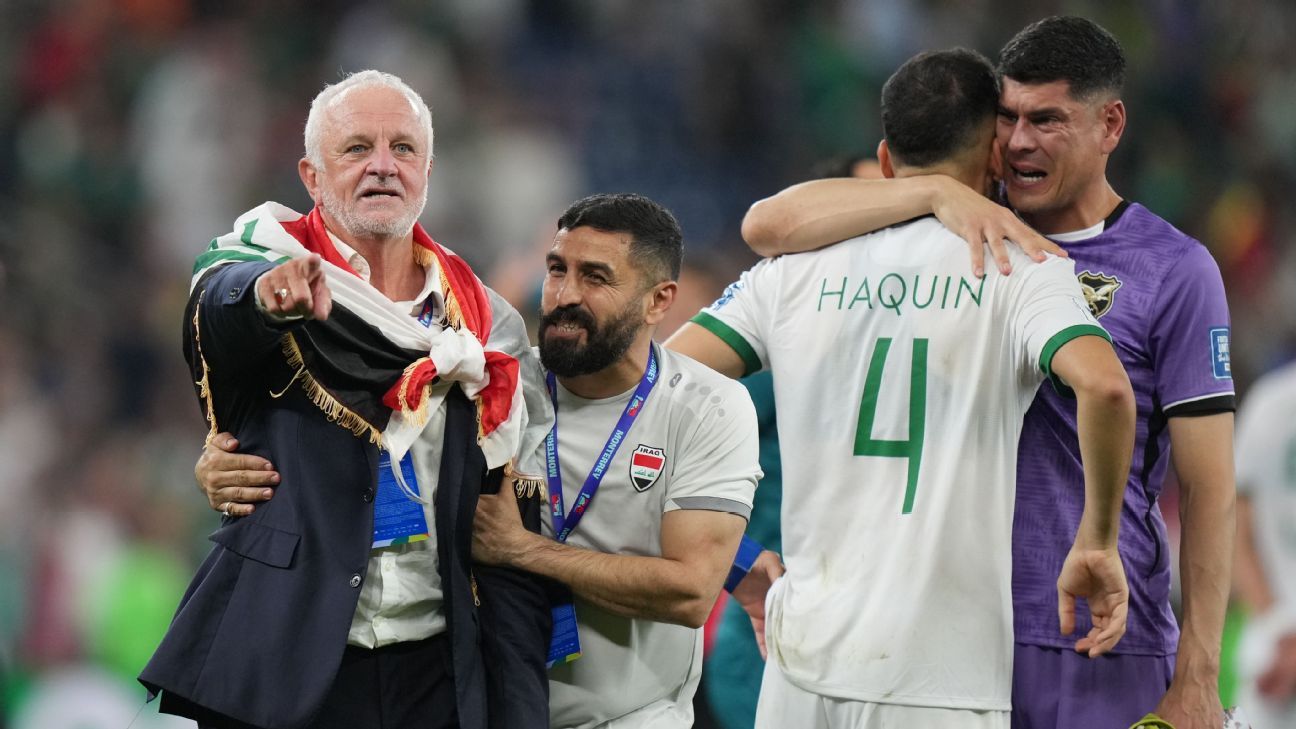
Mohannad Ali Kadhim gazed upward and shouted in elation, while goalkeeper Ahmed Basil Al-Fadhli was overtaken by emotion as he collapsed face down on the ground. Coach Graham Arnold was surrounded on the sidelines, before being lifted onto his players’ shoulders, proudly holding the Iraqi flag aloft and presenting it to the ecstatic supporters in the stands.
Across the globe, the celebrations in Baghdad, Basra, Mosul, and Erbil as Iraqis rejoiced in the early morning light were equally remarkable—videos shared on social media depicted fans congregating wherever a screen was available, captivated as Ali Ibrahim Al-Hamadi and Aymen Hussein scored in a historic 2-1 intercontinental playoff victory over Bolivia. For the first time in four decades, and only the second occasion in their history, the Lions of Mesopotamia have earned a spot in the FIFA World Cup.
– Ogden: Late qualifiers Türkiye are now favourites for World Cup Group D
– Meet 2026 World Cup debutants: Cape Verde, Curaçao, Jordan, Uzbekistan
– As it happened: Italy miss third straight World Cup after losing to Bosnia
Not long ago, it seemed that fate had been snatched away from them through no fault of their own. The attacks by Israel and the United States on Iran initiated a series of events that resulted in missiles being launched across the Middle East, putting those on the ground at risk and causing flights to be grounded as airspace was closed. Arnold, who took over from the dismissed Jesús Casas last year, found himself stranded first in Fujairah in the United Arab Emirates and then in Dubai, while his squad members based in Iraq and neighboring countries faced similar challenges. Embassies were also closed, hindering potential travelers from obtaining the necessary visas to enter Mexico, even if they managed to secure a flight out.
There were speculations that Iraq might take Iran’s place in the World Cup if they withdrew, but that was quickly dismissed. Then there were discussions about a lengthy overland journey to Istanbul, where flights could be arranged to take the squad to Mexico. However, Arnold opted for a postponement, requesting FIFA to delay his team’s match against the winner of the Bolivia and Suriname playoff. No postponement was granted, and instead, plans were made for a (relatively) shorter journey to Amman in Jordan, where a private jet would be waiting to transport them to the playoffs. The entire trip required twenty hours of flying, taking the team more than three days to complete.
This was far from ideal preparation. Additionally, there were more routine football-related obstacles to navigate, as veteran goalkeeper Jalal Hassan Hachim and defender Ahmed Yahya were not deemed fit for the squad, while key players like Al-Hamadi, Youssef Amyn, and Zidane Iqbal arrived with limited recent match experience. Nevertheless, Iraq found a way to succeed.
This victory is a success for the players, a success for a football-enthusiastic Iraq. However, particularly for those observing from his home country of Australia, it is also a triumph for Arnold. Having already made a significant impact in Australia, he is now set to become the first Australian to lead two nations to a World Cup, and he and his staff, which includes former Manchester United coach René Meulensteen, Rob Stanton, Zeljko Kalac, Chris Pappas, Adam Barbera, and interpreter Ali Abbas, have become icons to 46 million people.
“In the 10 months since I’ve been in the role, I believe I’ve spent seven of them in Baghdad because I wanted to immerse myself in the culture,” Arnold stated prior to the match. “I can’t go anywhere without being mobbed—everyone wants photos and they rush towards you.
“I witnessed footage of the celebrations in Baghdad [after securing a place in the inter-confederation playoffs], where people were marching in the streets, waving flags and celebrating. The emotion of that victory was immense, and after the match, I had to remind everyone that we haven’t qualified yet. These players are incredibly passionate about achieving this for their country.”
Given the circumstances, Iraq could hardly have had a coach more suited to the challenges at hand. For one, while it can sometimes work against him, such as during the conclusion of his tenure with Australia, few coaches in global football are better at fostering a close-knit, siege mentality within a squad than Arnold. Under the guidance of the 62-year-old, doubt, criticism, and adversity are transformed into motivation and a collective mindset. Furthermore, the narrative of the Lions of Mesopotamia’s journey to North America is unique, as the Australian coach has experienced a similar path.
Over the past month, Iraq’s players have faced numerous challenges. Although Arnold lacks extensive experience in navigating an active warzone, four years ago, he managed a team that dealt with one of the most logistically complex qualification campaigns in history. During that time, he had to contend with the vast distances of Asia and the intricacies of an inter-confederation playoff, as well as a home nation that enforced some of the strictest border control and quarantine measures globally. In essence, Arnold is accustomed to dealing with unexpected complications.
By overcoming Bolivia, Iraq has finally concluded an 867-day qualifying journey as the last team to secure their place in the World Cup. The last nation to qualify four years prior? That would be the Socceroos team that Arnold led to Qatar. Australia also needed to defeat a South American team in that playoff, overcoming Peru in a dramatic penalty shootout. Additionally, by playing their 21st qualifying match in Monterrey, Iraq surpassed Indonesia as the busiest nation in World Cup qualification. The only team to have played more matches in a single campaign? The Socceroos squad under Arnold four years ago.
Arnold’s experiences have evidently played a crucial role in leading Iraq to the World Cup. He has expressed a desire to act as a “father figure” to his players during this challenging period, as well as encouraging them to limit their social media use, which he refers to as “crap,” and focus on a close-knit circle of family and friends. The coach has sought to divert their attention from the ongoing situation back home and instead channel their pride into making history for Iraq, providing its football-loving populace with a moment of national significance. He has spoken confidently about what has become a “very special night for Iraq.” This approach is consistent with a coaching philosophy developed over two decades in Australia.
The Lions of Mesopotamia will now enter Group I for the World Cup, alongside France, Senegal, and Norway. This will mark a reunion between Arnold and Didier Deschamps—France defeated Australia in the opening match of the 2022 tournament, but the Socceroos rebounded to reach the round of 16. Similarly modest expectations will surround Iraq in 2026. However, after defying the odds to qualify for the World Cup, Arnold likely wouldn’t want it any other way.
