
After Champions League loss, is there a way to rescue Madrid’s initiative?
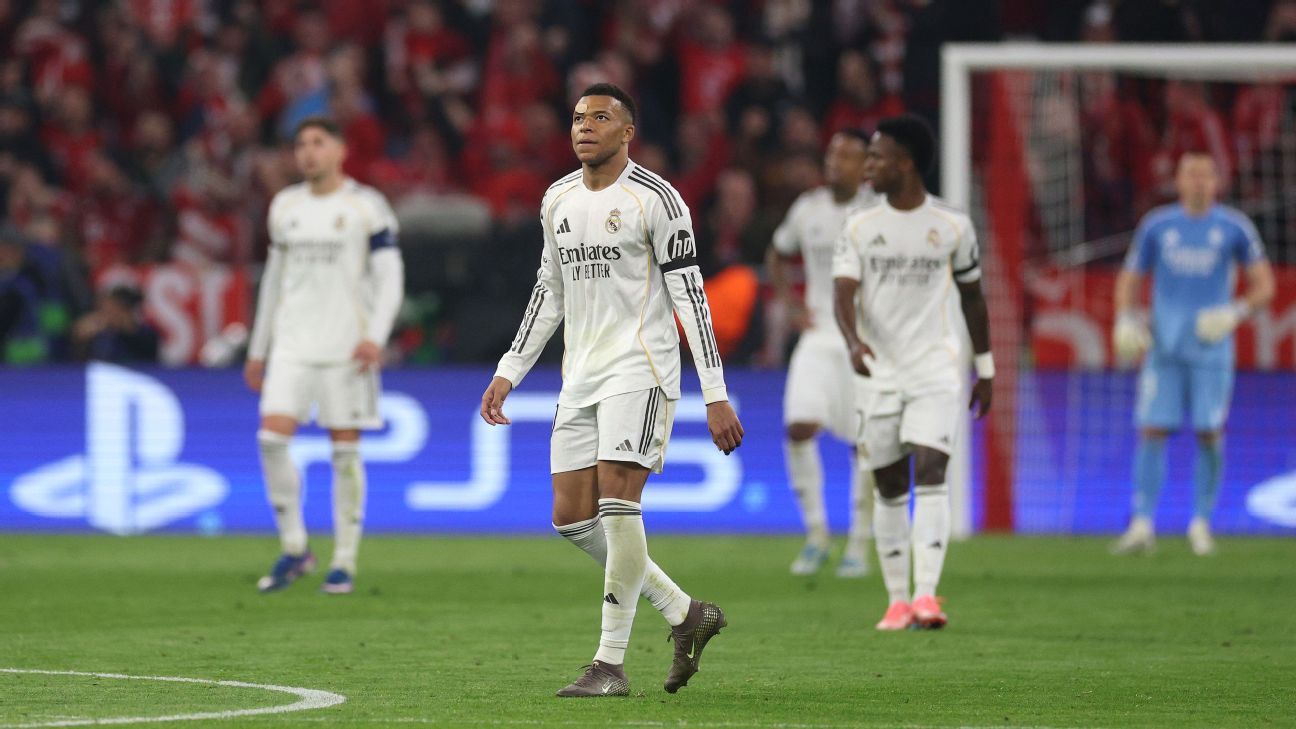
Just when it seems that Real Madrid has shown everything, they deliver a performance reminiscent of their first half at the Allianz Arena.
The 15-time European Cup champions, known for their unexpected victories in challenging situations, have been facing difficulties. As they approach the conclusion of the LaLiga season, they find themselves nine points behind the leaders, and in the UEFA Champions League, they were outperformed by Bayern Munich in the first leg last week.
However, in Munich, against one of Europe’s elite, they managed to net three first-half goals—while conceding two—in a thrilling 45 minutes, leveling the aggregate score at 4-4 and prompting the question: Could they actually achieve it again? Only one visiting team had previously scored three times in a Champions League first half at the Allianz, and that was Madrid as well, back in 2014, in a memorable away display.
Ultimately, the answer was no, as they returned home eliminated at the quarterfinal stage after a 4-3 defeat on the night, resulting in a 6-4 aggregate loss. Yet, they came remarkably close. The match was on the brink of extra time until substitute Eduardo Camavinga received a needless second yellow card. This was soon followed by Bayern winger Luis Diaz’s goal in the 89th minute, and then Michael Olise scored brilliantly with the final kick of the game.
– Report: Bayern Munich eliminate Real Madrid in Champions League thriller
– Why Klopp, Luis Enrique are the only managers to fix Real Madrid
– Liverpool’s star power can’t match PSG’s in Champions League
“You can’t send a player off for something like that,” coach Álvaro Arbeloa remarked, identifying Camavinga’s dismissal as pivotal. “I believe the referee didn’t even realize he had already received a yellow card.” Jude Bellingham expressed that the sending off was una broma, a joke, as he hurried through the mixed zone afterward.
Madrid is now poised to conclude their second consecutive season without a major trophy. This is deemed unacceptable at a club where success is gauged by the addition of trophies, and significant changes are likely to follow, potentially affecting Arbeloa himself.
“I will accept the repercussions of a defeat like this,” the coach stated. “I fully understand any decision the club may make.”
The only solace for Madrid supporters was a thrilling and unexpected reminder that, when at their best—which has not occurred frequently this season—they remain a squad brimming with exceptional talent.
This also served as further evidence for some of their critics: If they can perform like this occasionally, particularly against Manchester City or Bayern, why can’t they do it more consistently?
A day prior, Arbeloa had been candid in his pre-match press conference: a comeback was entirely feasible. “We’re Real Madrid,” Arbeloa asserted. “If any team can come to this stadium and turn things around, it’s us. … I don’t believe we need to perform any miracles. Everyone has faith.”
Arbeloa backed up his statements by selecting an attack-oriented lineup, featuring a midfield quartet of Federico Valverde, Bellingham, Arda Güler, and Brahim Díaz, together for the first time this season.
Güler set the pace, scoring just 35 seconds in, marking Madrid’s fastest-ever Champions League goal and the earliest Bayern has ever conceded in this tournament. The error was on goalkeeper Manuel Neuer’s part, who gifted Güler the ball. Güler, known for his long-range shooting, is the last player one would want to provide such an opportunity.
The tie was level, but not for long. Five minutes later, Madrid keeper Andriy Lunin misjudged Joshua Kimmich’s corner, allowing Bayern midfielder Aleksandar Pavlovic an easy header to make it 1-1 on the night.
Güler was not finished. In the 29th minute, his free kick found the back of the net again, with Neuer getting a hand to the ball but unable to prevent it from crossing the line. Bayern’s Harry Kane soon equalized, making it 2-2, with Trent Alexander-Arnold at fault for not tracking his man.
Madrid continued to press, with Vinícius Júnior hitting the crossbar and Kylian Mbappé leveling the aggregate score at 4-4. The play was a model for the best-case scenario for this Madrid side: Bellingham passing to Vinícius, who then found Mbappé—the star trio combining with remarkable speed.
“I feel there’ve been many matches where we’ve meshed really well,” Bellingham had stated before the match. “When things are right. I’ve witnessed it before.”
Mbappé will conclude the Champions League campaign with 15 goals—two shy of his idol Cristiano Ronaldo’s record of 17—as his quest to finally win the competition continues. In the second half, he remained a threat, with one opportunity inside the six-yard box—set up by Alexander-Arnold’s cross-field ball—saved by Neuer. Later, the forward nearly assisted Bellingham.
Then came Camavinga’s red card, having been on the field for only 25 minutes, followed by Diaz’s deflected goal.
Madrid’s players angrily confronted referee Slavko Vinčić at the final whistle, infuriated by the Camavinga decision, as coaching staff attempted to pull them away. None of them paused to speak to the media afterward, leaving Arbeloa to contemplate the future alone.
“We’ve faced numerous teams [this season],” Arbeloa noted. “[Vincent] Kompany’s Bayern, Pep Guardiola’s City, [Diego] Simeone’s Atletico. I am uncertain how much of this team reflects me. For sure, it’s significantly less than the examples I’ve provided.
“I’ve endeavored to assist the club in the manner I’ve been able to, and it will remain that way until the final day.”
That day will arrive at the season’s end, when Madrid—and president Florentino Perez, who was present with the team in Munich—will need to determine: How much of this project can be preserved, and how much requires a complete overhaul?
