
NBA All-Star Game: Four key narratives following a hectic weekend in Los Angeles.
Anthony Edwards beamed as he held the NBA All-Star MVP trophy for the first time in his career, just a day after asserting that the U.S. vs. World format of Sunday’s event would not reignite competitive spirit in the league’s midseason exhibition.
Whether the Minnesota Timberwolves guard was inspired or engaged in a clever tactic, he demonstrated his commitment to competition and fan engagement. By the time Edwards and the youthful Team Stars concluded the weekend by defeating the veteran Team Stripes in the championship match, the event had already become one of the more significant in recent league history.
Here are four key narratives that emerged from Los Angeles, including the potential longevity of the revamped All-Star Game, the security of the 3-point contest title with Damian Lillard, and the implications of NBA Commissioner Adam Silver’s remarks over the weekend for the future of the draft.
Is the All-Star Game back? Sunday proved it’s up to the stars
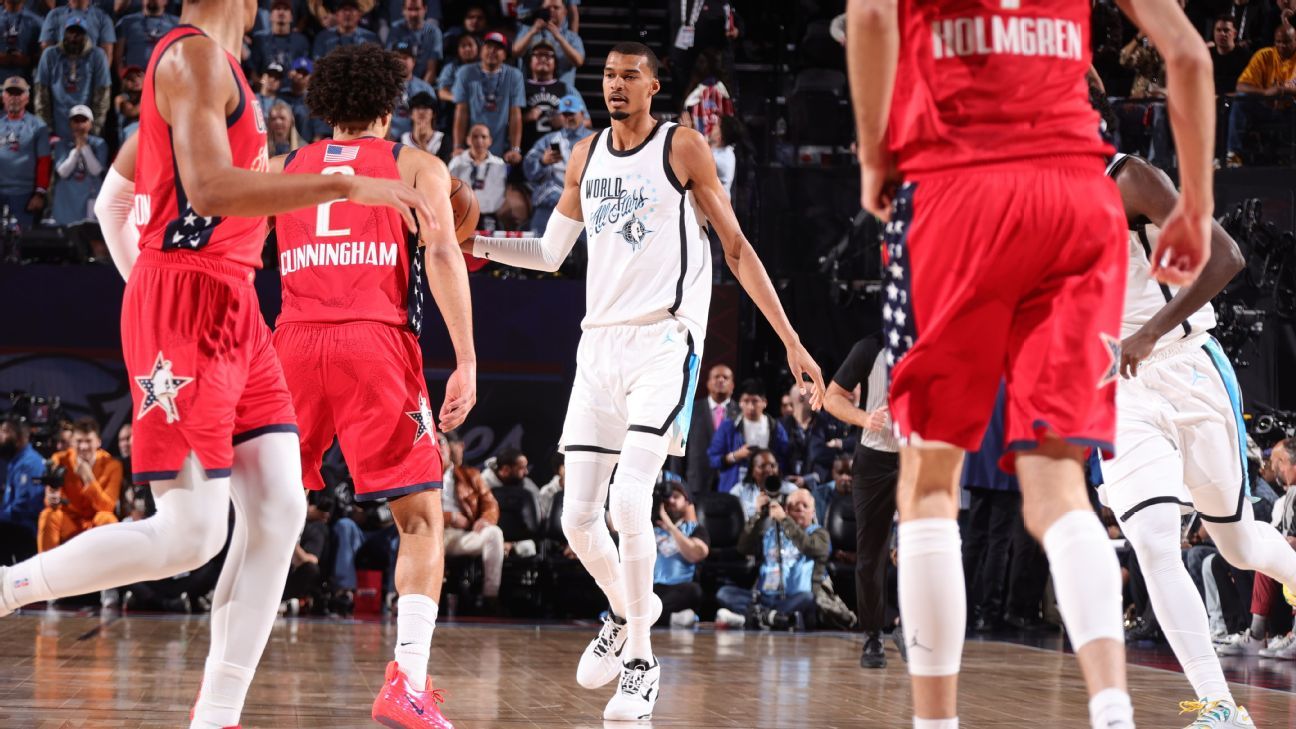
All it took was witnessing Victor Wembanyama storm off the court after the first game.
Following Team Stars’ Scottie Barnes being left open for a game-winning 3-pointer in overtime, the 7-foot-4 phenom from the San Antonio Spurs was seen heading in the opposite direction, muttering to himself about a missed assignment.
“It was our second time allowing a 3 when we shouldn’t have,” Wembanyama stated. “I would have expected us to be smarter in that moment, so that was disappointing.”
It is uncommon for a player to express disappointment over an All-Star Game loss, particularly in recent years. Typically, it has been the game itself that has failed to meet expectations.
However, while Wembanyama did not earn the night’s Most Valuable Player award, he might as well have. Edwards acknowledged this in his postgame press conference, mentioning that Wembanyama’s significant presence inspired him to perform, driven by the fear of being outshined. This heightened awareness extended to fellow All-Stars.
“Of course I played a part in it,” Wembanyama remarked. “If someone blocks me or if someone gets blocked on the other end, you don’t want to let the opponent score, you know what I mean?”
This illustrates that the game held significance after years of indifference and criticism: Players exerted themselves, committed (and contested) fouls, and displayed emotion. Wembanyama appeared unbothered by the responsibility of revitalizing the NBA All-Star Game, but does this indicate he is prepared to take on the role of the league’s face?
Wembanyama has no qualms about stating the obvious.
“It’s something that’s got to be natural, of course,” Wembanyama explained. “The NBA can promote whoever they want. But ultimately, it will be the best players and who the fans desire. Being the face of the league can be orchestrated, but only to a certain degree.”
His comments were the weekend’s most significant influence, prompting other players to follow suit. They did not require financial incentives or a speech from Silver. The audience desired increased effort and charisma. While players are stretched thin throughout the weekend with minimal time to recuperate before the regular season resumes, Sunday demonstrated that the league can successfully inject drama into the game.
Although Wembanyama did not secure MVP or a victory, his performance on the court and enthusiasm off it contributed to a much-needed win for the league.
 play0:52Ant Edwards explains why he enjoyed the All-Star Game’s competitiveness
Anthony Edwards tells Malika Andrews why he enjoyed the NBA All-Star Game’s competitiveness this year.
Ant Man plays it cool before playing hero
Edwards rose to the occasion, even in the game his team lost to Team Stripes, pressuring Kevin Durant into a steal and pulling up in transition for a 3 that would have given his team the decisive edge until De’Aaron Fox hit his own buzzer-beating triple. Throughout the evening, Edwards’ energy propelled his team, particularly in the championship game when the older players on Team Stripes began to fatigue. Edwards was fresh and had no trouble leading Team Stars to a victory that was not nearly as thrilling as the first three games.
His laid-back demeanor masked his competitiveness. This was evident to Detroit Pistons coach J.B. Bickerstaff, who had not spent significant time with Edwards until this past weekend.
“You appreciate individuals who bring that kind of energy every single day, those who possess that spark,” Bickerstaff noted. “People who exhibit joy around the game, where basketball is not a burden but something they genuinely enjoy.”
Perhaps Edwards genuinely does not desire the responsibility of guiding the league into the next generation. Perhaps he prefers not to have a glaring spotlight on every aspect of his life. However, there is something undeniably compelling about how he presents himself, how he engages with the cameras, and appears so at ease in his own skin, which could be concerning for a league office that prefers its stars to be polished and predictable, traits not always associated with the dynamic 24-year-old.
Edwards’ personality nearly overshadows the effort he has invested in his game. The Minnesota Timberwolves have been the only constant in the NBA’s version of the Final Four over the last two years, with Edwards serving as the driving force. He has yet to become a Finals champion, but he has eliminated some of the league’s giants in the past two postseasons: Nikola Jokic, LeBron James, Kevin Durant.
Do Silver’s comments on tanking spell draft changes?
During one of Silver’s most significant All-Star Weekend interview sessions, the commissioner addressed expansion and the potential for relocation. However, the most notable discussion revolved around tanking, which has become a significant issue in the league, with as many as 10 rebuilding teams actively pursuing improved draft positions.
Could the league further flatten the lottery odds? What about eliminating the draft entirely and allowing prospects to choose their own teams?
So far, the latter idea has not been discussed in meetings with the competition committee, sources informed ESPN. The concept of lottery-bound teams competing against each other in a tournament has also not gained traction, indicating how far the elimination of the draft is from the league’s agenda. Several substantial obstacles, including the need for any draft changes to be collectively bargained, would need to be addressed.
Currently, with the Utah Jazz being the latest team under scrutiny, the NBA appears to be exploring various options to combat tanking. This has included discussions about imposing heavier fines and the possibility of franchises losing draft picks if their tactics become overtly blatant.
In conversations with league officials over the weekend, some sources have shown openness to alternative methods, such as establishing lottery odds earlier in the season rather than after the full 82-game schedule. However, a high-ranking league official emphasized the importance of discussing fine amounts for teams that are blatantly circumventing the rules.
“You hit them in the wallet,” they stated. “What if they don’t receive their full revenue share if the league finds them guilty?”
Tanking genuinely undermines the essence of competition in the league. Even if this season has created the ideal scenario for teams to lose in order to maintain pick protections ahead of a potentially generational draft class, the league should explore every avenue to mitigate the annual race to the bottom.
The return of Dame Time, 3-point contest king
No one wanted to witness Damian Lillard appearing diminished in the 3-point competition, especially after his last appearance ended with him clutching his torn Achilles in the first round of last season’s playoffs. However, Lillard was determined not to exit on that note, ultimately outlasting Phoenix Suns star Devin Booker and Charlotte Hornets rookie Kon Knueppel to claim his third 3-point title.
“It started off as kind of a joke,” Lillard recounted regarding his entry into the contest. “Something opened up… It was literally that simple. I said I would do it, and the next day I was in the competition.”
He may not be able to sprint or engage in any serious on-court activities at the moment, but he can certainly still shoot from beyond the arc.
“I think this was necessary and needed for the fans,” Lillard remarked. “I recall when I was a kid attending All-Star Weekend in 2000 when it was in Oakland, and the highlight for me was seeing this player compete against that player in the dunk contest and these players facing off in the 3-point Shootout. I was once a fan like that.”
Lillard is not seeking to join a contender this year for the stretch run like Boston Celtics star Jayson Tatum, but the 35-year-old future Hall of Famer seems to have motivated some of his fellow sharpshooters to join him next season.
Stephen Curry, the league’s all-time 3-point leader, announced on Sunday that he will participate in next year’s competition in Phoenix, adding that he is willing to persuade former teammate Klay Thompson to re-enter as well.
Both Curry and Thompson are nearing the end of their respective NBA careers, but with All-Star Saturday nights needing a boost, it is not surprising to see Curry’s competitive spirit reignite one more time. If next season’s 3-point contest proves successful, credit goes to Lillard, who seems to embody the essence of what this weekend is meant to represent and who is inspiring other prominent names to join him. Perhaps the dunk contest, which has long been the centerpiece of All-Star Saturday night, requires a similar superstar endorsement.
