
NBA All-Star 2026: A chronology of jersey designs
The 2026 NBA All-Star Game marks the 75th iteration of this midseason event, and the league’s top talent is prepared to showcase their skills with flair.
While gathering the league’s premier players on a single court has been a tradition for many years—aside from 1999 due to the NBA lockout—numerous changes have occurred since the game’s inception in 1951.
One noticeable alteration for viewers is the increasing variety of uniform styles that have been utilized over the years.
Each NBA franchise is provided with four jersey styles: Association, Icon, City, and Statement. In the 2021-22 season, over 100 distinct uniforms were displayed across the league.
In the ninth consecutive year of collaboration with Jordan Brand, All-Stars can expand their extensive jersey collection. The uniforms for 2026 were revealed in February.
The NBA has officially presented the uniforms and court for the 75th NBA All-Star Game, scheduled for Sunday, Feb. 15 at Intuit Dome in Inglewood, California, the home of the LA Clippers. The annual midseason event will be broadcast on @NBAonNBC at 5 PM ET.
More: https://t.co/hfCckPI196 pic.twitter.com/KyKsfFT6y6
— NBA Communications (@NBAPR) February 4, 2026
Before these designs take the stage, let’s examine how the uniforms have transformed over the years.

1951: East 111, West 94
Location: Boston
MVP: Ed Macauley, Boston Celtics
In the inaugural game, players from the Eastern Conference wore a straightforward white jersey with blue highlights, while their counterparts from the Western Conference donned the reverse. The belt is a notable characteristic of the uniform, as elastic waistbands were not commonplace on basketball shorts during the 1950s.
1960: East 125, West 115
Location: Philadelphia
MVP: Wilt Chamberlain, Philadelphia Warriors
The design in the 1960s bore similarities to earlier styles. The addition of the East or West conference label on the front of the jerseys became a common feature later in the decade.
1967: West 135, East 120
Location: Daly City, California
MVP: Rick Barry, San Francisco Warriors
The latter part of the decade introduced a trend of honoring the city where the game took place. The Warriors’ City edition uniforms served as the initial inspiration for this new aesthetic.
1972: West 112, East 110
Location: Inglewood, California
MVP: Jerry West, Los Angeles Lakers
Players wore Lakers-themed uniforms when the Forum, the team’s then-home arena, hosted the All-Star Game.
1980: East 144, West 136 (OT)
Location: Landover, Maryland
MVP: George Gervin, San Antonio Spurs
Washington was the last team to have its jerseys serve as the model for the matchup between the two conferences.
1985: West 140, East 129
Location: Indianapolis
MVP: Ralph Sampson, Houston Rockets
This design gained significant popularity, being utilized for six consecutive years. It was even revived after a brief hiatus for the 2003 and 2004 All-Star Games.
1991: East 116, West 114
Location: Charlotte, North Carolina
MVP: Charles Barkley, Philadelphia 76ers
The ’90s produced some of the most iconic All-Star uniforms, beginning with this version that was in use from 1991 to 1994.
1995: West 139, East 112
Location: Phoenix
MVP: Mitch Richmond, Sacramento Kings
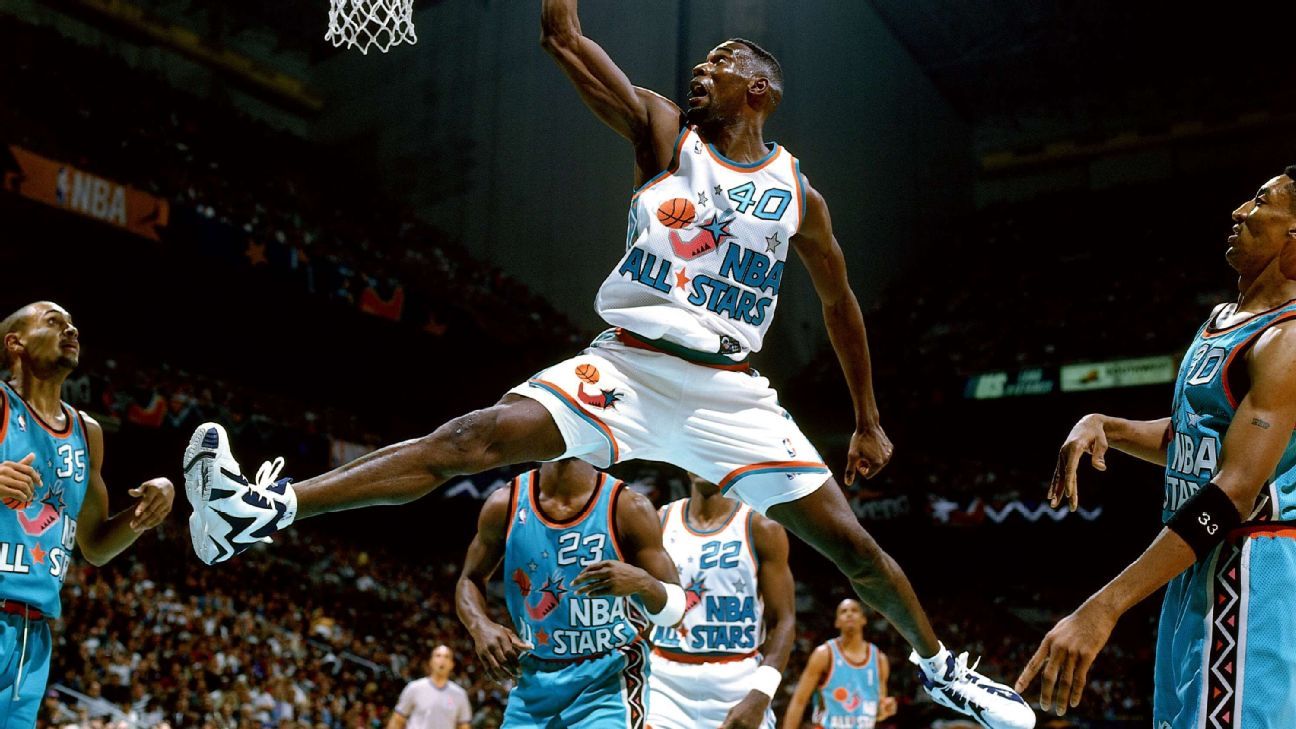
This design is another memorable one from the past century. The bright colors stood in stark contrast to the traditional red, white, and blue uniforms that dominated the All-Star Games for much of its history.
1997: East 132, West 120
Location: Cleveland
MVP: Glen Rice, Charlotte Hornets
The decade concluded with another well-known trend for the league’s midseason showcase, where players from the Eastern Conference wore their home jerseys, while those from the Western Conference donned their away uniforms.
2003: West 155, East 145 (2 OT)
Location: Atlanta
MVP: Kevin Garnett, Minnesota Timberwolves
This fan-favorite design from the late ’80s made a comeback for two years in the early 2000s.
2004: West 136, East 132
Location: Los Angeles
MVP: Shaquille O’Neal, Los Angeles Lakers
The first style of the new millennium featured diagonal lettering, but it was also the last time this format was employed. Grand opening, grand closing.
2007: West 153, East 132
Location: Las Vegas
MVP: Kobe Bryant, Los Angeles Lakers
Cursive font returned to the front of All-Star jerseys for the first time in over two decades, but this uniform was only utilized once.
2014: East 163, West 155
Location: New Orleans
MVP: Kyrie Irving, Cleveland Cavaliers
Sleeved jerseys became a trend upon their introduction in the 2013-14 season. They were also featured during the NBA’s Christmas Day games, along with appearing at the All-Star Game. This style was only used once.
2015: West 163, East 158
Location: New York
MVP: Russell Westbrook, Oklahoma City Thunder
This minimalist design reflects the earliest jerseys of the All-Star Games. It marked the first occasion that black and white were the primary colors, with black representing the Western Conference and white for the Eastern Conference. Players’ first and last names were also included on the back.
2018: Team LeBron 148, Team Stephen 145
Location: Los Angeles
MVP: LeBron James, Cleveland Cavaliers
This year marked the league’s adoption of its current format, rendering East and West designations obsolete. Similar to the style used in 2015, black and white distinguished the two teams, but each player’s team logo was prominently displayed on the front.
