
Luka Doncic’s tenure with the Lakers: A year in review and future outlook
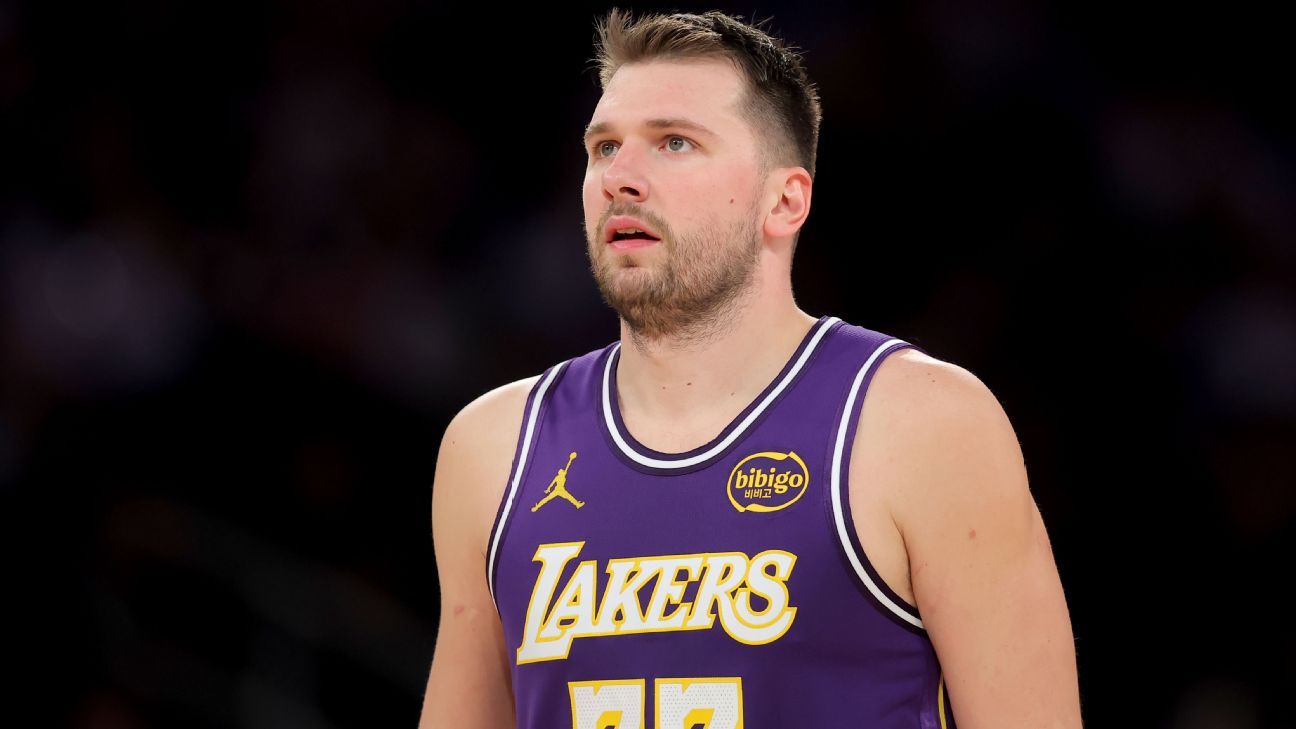
One year ago on Tuesday, Luka Doncic made his debut with the Los Angeles Lakers, stepping onto the court nine days after ESPN’s Shams Charania revealed the surprising news that the Dallas Mavericks had traded their franchise player to L.A.
As the Lakers continue to recover from questionable decisions made following their 2020 NBA championship victory, the trade has not yet altered the power dynamics within the Western Conference.
The Lakers’ record of 32-20 mirrors their performance from the previous year, when they held a 32-19 record after winning in Doncic’s first game.
However, the acquisition of an MVP candidate in his prime — and notably, his agreement to a three-year contract extension last summer that secures Doncic through at least the 2027-28 season — has significantly changed the Lakers’ operational approach. A team that previously revolved around the Klutch Sports-represented duo of Anthony Davis and LeBron James is now structured around Doncic’s timeline.
Let’s reflect on the initial 365 days Doncic has spent with the Lakers and look ahead to their efforts to regain championship contention.

Leaner Luka’s production
As expected, Doncic’s debut performance was unremarkable. After being sidelined for over a month due to a calf strain, he missed six of seven 3-point attempts in a win against the struggling Utah Jazz, concluding the game with 14 points on 5-of-14 shooting. It took four games, with the All-Star break in between, for Doncic to reach 20 points as a Laker.
Once he shook off the rust, Doncic averaged 28.2 points and 7.5 assists on 44% shooting over 28 games for the Lakers last season. While this level of performance is historic for most players, it was merely average for him. Both his shooting and playmaking were at their lowest since his rookie year.
Following a season plagued by injuries, and motivated by anonymous critiques regarding his conditioning and dedication from sources within the Dallas organization, Doncic revamped his physique last summer.
It is difficult to determine precisely how much this transformation has contributed to Doncic playing 42 of the Lakers’ first 50 games without any absence exceeding three games before sustaining a hamstring injury last Thursday against the Philadelphia 76ers. Nevertheless, he has certainly shown greater durability than Davis, who played only 29 regular-season games with the Mavericks before being traded to the Washington Wizards last week.
Thus far, Doncic’s enhanced conditioning has not resulted in significantly improved performance compared to his peak in Dallas, indicating that those conditioning concerns may have been exaggerated.
Doncic’s 32.8 points per game this season are nearly identical to his last two complete seasons with the Mavericks, albeit in slightly fewer minutes. (Doncic’s usage rate stands at 38% this season.) Perhaps the most significant change is Doncic leading the league in free throws made (8.5) and attempted (10.9) per game, surpassing his career-high average of 10.5 foul shots in 2022-23.
Of course, Doncic did not necessarily need to improve his output, having finished third in MVP voting during his last full season with Dallas. Over Doncic’s first 365 days with the Lakers, only reigning MVP Shai Gilgeous-Alexander of the Oklahoma City Thunder has generated more regular-season wins above replacement according to my WARP metric than Doncic’s 14.1.
Switching to Doncic’s timeline
The most compelling move the Lakers made after acquiring Doncic was one that ultimately fell through. Shortly after the Doncic trade, the Lakers agreed to send Dalton Knecht, a first-round pick, and another swap to the Charlotte Hornets for center Mark Williams, a 23-year-old lob threat who would have been an ideal pick-and-roll partner for Doncic.
Although the Lakers later rescinded the trade due to concerns regarding Williams’ physical condition, this move indicated their intention to prioritize winning during Doncic’s prime rather than constructing the best team possible in the latter stages of James’ career.
This became more evident in June when the Lakers allowed James to complete the option year of his latest extension instead of signing him to a new, long-term deal. James’ agent, Rich Paul, informed Charania at that time that James aimed to compete for a championship and would be observing the team’s actions.
The Lakers’ acquisitions last summer aligned with the same philosophy as the Williams deal: They replaced veteran 3-and-D wing Dorian Finney-Smith, 32, with Jake LaRavia, who turned 24 in November, and addressed their center position after trading Davis by bringing in Doncic’s fellow 2018 draft pick Deandre Ayton.
Since reversing the Williams trade, the Lakers have yet to utilize their remaining first-round picks in a deal.
The outcome is a team that is unlikely to make a significant playoff run this season. The Lakers are currently fifth in the West alongside the Houston Rockets and the Minnesota Timberwolves but hold the eighth-best point differential in the conference. The Lakers rank sixth in odds to win the West at DraftKings. Simulations based on ESPN’s Basketball Power Index suggest that L.A. has a 25% chance of winning a playoff series, making another first-round exit the most probable scenario.
The Lakers are looking towards the summer as a pivotal time to alter their fortunes.
Crucial decisions ahead
Despite Doncic’s talent, acquiring him did not resolve the Lakers’ most pressing issue: a shortage of role players capable of supporting their stars. This has been a persistent problem for years. In fact, the Doncic trade intensified the issue by sending away the best 3-and-D player the Lakers had developed since their 2020 title run in guard Max Christie.
The Lakers are aiming to make another attempt this summer. After trading one expiring contract (Gabe Vincent) for another (Luke Kennard) in their only in-season trade, the Lakers have just three other players besides Doncic under guaranteed contract for 2026-27: Knecht, LaRavia, and reserve forward Jarred Vanderbilt.
If the Lakers allow James to depart and see Ayton and veteran guard Marcus Smart exercise their player options, L.A. would have over $50 million in cap space to build around a core of Doncic and unrestricted free agent Austin Reaves. Reaves’ $21 million cap hold will likely be significantly less than his earnings this summer, allowing the Lakers to utilize that space and then exceed the cap to re-sign him.
Furthermore, by postponing the trade of first-round picks until the offseason, the Lakers will be able to offer up to three first-rounders instead of the one they previously had available. They can trade their 2026 first-round pick as soon as it is made, along with picks in 2031 and 2033.
The approach the Mavericks took to construct a Finals team around Doncic and Kyrie Irving should serve as a model for the Lakers.
After missing the playoffs in 2023 and winning the West the following year, Dallas drafted a rim-running center in Dereck Lively II and acquired another via trade in Daniel Gafford. The Mavericks also secured two defensively-minded forwards in Derrick Jones Jr. (free agency) and P.J. Washington (trade) who provided sufficient shooting to space the floor.
If Dallas is open to negotiating with the Lakers again after dismissing the general manager who orchestrated the Doncic trade (Nico Harrison), Gafford and Washington would be logical trade targets this summer. Mavericks forward Naji Marshall, who replaced Jones after he departed in free agency following the Finals, could also be a target.
The unrestricted free agent market appears most likely to yield a center, with Mitchell Robinson of the New York Knicks and Robert Williams III of the Portland Trail Blazers being realistic options.
The Lakers might also pursue guard Keon Ellis, who was traded from the Sacramento Kings to the Cleveland Cavaliers before the deadline. The Cavaliers’ tax situation may make them hesitant to match a substantial offer for Ellis.
Restricted free agency poses challenges for a team like the Lakers that cannot afford to wait out the matching period, but Denver Nuggets forward Peyton Watson — a native of the L.A. area who played at UCLA — might be obtainable via sign-and-trade due to Denver’s tax circumstances.
In many respects, the Lakers’ situation this summer resembles the period following their acquisition of Davis to pair with James in 2019. The Lakers delayed making that move official, preserving enough cap space to sign 3-and-D wings Kentavious Caldwell-Pope and Danny Green, along with center JaVale McGee. The Lakers capitalized on players’ desire to play in L.A. to secure multiple minimum signings, adding Rajon Rondo and re-signing Dwight Howard.
The outcome was championship-caliber depth that the Lakers sacrificed over the following year in pursuit of additional shot creation. Trading for Doncic provided the Lakers a potential solution to that dilemma. Now, it is up to them to optimize their opportunities this summer to capitalize on it.
