
Lakers aim to emulate back-to-back championship success of Dodgers
LOS ANGELES — The Los Angeles Lakers, who have won the NBA championship 17 times, are collaborating with the back-to-back World Series champions, the Los Angeles Dodgers, on basketball-related matters.
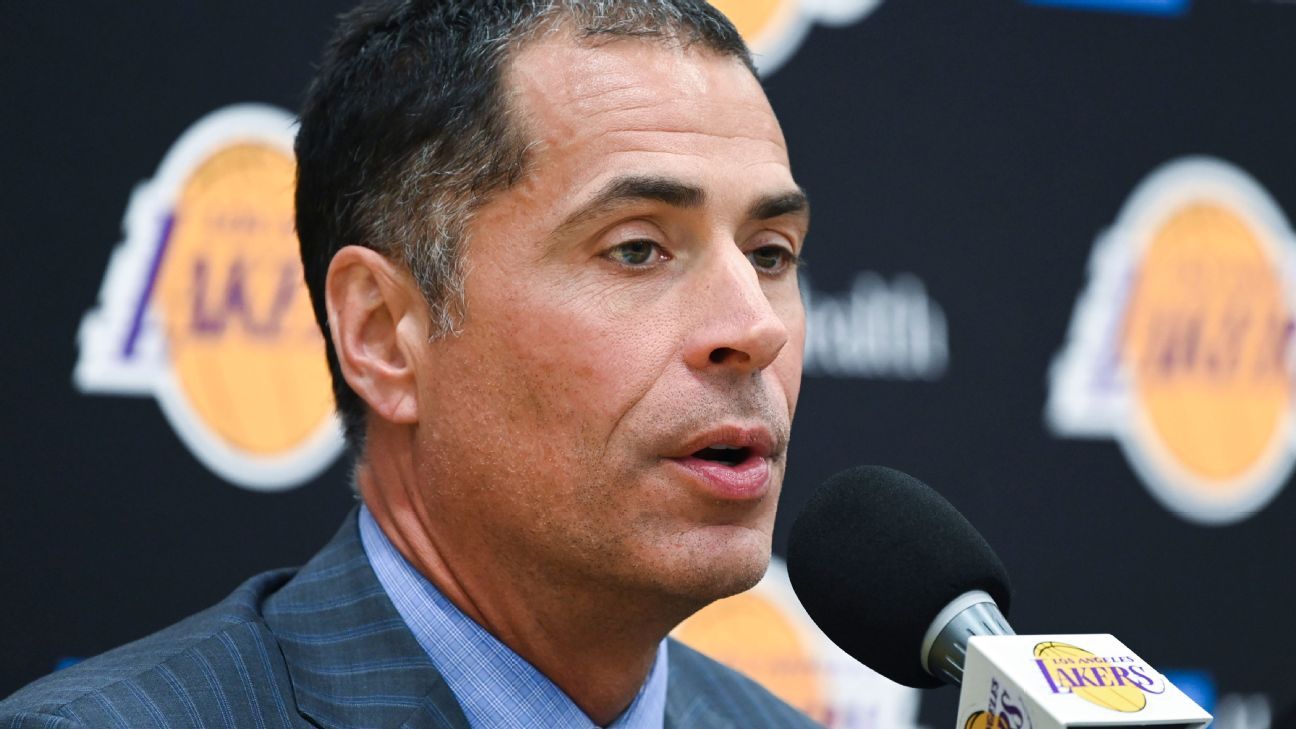
Rob Pelinka, the Lakers’ president of basketball operations and general manager, elaborated on this partnership prior to the Lakers’ game against the Golden State Warriors on Saturday, addressing the media for the first time since the official announcement of Dodgers owner Mark Walter’s acquisition of the Lakers at a valuation of $10 billion in late October.
“[It’s] been fantastic to have external allies and advocates observing the Dodgers and their achievements, as well as what they have established, and being able to consult with someone like Andrew Friedman for best practices,” Pelinka stated.
Friedman, 49, serves as the Dodgers’ president of baseball operations and joined the organization in 2014, shortly after Walter acquired the team from Frank McCourt in 2012.
“He is exceptionally intelligent and has done an outstanding job securing championships for the Dodgers,” Pelinka remarked. “Having another team leader to consult with, whether regarding roster decisions or staff changes, has proven to be an invaluable resource.”
In addition to his relationship with Friedman, Pelinka mentioned that he, Walter, and Lakers acting governor Jeanie Buss have explored ways in which Walter can further assist the team, beginning this summer. Buss is set to remain acting governor for at least four additional seasons following 2025-26, as per the Lakers.
“When Mark acquired the team, Jeanie and I conducted an in-depth discussion with him regarding the areas he aims to develop and pursue aggressively,” Pelinka noted. “Examining the Dodgers and their development has served as an excellent example and guiding principle. We are still navigating the process of how we will approach the offseason and what enhancements we will implement. However, there will be positive changes, and we will expand our operations.”
While indicating that one anticipated change will involve emulating the Dodgers’ draft strategy and farm system framework, Pelinka clarified the Lakers’ leadership structure for implementing these modifications.
“Led by myself and Jeanie,” he stated, “with Mark’s backing.”
The Lakers have a smaller front office compared to many other NBA teams. Since Magic Johnson’s unexpected resignation as Lakers president of basketball operations in 2019, Pelinka has been the primary decision-maker for the franchise, with Kurt Rambis acting as a senior basketball advisor. The front office became even less populated in November when the Lakers dismissed Joey Buss, the alternate governor and vice president of research and development, and Jesse Buss, an assistant GM, along with several scouting department members.
Pelinka mentioned that the Lakers would take cues from the Dodgers and he intends to recruit executives to support him.
“[The Dodgers], just the way they’ve structured their front office, how extensive it is — they spare no expense in striving to have the best front office in the world,” Pelinka remarked.
Pelinka also discussed the Lakers’ strategy regarding Thursday’s trade deadline and the team’s plans for the roster this summer, when L.A. will possess three future first-round picks available for trade, along with projected cap space nearing $50 million.
• On trading Gabe Vincent and a second-round pick to the Atlanta Hawks for Luke Kennard: “When you have the chance to add the best shooter in the game to your roster at the deadline, it’s a tremendous opportunity. So, we took advantage of it.”
• On other potential opportunities that may have been available to L.A. before the deadline: “I would say we were proactive. One aspect of being proactive is declining moves that come your way that may not be in the best interest of the short- and long-term future. That constitutes being proactive, even if it results in no action, because it can be challenging to turn down a good player that might provide a quick fix but could have long-term implications that don’t align with the overall vision for the team.”
• On the Lakers’ positioning for the summer: “It’s evident to all teams in the league that this dual-apron system is stringent and rigid, and some teams have ventured over the second apron and found it to be quite challenging. … Recognizing that there are unintended consequences when a new system is implemented, teams gradually learn to navigate it. We believe that creating flexibility or having options now is a significant advantage for us this upcoming offseason. Because there are teams that may have overextended themselves into the aprons. And we anticipate that players will become available around the league when teams find themselves in that situation.
“Thus, whether through free agency, retaining our own players, or exploring the league for quality players that teams are looking to offload salary, we believe there will be numerous avenues to enhance our roster in the offseason.”
• On the Lakers’ interest in the buyout market: “We are assessing [our open] 15th roster spot and will likely fill it at some point.”
