
Kobe Bryant and the hidden legacy of the Black Mamba
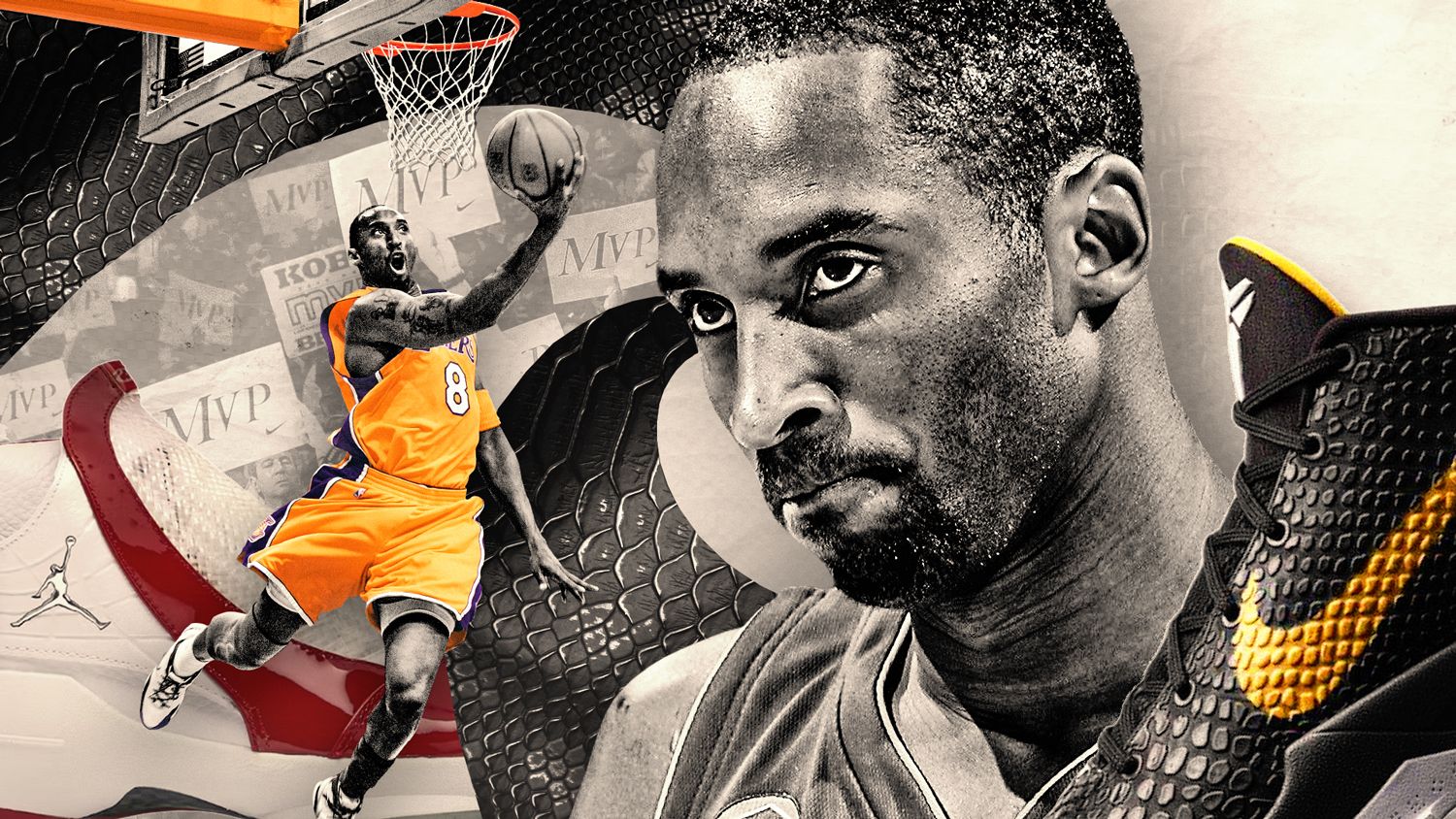
NIKE EMPLOYEES GATHERED around a conference table at the company’s Oregon headquarters in late 2002, examining an advanced material.
Black and tubular, Tech Flex was typically used in automobiles and aircraft. Its grip would expand and contract around whatever was placed within it.
The team viewed it as a potential basis for the next generation of a basketball shoe, one that would not require laces.
Gentry Humphrey, a Nike executive responsible for marketing the shoe, noted the braided design. “It resembles a snake,” he thought. Others shared this sentiment.
Later that evening, Humphrey researched “the most formidable black snake” online.
The search yielded quick results: black mamba.
The snake was characterized as incredibly fast, agile, and feared—qualities that mirrored the star NBA guard for whom they were creating the shoe.
Having been with Nike since 1994, Humphrey swiftly assembled a presentation that highlighted the snake as the focal point of a new sneaker campaign. Accompanying images of the snake were clips of the NBA star driving to the basket.
Shortly thereafter, Humphrey presented the concept to his colleagues. The connection between the material, the black mamba, and the NBA star felt instinctive and appealing.
“Everyone was on board,” he told ESPN.
From that point, it was time to develop a worldwide campaign featuring the black mamba and introduce it to the player who would ultimately embody it.
That player was Michael Jordan.
NOW, THE BLACK mamba is closely associated with Kobe Bryant, the late Los Angeles Lakers icon.
Numerous posters, murals, and advertisements celebrate the fervor of his “Mamba Mentality.” Bryant established an academy that carried the same name. Mamba Day is observed on August 24—8/24—a tribute to the two jersey numbers he wore throughout his 20-year tenure with the Lakers.
Nearly a decade ago, after scoring 60 points in his final game on April 13, 2016, Bryant addressed the audience at Staples Center, stating “Mamba out!”—his last words as a Laker before placing the microphone on the court.
As part of his signature sneaker line, Nike has launched several shoes featuring Mamba-themed designs, including textured snakeskin patterns.
The transition of a shoe and persona originally intended for Jordan to Bryant instead unveils an alternate narrative—one of the most extraordinary untold stories in the realm of sports marketing, advertising, and apparel.
The inaugural Air Jordans debuted in 1985. The 40-year-old signature shoe line generated nearly $7.3 billion in sales for the fiscal year ending in May 2025, with each annual launch involving a large team of staff—and, crucially, input from Jordan himself.
For the first 18 iterations of the Air Jordans, initial design concepts originated from Jordan, who would provide feedback on sketches and prototypes until the shoe met his standards.
It was common for influences beyond sports to shape the shoes. The Jordan 5 drew inspiration from an American WWII fighter plane, the 6 from a German sports car, the 7 from West African tribal art, the 12 from the Japanese flag, the 14 from a Ferrari sports car, the 15 from an X-15 fighter plane, and the 17 from jazz and an Aston Martin.
For the 18s, released in 2003, Jordan informed Tate Kuerbis, the shoe’s designer, that he envisioned a beautiful, Italian-made leather driving shoe, typically used in Formula 1 racing. “And he was like, ‘Hey, can you design a basketball shoe that looks like one piece of leather inspired by this driving shoe?'”
Eventually, samples of the 18 were produced for him to try on.
“When he puts it on, that’s when it truly becomes the Air Jordan,” Kuerbis remarked. “And he’s approving it, saying this is ready for market.”
“MJ’s vision guided the process,” Kuerbis added.
The 19s marked the first occasion where the initial concept originated from the design team instead.
For years, Jordan had been known as “The Black Cat” among players. However, Humphrey and others at Nike believed that Jordan’s aggressive style on the court more closely resembled the speed and agility of a snake—and now they had a material to embody that.
This idea represented a “white whale” for the industry—the laceless shoe. There had never been a performance basketball shoe without laces, but the Tech Flex material made that feasible, according to Humphrey and Kuerbis.
Now, they just needed to convince Jordan of their concept.
ANTICIPATION MOUNTED FOLLOWING Humphrey’s presentation for a black mamba campaign for the Air Jordan 19s.
Shortly thereafter, Kuerbis began developing sketches and prototypes.
He recalled presenting them to Jordan during an off-day when the Wizards were in Miami to face the Heat.
In the locker room, Jordan, who was then wearing the recently launched 18s, examined the shoe. Those who collaborated with him noted that he was always meticulous, inquisitive, protective of the brand—and, above all, competitive. He wanted his shoes to excel.
He inquired whether the Tech Flex material would stretch over time. Would it still offer the necessary support during gameplay? He suggested that it might be beneficial to include some laces beneath the braided sleeving. Overall, Kuerbis described Jordan as “excited and curious and on board.”
Humphrey and Kuerbis pressed ahead. They recalled a meeting with Jordan in the spring of 2003, as his NBA career was nearing its end, in an office in downtown Chicago, attended by several Nike officials.
It was there that Humphrey first introduced the black mamba campaign concept to Jordan.
By that time, Humphrey noted that the idea had already been communicated internally to advertising and marketing officials at Jordan Brand, and they had begun strategizing on how to present it to a global audience.
However, as soon as Humphrey began to explain the black mamba concept to Jordan, he sensed a significant issue.
“You could tell from the very start,” Humphrey remarked, “he was uneasy.”
IN SPRING 2003, after receiving the black mamba brief from the Jordan Brand team, Tina Davis of the Wieden+Kennedy advertising agency convened her team in New York.
Nike had partnered with Wieden+Kennedy since 1982, and Dan Wieden—one of its founders—had coined Nike’s iconic “Just Do It” slogan. The agency was also responsible for the Air Jordan commercials featuring Spike Lee as “Mars Blackmon” in the late 1980s and early 1990s.
Typically, Wieden+Kennedy would receive a brief, then distill the essence of an idea and express it visually in the most ambitious manner across various platforms: commercials, print ads, billboards, posters.
Justin Barocas, then a media director at Wieden+Kennedy, stated they aimed to create visuals for the black mamba campaign that possessed “stopping power.”
Initially, they attempted to locate a live black mamba snake, typically found in sub-Saharan Africa, hoping to feature it in a photoshoot with the shoe.
“Then we discovered that they’re illegal in the United States,” Davis recalled. “You can’t even bring them into the country.”
They opted for a different black snake, one so large that, according to Charles Hall, then an associate creative director at Wieden+Kennedy, “you wouldn’t have wanted it loose in the room.”
Inside the New York office, they digitally stitched photos together to recreate a version of the black mamba slithering around the shoe, rearing its head, and the team prepared for the targeted spring 2004 launch of the Air Jordan 19.
The next step was for Jordan to visit the Nike campus to view the campaign firsthand.
IN LATE 2003, Jackie Thomas stood in an empty conference room on the Nike campus, her back to the door, reviewing the notes for a presentation she was about to give.
She heard a deep voice behind her.
“You must be Jackie.”
She turned around.
“You must be MJ,” she replied, extending her hand to the man himself, the namesake of the empire who had his own reserved parking space on the campus.
Thomas was the new director of marketing for Jordan Brand, a role she took on in August 2003 that tasked her with overseeing marketing for all Jordan products, with an emphasis on increased innovation.
“We had a very strong retro business,” she told ESPN. “And there was concern—rightfully so—that the brand was heavily reliant on the retro market, and we did not want to jeopardize that success.”
The objective was to maintain the integrity of a retro product while also advancing it into the future. The 19, she stated, was a crucial part of that initiative, and Wieden+Kennedy had already developed the ads for the launch. The entire campaign was ready.
It was now her responsibility to present it to Jordan.
Thomas had spent weeks preparing, planning, and researching. Marketing, apparel, footwear, and advertising staff soon filled the room. Thomas’ mission was to detail every aspect of the launch.
Over the next hour, she broke down each component; the section discussing the black mamba snake lasted about 15 minutes.
While she spoke, Jordan appeared engaged, and when the presentation concluded, Thomas felt relieved and excited—like she had hit a home run.
The following day, Thomas received a call from Larry Miller, the president of Jordan Brand.
“Why don’t you come down to my office?” he asked. “I need to discuss something with you.”
Still feeling elated, she thought nothing of the call. She walked down the hall.
“What’s up, boss?” she inquired.
“Hey, great job in there yesterday,” Miller said. “MJ really liked the meeting. The product looked fantastic, but there’s an issue.
“MJ doesn’t like snakes.”
THOMAS WAS BAFFLED. No one had informed her that Jordan had a dislike for snakes. At no point during the meeting did Jordan convey such a sentiment.
“Well, I wasn’t involved in product creation,” she explained to Miller, “and you all knew that the snake was a significant part of the narrative surrounding the product design. I believe this campaign is quite strong.”
Miller shrugged.
“Here’s MJ’s number,” he said. “Give him a call. Convince him.”
She took a deep breath, steeled herself, and dialed.
It was late in the week, a Thursday, she recalled.
No answer. She called again later that day—still no answer. She called twice the next day. She left voicemails.
The weekend came, and Thomas paced through her Oregon home.
Thomas gathered her team and analyzed the numbers. On Sunday, she called Jordan again and left a detailed voicemail.
The launch was just months away, and plans were in place, she explained—advertisements, marketing. There was no way they could suddenly inform retailers, for example, that they had no visuals, no in-store point-of-sale materials.
The sales team had already placed ads to be published. There had been numerous meetings, countless checkpoints, and they all had received approval. Delaying, she noted, could result in millions of dollars in losses.
A couple of hours later, Jordan returned her call. He stated he understood.
“I’m okay on this one specific occasion to allow you to run the ad,” he told her, “but you need to reconcept before the next colorway is released.”
She expressed her gratitude, thankful for the compromise.
After the call, she sent him a box of Davidoff Millennium cigars and a thank-you note.
On March 14, 2004, the same month the $165 shoe launched, a two-page black mamba Air Jordan 19 advertisement appeared in ESPN The Magazine, as part of a print-focused campaign that Thomas indicated included other national publications. It featured the tagline “Only Greatness Equals Greatness.”
Then, the campaign quickly shifted.
Commercials showcased additional colorways. One featured Carmelo Anthony, another with Gary Payton, and another with Jason Kidd. Legendary Georgetown coach John Thompson provided the voiceovers.
None referenced the black mamba.
REFLECTING ON THE PAST, THOSE involved with the shoe express surprise that the black mamba campaign progressed as far as it did, given Jordan’s aversion to snakes. “We couldn’t believe it when we found out,” Hall remarked.
However, Jordan Brand and Wieden+Kennedy officials at that time all cite the same reason for this: Jordan’s fear of snakes was one of his closely guarded secrets.
Nike officials were aware of his other fear, which he had disclosed in a 1992 interview with Playboy. “Everyone has a phobia about something,” Jordan told the magazine. “I do not mess with water.”
He explained that it stemmed from witnessing a friend drown as a child.
But author Mark Vancil, who collaborated with Jordan on the 1993 book “Rare Air,” elaborated in a 2024 podcast with Jordan’s former teammate Stacey King on the extent of Jordan’s phobia.
“He was terrified,” Vancil said. “If you were watching TV with him and a snake appeared, he would change the channel. And [Jordan] said, ‘If you write that, someone is going to get hurt because someone will throw a snake one day.’
In August 2023, Jordan’s son Marcus disclosed on his “Separation Anxiety” podcast that he and his older brother Jeffrey once pranked their father by tossing fake snakes onto his bed.
“We were grounded,” Marcus recounted. “I think he was caught off guard, and he realized they weren’t real after a while. He was running around the house trying to find out who pranked him.”
Barocas and others noted they were not surprised that Jordan concealed his fear of snakes from Nike officials.
“If you know anything about him, he was the ultimate competitor,” he stated. “He was a trash talker. He got inside your head. He utilized any competitive advantage he had. If he had a genuine fear of snakes, then he wouldn’t want that out in the open.”
On April 16, 2003, a year before the release of the Jordan 19s, Jordan played his final game, a 107-87 loss to the 76ers in Philadelphia.
Exactly one year later, in a twist of fate, a new film directed by Quentin Tarantino was released: “Kill Bill Vol. 2.”
The film featured a group of assassins known as The Deadly Viper Assassination Squad.
In one scene, a member of the group named Elle Driver (played by Daryl Hannah) uses a black mamba snake to attack a fellow assassin named Budd (played by Michael Madsen).
As Budd writhes on the ground with the snake’s venom coursing through his body, Elle delivers a monologue:
“Budd—I’d like to introduce my friend, The Black Mamba. Black Mamba—this is Budd.”
Elle mentions that she researched the black mamba online.
“Fascinating creature, the Black Mamba. Listen to this.”
She begins to read:
… In Africa, the saying goes, in the bush, an elephant can kill you. A leopard can kill you. And a Black Mamba can kill you. But only with the mamba, and this has been true in Africa since the dawn of time, is death certain. Hence its moniker:
Death Incarnate.
Bryant would later state, in a 2018 interview with the Washington Post, that he watched the movie one night at home when he couldn’t sleep. It was past 2 a.m. The scene had captivated his imagination.
“The length, the snake, the bite, the strike, the temperament,” he told the Post, “‘Let me look this up.’
“I researched it—yeah, that’s me. That’s me!”
IN JUNE 2003, four months after Jordan’s black mamba advertisement appeared and three months after “Kill Bill Vol. 2“ was released, Bryant signed with Nike after his contract with Adidas ended.
That same month, he also traveled to Colorado for a knee procedure. He stayed at The Lodge and Spa at Cordillera. There, a 19-year-old woman worked at the front desk. She would later inform authorities that Bryant assaulted her in his room.
One month later, in July 2003, Bryant, then 24, was charged with felony sexual assault against her. On the same day, Bryant held a news conference, admitting to infidelity but asserting that the encounter was consensual. In September 2004, the charge was dismissed. Six months later, a civil lawsuit was settled out of court.
The incident marked a pivotal moment in his life and career. During the subsequent 2003-04 NBA season, Bryant traveled back and forth between Colorado, where court proceedings were held, and Los Angeles, where he played with the Lakers. Bryant would later state, in the 2015 documentary “Kobe Bryant’s Muse,” that he adopted the black mamba persona during this period.
“In 2003, I transitioned from a person at the pinnacle of his career, who had everything ahead of him, to a year later, having no idea where life was headed or if I would even be part of life as we know it,” Bryant said in the documentary, which he produced
