
Fires, devastation, optimism: A year later for JJ Redick, the Lakers, and Los Angeles.
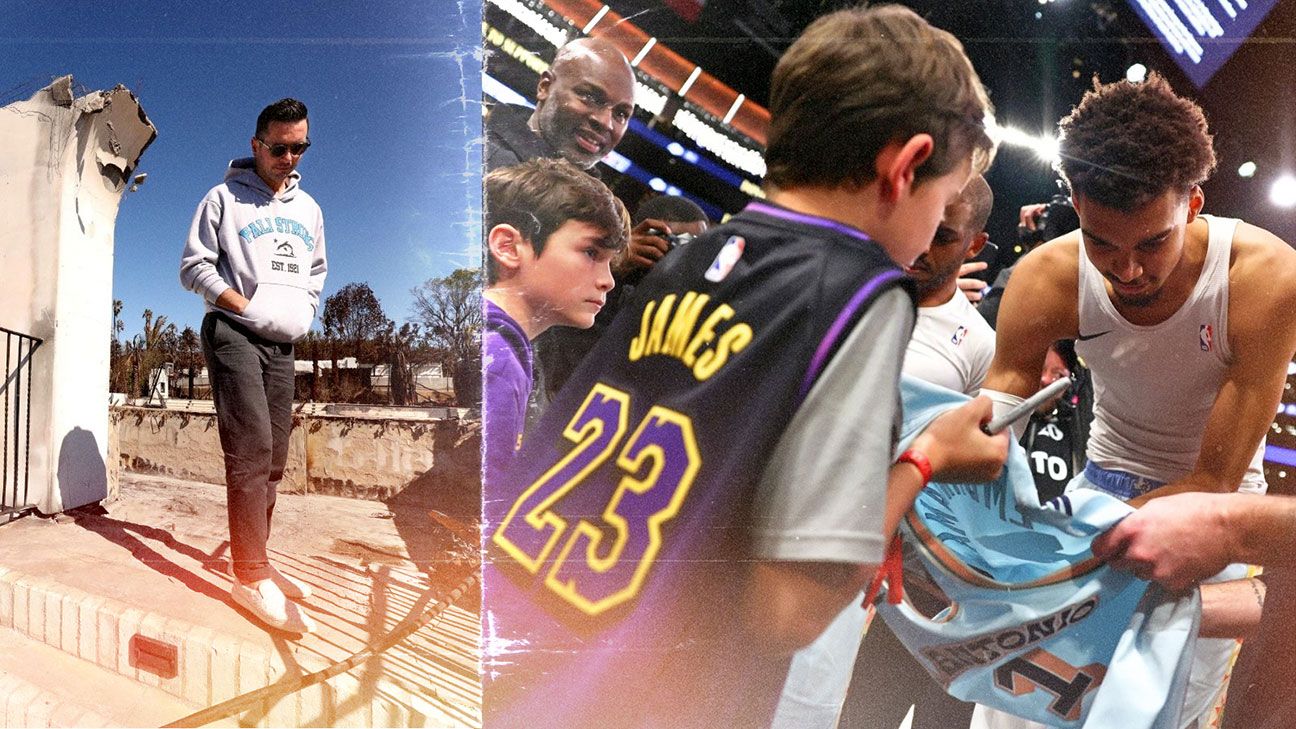
ONE YEAR LATER, everything felt strikingly similar for JJ Redick. A road defeat for the Los Angeles Lakers in Texas during January. Images on his phone that lingered in his mind. A late-night flight back home.
On January 8, 2025, Redick and the Lakers returned from Dallas to discover parts of Southern California consumed by flames. Wildfires had ravaged nearly 60,000 acres, destroying numerous homes and businesses, and devastating neighborhoods in Altadena, Malibu, and the Pacific Palisades, where the new Lakers coach and his family had resided.
On January 8, 2026, Redick and the Lakers came back from San Antonio to find Southern California still in the process of recovery. “When I got back that night, it was literally 365 days later,” Redick told ESPN. “I’m driving up the 405 [Freeway], and when we lived in the Palisades, I would take that left onto 10-W to head to the Palisades.”
“As I drove past the 10, I thought, ‘F—, dude.’ It just kind of hit me.”
His feelings had surfaced in San Antonio, where he received messages from friends and supporters checking in on the anniversary of the day his rental home by the Via Del Paz bluffs was destroyed.
Redick’s wife, Chelsea, had shared about the experience on Instagram, and many friends referenced her post in their messages to him, prompting the Lakers coach, who had stepped away from social media to concentrate on his role, to redownload the app and log into his inactive account just to view what his wife had posted.
He was in the midst of a coaches’ meeting when he read her message.
“I cried,” he admitted, before apologizing for the disruption.
Like many others, he has spent the year reflecting on his family and their losses, as well as the surrounding areas and people. The destruction has been relentless.
“It was as emotional as I’ve ever been in my life, and I was trying to understand why I felt that way,” Redick stated. “There’s obviously the loss of the home, which is clear. There’s the loss of community. There’s the anxiety, the concern that even if they rebuild, it won’t be the same. That worry is there.”
“So, that was all part of my [thought process]. … But I thought, ‘There has to be more. There has to be more.’ And I actually realized — this might sound strange — where a lot of my anger stemmed from. My anger was that my family and I only got to live there for five months.”
“And it was like, I wish we could have experienced that longer, and I wish my kids could have experienced that, and Chelsea could have experienced that for a lifetime.”
Redick has channeled those feelings into action, working with other leaders in Los Angeles to establish his charity, LA Sports Strong, and collaborating with the nonprofit Steadfast L.A. to aid in the reconstruction of the Palisades Recreation Center. He has engaged with builders, funders, and civic partners. They have envisioned a revamped rec center, featuring fire-resilient structures and 50,000 square feet of restored green and community space, safeguarded by fire-resistant landscaping.
On January 8, Redick participated in a fundraiser for the rec center, held at a residence in the Palisades.
Judd Apatow performed stand-up. Jennifer Garner spoke to the dinner attendees. Ryan Tedder from OneRepublic delivered a musical set. And Adam Sandler introduced Redick and L.A. Dodgers manager Dave Roberts before the leaders of the city’s two major professional sports franchises engaged in an intimate “coach’s corner” discussion.
The event generated millions of dollars, sources informed ESPN. “Way more than we anticipated,” Redick remarked. “More than double our target.”
This reflected the generosity his family experienced last spring when the NBA community rallied around Redick’s two sons, 11-year-old Knox and 9-year-old Kai, to replace the cherished items lost by the two sports-enthusiast children with a new memorabilia collection beyond their wildest dreams.
EVEN FROM THOUSANDS of feet in the air, Redick could sense the devastation.
As the team plane descended toward LAX after that Mavericks game last January, he observed the orange, burning remnants. The players and coaches could smell it.
“You could see the embers, the fire, the smoke,” Redick recounted. “We kind of flew through a dark patch of smoke. It just … it … it was overwhelming.”
Chelsea and the boys had already evacuated. Redick met them at their hotel, arriving at 3 a.m., still in his coach’s attire from the previous night.
He rested for a few hours and then, armed with a list from Chelsea, drove to the Palisades to see if he could salvage anything from the house.
The list included sentimental items — Chelsea’s original engagement ring — and practical necessities — iPads for the kids and a week’s worth of clothing for the family after they arrived at the hotel with only overnight bags.
Upon his arrival, after navigating blocked streets, smoldering flames, and emergency vehicles, what he encountered was unrecognizable.
“Just a pile of ash and rubble, just like our neighborhood … and most of the Palisades,” Redick described. “It was probably the most devastating thing I’ve ever witnessed.”
He exited his vehicle and stood on the sidewalk in front of where his home once stood. He could feel the heat from the smoldering debris on his skin.
“I mean, everything had just collapsed,” he said. “The framing and the stairs — the metal is still there — but everything just came down to the basement in the garage. It was just a pile of ash.”
He glanced at the list. Checking it off would be impossible.
“There was nothing in there,” Redick stated.
He called his wife and drove back to his family.
“By the time I returned to the hotel, Chelsea had already informed the kids,” Redick said. “And, you know, I … I can’t imagine what those first five minutes were like because I wasn’t in the hotel room, but … I know they were highly emotional.”
As Redick and the city dealt with unimaginable loss, the league postponed the Lakers’ games on January 9 against Charlotte and January 11 against San Antonio, but the team resumed practice before returning to game action on January 13 against the Spurs.
Redick mentioned that his players and coaches “supported” him, surrounding him with their care.
He responded with a message. “‘If you guys want to play, I want to coach,'” Redick said. “‘I’m ready to go.’ I wanted to make that very clear to them, like, ‘Don’t think I’m not going to give you my best.'”
He also acknowledged the role the team could play in serving the community. Redick had an LAFD patch sewn onto the arm of the sweaters he wore while coaching on the sidelines, honoring the fire department. The Lakers organized collections at the arena and their practice facility for fans to donate food items and other essentials. The team hosted a first responders night at Crypto.com Arena — complete with an opportunity to play on the Lakers’ court and participate in a clinic led by Robert Horry.
Redick became a public figure representing the tragedy. He took the responsibility seriously, but he was also acutely aware of how fortunate his family was, having the means to cover the costs of their displacement. He committed to action, not just representation.
Meanwhile, during their first practice, Austin Reaves had a message for his coach, too.
“He approached me and said, ‘Hey, I left something in my locker for Knox and Kai.’ And it was personalized, signed jerseys for them.”
Reaves, whom Redick’s children refer to as “Uncle A,” was aware of Knox and Kai’s memorabilia collection and how much they valued it.
“I get to rebound for him before games, and he always lets me shoot a 3 when he’s done,” Knox said of Reaves. “He is someone I look up to.”
The lost memorabilia included what collectors call “grails.” There was a Luka Doncic Mavs jersey personally autographed to Knox that Doncic — at that time, his dad’s former teammate — presented him at a Dallas-Brooklyn Nets game when they lived in New York and Redick was beginning his media career.
There was a Stephen Curry jersey personally autographed to Kai that Redick had Curry sign after a podcast recording. In total, Redick estimates his sons had eight to 10 jerseys each, plus countless basketball cards they had purchased with money saved from birthday gifts and earned from chores. All of it was lost.
What Reaves initiated, a couple of Spurs — Chris Paul and Victor Wembanyama — continued.
When the Lakers’ season resumed on January 13, the duo presented Knox and Kai with their game-worn jerseys on the court after the final buzzer.
“Chris just gets it,” Redick said of his former L.A. Clippers backcourt mate. “We had a complicated relationship in college and early on in the NBA. We didn’t like each other. Then, we became teammates. And we realized we had a lot in common. And I love that guy. And it meant a lot. And I’m not surprised that Vic participated in that gift, as well, because he’s one of the best people I’ve met.”
With Paul and Wembanyama’s gesture circulating on social media, others joined in to enhance Knox’s and Kai’s collection.
Curry sent two autographed jerseys, one to replace Kai’s and another for Knox. Three-time MVP Nikola Jokic also sent two.
The boys received authentic LeBron James and Kobe Bryant jerseys.
Hall of Famers David Robinson, whose son, Justin, is a Lakers player development coach, and Michael Cooper sent autographed jerseys as well. Current players, including Franz Wagner and Paolo Banchero from the Orlando Magic, and Cooper Flagg, who was excelling at Duke University at the time, also contributed. (Duke, Redick’s alma mater, also sent a Redick No. 4 Blue Devils jersey for good measure). UCLA’s basketball program sent jerseys, too.
Topps and Panini provided basketball and football cards to replenish their cardboard collections.
Each item brought some temporary joy and pride of ownership, while the boys were surrounded by so much sorrow and disruption, with 37 other families in their school also losing their homes.
“The awareness they have for their loss and everyone else’s loss, it’s something we discuss frequently as parents,” Redick said. “They comprehend the significance of this natural disaster and that it doesn’t only impact them.”
How did it make them feel?
“Excited and thankful,” Kai responded.
“Happy and shocked,” Knox said.
TURN OFF THE Pacific Coast Highway and head up Temescal Canyon toward Pacific Palisades today, and signs of the fires are evident everywhere.
On the north side of the street, there is a park bench with the slogan “PALI STRONG” printed in bold letters — a rallying cry for the community during its recovery.
On the south side, spaced out every 50 yards or so as the road winds up the hill, are hazard signs:
SEVERE FIRE DANGERS
— No Smoking
— No Fires
— No Barbeques
— No Portable Stoves
As the hill reaches its peak, Palisades High, where Golden State Warriors coach Steve Kerr attended, stands unscathed, with bright aqua letters proclaiming “Pali High — Home of the Dolphins” on the side of the building.
Across the street from the school, there are vacant lots where homes once stood, some with construction equipment parked on the property. A few have wooden frames erected. Some remain filled with debris and will never be rebuilt.
On Redick’s former street, there are constant reminders of how much work remains.
The sign in front of Palisades Charter Elementary School reads: “Returning August.”
And on the line below: “2028.”
Placards from the U.S. Army Corps of Engineers are placed near the curb, sometimes as the only marker of the address of a house that once existed there.
Charred tree branches stand out like ink stains against the vast blue sky and ocean views.
On Swarthmore Avenue, a statue has been erected featuring two metallic human-like figures holding hands, with each figure missing parts of its body. Half an arm here, a chunk out of its side there. Its title is “Broken But Together.” A sign next to it reads, “This statue was the only thing that miraculously survived the fire at our home.”
Redick hopes that the community can gradually rebuild — together.
“We found this incredible place with amazing people,” Redick stated. “And that’s really the hope for the [new] rec center, to be honest with you. And whether it’s a church, a school, a rec center, like these public spaces being open — Rick [Caruso’s] Palisades Village, honestly — it gives a reason for people to return.”
Redick acknowledges the “logistical nightmare” many Palisades residents face — even if their homes survived the fires.
Redick has focused his efforts on a location that he and his family found to be the heart of his Palisades experience.
“If we were in town and it wasn’t a game day, I was at the rec center,” Redick said.
He wasn’t alone. His LA Strong Sports foundation estimates the center served over 750 kids daily, hosting more than 70 programs ranging from basketball and baseball for children to tennis and bocce ball for adults.
It provided an opportunity for connection, conversation, and growth for children. It was a sanctuary.
The gymnasium where Knox and Kai played their basketball games has been demolished. It survived the fires, but the heat, combined with the sprinkler system, caused the court to warp and buckle so severely that the wooden planks resembled rolling waves — some several feet tall.
Redick invited the kids from the displaced rec league to come to the UCLA Health and Training Center to play last March. With a new rec season underway, the Redicks still return for rec practices in the Palisades auxiliary gym, a brick building that survived the tragedy, and are reminded of what was lost.
“It’s crazy to see all the things that used to be there are gone now,” Knox said. “It makes me feel sad.”
Redick anticipates that the city will approve building permits for the rec center by the end of the month, if not early February, and he has helped secure nearly $25 million of the $47 million needed for reconstruction, with the aim of reopening as early as the first half of 2027, sources informed ESPN.
Knox chose their home by the bluffs, falling in love with it out of all the locations the family visited.
“We told him he could pick because we were moving him,” Redick said. “He was so excited to be in fourth grade and have his electives and go to the big school.”
Redick mentions that his family has lived in 19 different homes throughout his NBA career and post-playing days.
The Palisades was their Camelot.
“We arrive in L.A., and within days, we’re like, ‘Oh, this place is magical. We’re happy,'” Redick said. “And Chelsea remarked to me early in the season, ‘This is the happiest I’ve seen you since you played.’
That home may be gone now, but it remains in their memories. After 10 months of moving between hotels, temporary units, and spending the offseason out East, the Redicks have settled into a new residence they purchased, and they hope it will be their permanent home.
“The word of the night for our [fundraising] event was ‘a night of resilience.’ And what I told Chelsea,” Redick said, “was we couldn’t have predicted this would happen, but her and the kids’ level of resilience and toughness and love and adaptability and all that stuff was like, it’s been incredible to witness.
“It made us tighter as a family, truthfully. It made us stronger as a family. I’m proud of the three of them. Really proud.”
And Redick is hopeful that the Palisades can once again become the place it once was, providing a haven of happiness for other families, just as it did for him.
A hope perfectly articulated by Knox when asked for his definition of home.
“A safe and comfortable place that you can return to and that cheers you up.”
