
England’s poorest performance in Six Nations history? An analysis of the issues, causes, and future following loss to Italy.
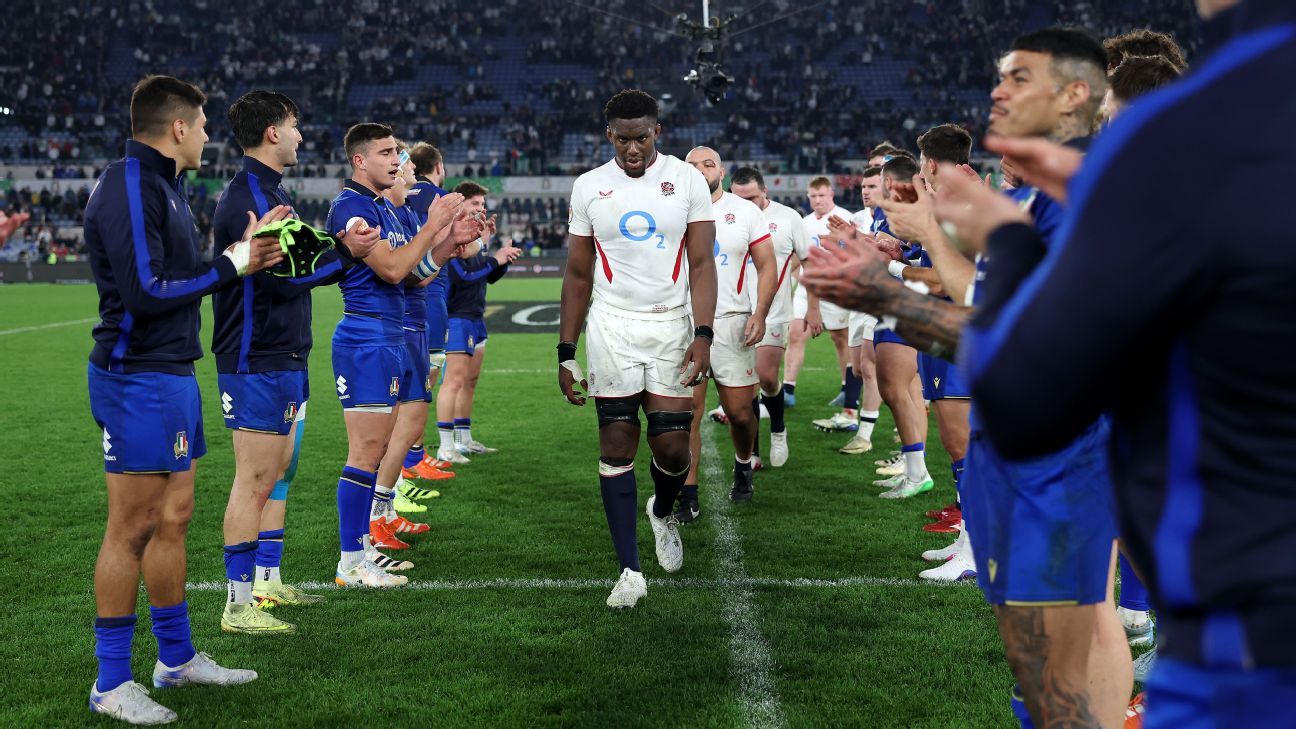
The expression of confidence was delivered at 11am on Sunday. The England players were likely still recovering from the physical and emotional toll of their disappointing loss to Italy.
As they got ready to depart from Rome to their training base in Verona, RFU CEO Bill Sweeney released his statement.
In essence, despite the England men’s team experiencing three consecutive defeats in the Six Nations, he continues to support head coach Steve Borthwick. This backing is expected to last at least until the conclusion of the Nations Championship, effectively granting Borthwick four matches to rectify the situation, beginning with France on Saturday in Paris.
This Six Nations was anticipated to be one where England entered the final weekend in pursuit of a Grand Slam. They started the championship with 11 consecutive victories, appearing to have forgotten how to lose. However, circumstances have deteriorated, leading to confusion over how England has transformed into a team that seems low on confidence and lacking clarity on the field.
Six Nations 2026: Schedule, results, table, squads, news, TV info, more
Six Nations: England player ratings after first ever loss to Italy
What has gone wrong?
Essentially, everything except the scrum. Following their comfortable opening round victory against Wales, it seemed as though a slightly out-of-sorts England was beginning to find their rhythm. At that time, Scotland had just suffered a loss in Italy, putting Gregor Townsend’s position in jeopardy. Then came the heavy defeat at Murrayfield, where England’s discipline faltered with Henry Arundell receiving a red card, allowing Scotland to capitalize and hand Borthwick’s side a 31-20 loss. They fell into uncharacteristic mistakes and appeared to struggle with the emotional intensity presented by their opponents. Scotland exploited the flanks, took advantage of the space, and dismantled a disorganized English defense.
However, there was a glimmer of hope: Ireland was set to visit Twickenham, and they had shown vulnerability in their defeat to France and a shaky win over Italy. Yet, Ireland dominated England. England’s lineout collapsed, their defensive wide channels were weak, and Ireland capitalized on these issues. Discipline again proved problematic, with England receiving two yellow cards, and Ireland achieved their largest victory ever at Twickenham, winning 42-21.
With Italy next on the schedule, a team England had never lost to in 32 encounters, Borthwick implemented nine changes, discarding previous plans and informing his team that they had not met his expectations. New combinations were introduced across the field. Borthwick had consistently emphasized the need for a team to maintain emotional composure: to remain calm and humble during successful times and to trust the process when results are unfavorable. However, this was a significant overhaul. For the first 60 minutes in Rome, England managed to establish an 18-10 lead with a conservative game plan: kicking off 9 and nudging behind. Yet again, their discipline faltered with two yellow cards disrupting any momentum, allowing Italy an opportunity for history, which they seized.
England has recorded 12 wins from 15 matches, which is not a poor outcome, but the three consecutive defeats raise concerns. The team appears disorganized and fragmented. England’s disciplinary record is the worst in this year’s Six Nations (7 yellows, 1 red). Their attacking efforts are faltering. According to Opta, they have made the second-most entries into the attacking 22 this tournament (48), but have the second-worst points per entry rate (2). Conversely, they have conceded the fewest entries into their 22 (29) but allowed the most points per entry (3.2). They have also made the fewest turnovers in the championship with 22, 13 fewer than the leaders, Ireland.
Back in November, England effectively utilized their “pom squad” — a series of second-half substitutions that maintained tempo and momentum, including several British & Irish Lions. Injuries to Fin Baxter, Will Stuart, Asher Opoku-Fordjour, and Immanuel Feyi-Waboso have diminished the bench’s impact, and the same tempo-shifting influence has not been observed this championship. Against Ireland, Borthwick made two tactical adjustments in the first half to address their collapsed lineout and inability to launch attacks from deep. In Rome, the substitutions came later than ever, perhaps indicating he has less confidence in his bench compared to November.
Some players appear emotionally and physically drained. A source informed ESPN that the team is experiencing “paralysis from analysis.” Another mentioned that the professional partnership between the RFU and Prem Rugby, which grants England influence over the skills and conditioning of a select group of key players, is evidently not functioning, as the players are “out on their feet.” A different source remarked that the team “looks tired” and there is “poor team leadership.” Regardless of whom you ask, various theories exist regarding the downturn. However, the overall sentiment is one of confusion and concern.
What are the England players saying?
Following the defeat over the weekend, Itoje stated, “We must take responsibility for our current situation. However, Steve is undoubtedly the right person for the job, and the rest of the coaching staff has been exceptional. It is our responsibility as players to improve. We are the ones on the pitch. He cannot play the game for us.”
“As captain and along with the other senior players, I believe we must take responsibility. The solutions lie within that group, among the players and coaches. Therefore, as a collective of senior players, we need to perform better. No one should be satisfied with losing three games. We certainly are not.”
Ben Earl provided a somewhat perplexing perspective to reporters, saying, “There’s a sense of pride because I genuinely thought we performed quite well. If that match had concluded at 60 minutes, you would say it was an outstanding performance by England. Honestly, I am very optimistic about this team; we just need to win some rugby matches, and we will.”
Earl has been one of the few bright spots for England in this campaign, achieving his 50th cap against Italy on Saturday. However, when asked about concerns regarding fans losing patience, he replied, “Because what, we’ve lost three in a row? England rugby should never lose a match, apparently.”
The team is unequivocally behind Borthwick. “Steve provides us with a game plan in which I have complete, unwavering confidence that we will win every match, which has not always been the case with every coach I’ve played under,” Earl stated. “The game plan has succeeded in 12 out of the last 15 instances, so the criticism is excessive. It’s absurd. It’s absurd because if anyone is letting Steve down, it’s us.”
Itoje reiterated, “Steve is undoubtedly the right person for the role,” he said. “He’s an excellent coach. He has led us to 12 victories, including significant performances against the All Blacks and major wins. So, clearly, this is not where we want to be at the moment, and there’s no denying that.”
What is the perspective from former professionals?
The opinions vary from Austin Healey, who is advocating for Borthwick’s departure, to Dan Cole, who expresses confidence in Borthwick’s leadership. There is widespread commendation for Italy, but differing explanations for England’s decline.
“Questions must be raised regarding England’s strategy and methodology — about how they envision the game should be played at this level,” Matt Dawson commented on BBC 5 Live. “Given the way England is performing, they will not win international matches.”
Ben Youngs and Cole had differing views on whether there is cause for alarm during their For the Love of Rugby podcast. “With the current setup involving central contracts, resources, players, and coaches, this should not be occurring,” Youngs stated. “I simply do not agree that this should be happening.”
“England appeared to be a team designed to avoid losing rather than to pursue victory. And we are going to approach a game against Italy with that mindset? The entire setup is flawed. That’s not the mentality. I never enter a match thinking that. It’s madness. And I believe if we accept this as acceptable, that’s not right.”
Cole countered: “He’s one of the few coaches I’ve worked with who truly thinks. He has a plan in place, and while it may sometimes seem unemotional, he has a method for preparing, structuring, and performing that clarifies my role on the field. Everything in the environment is focused on winning; nothing is done for show.”
Their former Leicester teammate Healey remarked on TNT: “The statistics are not favorable for Steve Borthwick, and the level of support he has received is exceptional. I believe it’s time for a change. I think it’s time for Steve to step down because I observed that side, and there appears to be a lack of trust between the players and the coaching staff. There doesn’t seem to be a recognizable style of play. They do not go out and attack; there is no pace.”
Is Borthwick’s position at risk?
Not in the short term, no. The RFU statement released on Sunday indicated that the governing body remains “fully committed to supporting” the coaches and players ahead of the match against France and throughout the Nations Championship. Therefore, with France, South Africa, Fiji, and Argentina on the horizon, Borthwick effectively has a four-match window to turn things around. This is a challenging task.
Between the match against South Africa on July 4 in Johannesburg, Fiji in Liverpool a week later, and Argentina in Santiago del Estero, that amounts to 25,000 miles of travel — a three-week journey starting with an opening match at altitude against the reigning double World Cup champions.
In his statement, Sweeney mentioned that they will collectively strive to gain clarity on why this championship has not unfolded as planned and “[they] will collaborate to understand and address why we have been unable to meet the expectations and anticipation leading into these matches.” He has urged England to “grow through adversity.” Thus, this is the challenge for Borthwick and his squad.
Are there grounds for optimism?
Rugby is cyclical, and England will rebound, but this is a concerning period. They significantly miss the front-row reinforcements of Stuart, Baxter, and Opoku-Fordjour, although their standout player this championship has been tight-head Joe Heyes.
Feyi-Waboso’s return will provide fresh energy on the wing, but it seems Borthwick needs to identify his best team and remain consistent. Seb Atkinson appears to be the right choice at No.12, even though he faced challenges on Saturday in syncing with Fin Smith. The fullback position remains problematic, but with George Furbank nearing full fitness, he is likely to become the first choice at No.15. Henry Pollock is gaining valuable Test experience in the back row, while England also has George Martin returning from injury to add significant strength to the locks. A combination of Martin, Itoje, and Ollie Chessum across 4, 5, and 6 is not to be underestimated.
It was not long ago that England’s supporters were hopeful. Borthwick is deeply committed to this team, and while he may not always be favored by the public, no one will work harder than him to rectify this challenging period. However, he requires results, and quickly.
Will this be England’s worst ever Six Nations?
It is difficult to argue otherwise. England has never experienced four defeats in a single championship, and following their lackluster trio of performances, it is hard to envision how they will secure a victory in Paris on Saturday to regain their footing.
France suffered a heavy defeat in that 90-point match at Murrayfield but is still in pursuit of the Six Nations title. England must rise from their current struggles if they are to deliver a significant blow. Some players appear mentally fatigued and require a break, but there is no opportunity for rest in this championship. Somehow, they need to rediscover the mindset that led them to 12 consecutive victories, but they seem to be lacking in confidence, precision, and creativity.
