
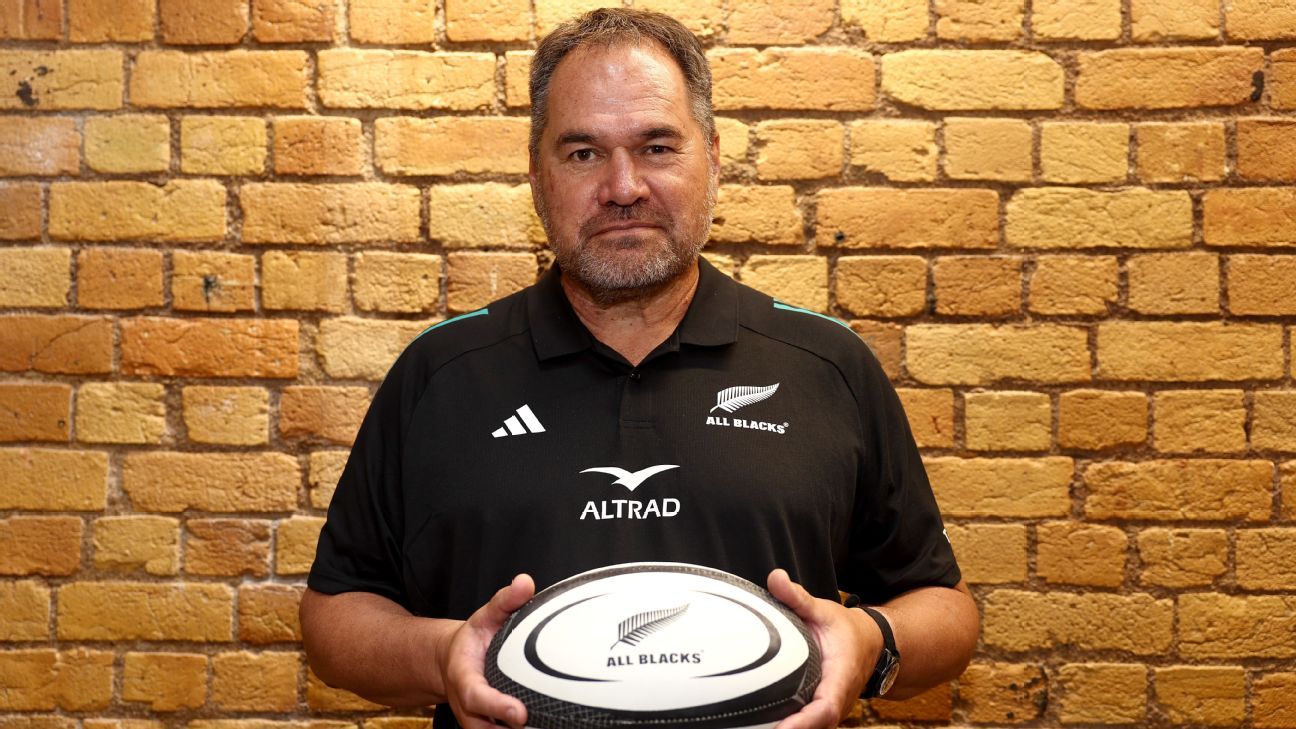
Dave Rennie is making a comeback to Test rugby.
After being dismissed as Wallabies coach three-and-a-half years ago, Rennie has been appointed as the head coach of the All Blacks, as announced on Wednesday, succeeding Scott Robertson.
Rennie was chosen over Highlanders coach Jamie Joseph, who has now missed out on this prestigious position in world rugby for the second time.
The 62-year-old Rennie will also make history as the first individual to coach both the All Blacks and Wallabies.
Continue reading as we address some key questions regarding Rennie’s appointment, following his media appearance alongside NZR chairman David Kirk in Auckland.
WHEN WILL DAVE RENNIE BEGIN HIS ALL BLACKS TENURE?
Rennie is currently in the midst of the Japanese League One season with Kobe, who are currently positioned behind Kubota with nine victories from 11 matches. The regular season of League One will continue until the weekend of May 9/10, followed by a three-week finals series.
If Rennie’s Kobe team advances to the final, his last match in charge would occur on the weekend of June 6/7, coinciding with the quarterfinals of Super Rugby Pacific. This scenario allows Rennie the possibility to return to New Zealand to observe the country’s semifinalists, regardless of how many there are, in action, leading up to the Super Rugby final a week later.
New Zealand Rugby typically announces its squad for the mid-year Tests shortly after the Super Rugby final, which is scheduled for June 20, followed by a training camp.
This timeline will provide Rennie with two weeks to prepare his squad for their opening Nations Championship match against France, with subsequent Tests against Italy and Ireland. After the Nations Championship concludes, the All Blacks will face the Springboks in four Tests as part of the “Rugby’s Greatest Rivalry” series.
HOW MUCH SHOULD WE READ INTO RENNIE’S FAILED WALLABIES STINT?
Rennie led the Wallabies from 2020 to 2023, starting his tenure during the challenging period of the COVID-19 pandemic, which involved enforced isolation and training bubbles.
Facing the All Blacks in four consecutive Tests was always going to be a formidable challenge, but Rennie’s Wallabies nearly secured a victory in their first encounter, with only a coat of Dulux preventing Reece Hodge’s match-winning penalty, followed by a thrilling Wellington Bledisloe that ended in a 16-all draw after six-and-a-half minutes of injury time.
Rennie’s Wallabies were subsequently defeated in the second and third Tests but managed to break a 10-Test losing streak against the All Blacks in the fourth match in Brisbane. Two years later in Melbourne, the Wallabies were denied another win over New Zealand when French referee Mathieu Raynal made his controversial “we play” call and penalized Bernard Foley for time-wasting. Ultimately, Rennie concluded his tenure with a 1-7-1 record against New Zealand as Wallabies coach.
This statistic may hold little significance for All Blacks supporters, but one that may be of interest is Rennie’s 3-1 record against Rassie Erasmus’ Springboks, although it should be noted that all four of those Tests took place on Australian soil.
In the end, Rennie finished with a 38% winning record, the lowest of any Wallabies coach who has overseen 30 Tests or more.
“I’ve got no regrets. I’ve built many strong relationships there, and I learned a great deal from coaching at that level,” Rennie remarked about his time with the Wallabies. “The conclusion wasn’t ideal; I obviously didn’t have the opportunity to attend a World Cup, but I felt more for about 13 or 14 players who would have gone to a World Cup with me but didn’t get that chance either.
“So I am looking forward to the opportunity to attend one next year.”
WHAT ABOUT RENNIE’S ASSISTANTS, WHO MIGHT THEY BE?
Currently, Robertson’s All Blacks assistants remain employed by New Zealand Rugby. However, a change in head coach typically leads to some adjustments in the assistant coaching staff, so it is likely that one or more of Scott Hansen, Bryn Evans, Jason Ryan, and Tamaiti Ellison could be at risk of losing their positions. Ryan is well-regarded and would provide stability for the All Blacks if retained, having worked under both Robertson and previously Ian Foster.
Nonetheless, Rennie will likely seek to surround himself with his own “quality people,” and having coached in Scotland, Australia, and Japan after initially establishing his career in New Zealand, he has a wealth of options.
“We’ll work through that, but I have a strength in surrounding myself with quality individuals, so I’m eager to bring some people in,” Rennie stated. “However, when a head coach departs, it impacts many individuals, so I want to sit down and discuss matters with those affected before making decisions in the coming week or two.”
Reports have already emerged suggesting that current Kobe assistant and former Scotland scrum-half Mike Blair is likely to join Rennie with the All Blacks, although another member of his Kobe support staff, Wayne Smith, was announced to have left New Zealand Rugby earlier this year.
WHAT ABOUT THE PLAYERS, WHO IS THIS GOING TO AFFECT?
It is clear that one of Rennie’s initial tasks will be to implement a cultural shift within the All Blacks, as this was a significant factor in Robertson’s dismissal earlier this year.
According to various media reports, All Blacks players felt they did not receive the feedback they desired from Robertson and were not supportive of a setup that had assistant Scott Hansen managing much of the daily training.
Several Wallabies coached by Rennie have informed ESPN that communication is one of Rennie’s key strengths; he is generous with praise when warranted but also knows how to convey difficult messages when necessary.
Ultimately, similar to his assistants, Rennie will select players he believes will not only align with his playing style but also contribute positively to the culture.
It will also be a fresh start.
“Whether I was returning for this role or not, I would watch a lot of Super Rugby, and I keep an eye on developments in the U.K.; obviously, we have a competition that we participate in [League One], so I watch a fair amount of rugby,” Rennie explained.
“Therefore, I am not worried about understanding where players stand. However, I will observe closely and utilize some analysis as well, and I will spend time here during bye weeks. We will assemble support staff to facilitate planning around our game model and establish a few things so that players will be ready by the time they arrive.
“But one advantage is that players will need to earn the right to wear the jersey. I have no loyalties; I do not come from a team where I have had many players previously, so I find that really exciting. We will select based on form.”
COULD THERE BE A CHANGE OF ALL BLACKS CAPTAIN?
This is certainly a possibility, but Rennie suggested that determining the All Blacks captaincy would not be among his immediate priorities.
Given the environment managed by Robertson and the negative feedback players provided to NZR, it is possible that Rennie may choose to make changes in that area as well, potentially ending Scott Barrett’s captaincy.
“I think you need to address those matters, and I am eager to speak with players,” Rennie remarked. “I know Scott Barrett, a fantastic player and the current captain, and I will be keen to discuss the situation with him moving forward.”
If Rennie decides a change in leadership is necessary, it may be Ardie Savea who assumes the All Blacks captaincy. Savea is reported to have been one of the most vocal critics of Robertson’s tenure, a claim denied by NZR chairman David Kirk, but it is clear that the star flanker will welcome Rennie’s appointment.
Savea has previously served as All Blacks captain when both Sam Cane and Barrett were injured and is currently working alongside Rennie in Japan.
“I’m not going to disclose what conversation we’ve had, but he’s a proud All Black,” Rennie said regarding Savea. “He’s in Kobe at the moment, focusing on his fitness, and he’s performing well for us. I know he is genuinely excited about the future; our task is to ensure he returns mentally refreshed and in better condition than when he arrived.”
COULD ANY ALL BLACKS RETURN FROM OVERSEAS WITH THE CHANGE OF COACH?
New Zealand’s policy remains that only players contracted to New Zealand Rugby are eligible for Test selection, with Richie Mo’unga already set to return from Japan later this year. Whether Rennie can persuade NZR to allow Mo’unga to be available for the match against the Springboks is uncertain, but at this point, the No. 10’s first opportunity will arise against the Wallabies in October.
Additionally, there is Brodie Retallick, another member of Rennie’s current Kobe team, who recently expressed uncertainty about whether his 34-year-old body could withstand the demands of Test rugby again.
“I’ll comment on Brodie Retallick; I see him train and play every week,” Rennie stated when asked about New Zealanders playing overseas. “He’s stronger than ever, fitter than ever; he’s currently the top try-scorer in Japan with 11.”
When asked if he could entice him back, Rennie replied: “I’m not sure if I’m allowed to yet, but there’s no doubt that if you want to win a World Cup, ideally, you have your best players available. And obviously, Richie’s coming back, which will be beneficial; he’s been in excellent form in Japan.
“Certainly, if someone like Brodie Retallick were to join the environment, I believe it would greatly benefit the entire group. He has done an exceptional job in terms of leadership at Kobe.”
