
Verstappen expresses contentment during his Nürburgring excursion.
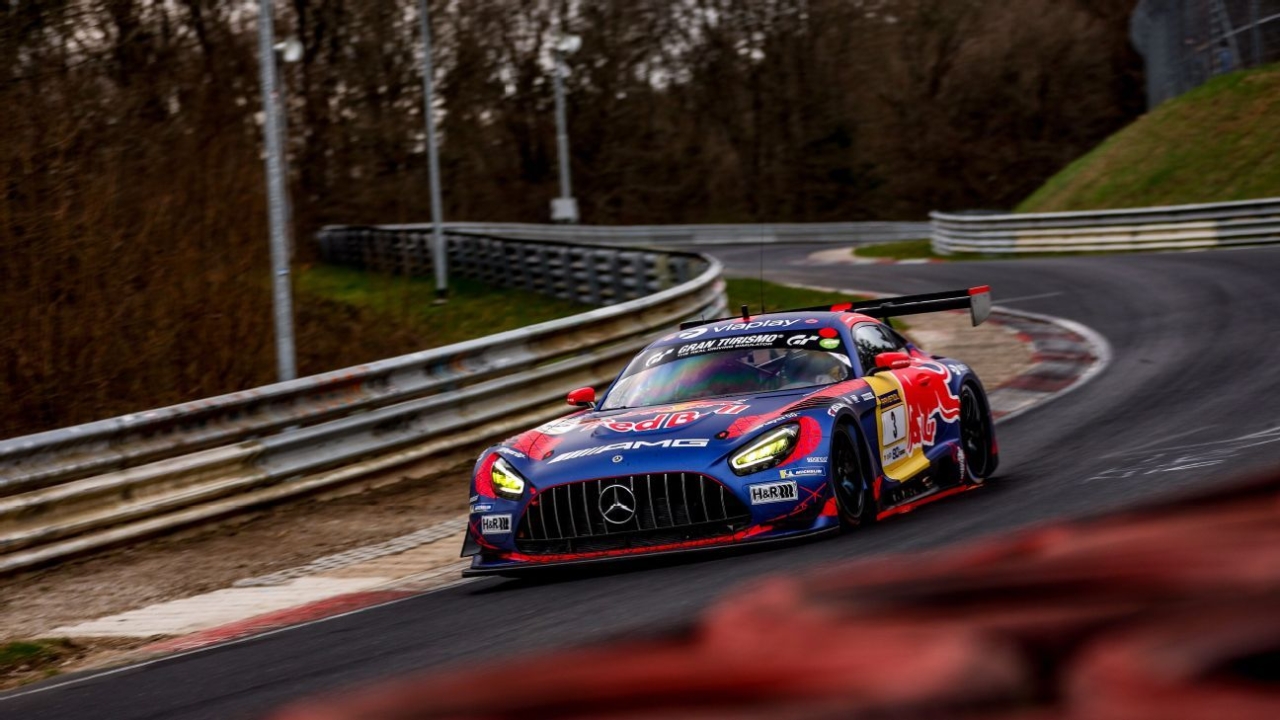
At the start of last month’s NLS2 race at the Nürburgring, Max Verstappen recognized he was in for a challenge. A light blue Audi R8 was visible in his rearview mirrors, its yellow-tinted headlights serving as a constant reminder that the four-time Formula 1 world champion would face a tough battle on this lap and throughout the race as he focused on preparing for this year’s Nürburgring 24 Hours.
Christopher Haase, a seasoned GT driver with over 15 years of experience at the Nürburgring, was behind the wheel of the Audi, eagerly embracing the chance to compete head-to-head with one of the sport’s top talents.
Haase had qualified 1.974 seconds behind Verstappen’s pole-position time earlier that morning, but as the two cars accelerated onto the 1.3-mile Döttinger Höhe straight, the more aerodynamic Audi gained a better exit from the previous corner and overtook Verstappen’s Mercedes-AMG GT3 to seize the lead.
The ensuing six laps showcased why F1’s leading driver has chosen to spend many of his free weekends at the Nürburgring recently.
Verstappen’s Mercedes remained closely behind Haase’s Audi for most of the first stint, at times coming within mere centimeters as he sought an opportunity to reclaim the position.
A single miscalculation could have led to severe consequences, but the combination of Verstappen’s skill and Haase’s vast experience ensured the contest remained clean, with millions of fans watching every turn through an onboard YouTube feed from the No. 3 Mercedes.
Just a week earlier, Verstappen had been fulfilling his role as a Red Bull Formula 1 driver at the Chinese Grand Prix. His race concluded after 45 of the 56 scheduled laps, and when he addressed the media following his retirement, his dissatisfaction with the new regulations in the premier category and the racing style they foster was evident.
“If someone enjoys this, then you really don’t understand what racing is about,” he expressed regarding F1’s new battery-assisted overtakes. “It’s not enjoyable at all. It’s like playing Mario Kart. This is not racing.”
Fast-forward to the Nürburgring, and as he pushed his Mercedes to its limits through the sweeping curves and blind crests of the iconic Nordschleife, those frustrations were far from his mind. Instead, he concentrated almost entirely on the rear of Haase’s Audi, looking for a way to get back ahead before pitting at the end of his first seven-lap stint.
“It just reminds me of what true motorsport feels like,” Verstappen told ESPN in the Suzuka paddock a week later while reflecting on his recent Nürburgring experience. “I get out of the car feeling happy, and that’s what I’m aiming for, rather than stepping out and feeling a bit disappointed.”
In a similar fashion to how Haase had positioned himself behind Verstappen’s Mercedes on the Döttinger Höhe straight on lap 1, Verstappen did the same on lap 7 when Haase was impeded by slower traffic. Utilizing side drafting to counteract his Mercedes’ straight-line speed disadvantage, the visuals were striking as the two cars, separated by mere inches, exchanged the lead three times by affecting each other’s airflow along the straight.
With the superior line as they approached the next braking zone, Verstappen ultimately made the move stick through Tiergarten, just before the historic Nordschleife circuit rejoined the modern Grand Prix layout, and both cars entered the pits for their first driver changes in the four-hour race.
“The Audi had a bit more speed on the straight, so it was quite challenging to pass him throughout the lap,” Verstappen recalled. “We were very close. At one point, I thought my front splitter was under his diffuser!
“Then, of course, he got held up a bit in that final kink [before Döttinger Höhe], which gave me a bit of a run, but even then, you could see I had to fully side draft to make a move where he had completely cleared me on the first lap. In the end, it worked out well. Sometimes you need a bit of luck to pass, or you might get passed due to bad luck.”
A week later, after Verstappen Racing was disqualified from ultimate victory due to a tire-usage infraction, the four-time F1 champion’s enthusiasm for the race remained apparent as he recounted the events.
This enthusiasm sharply contrasted with his remarks at the conclusion of the Japanese Grand Prix weekend, where Verstappen, after finishing a distant eighth in his Red Bull, once again expressed his frustrations regarding the current state of F1 and acknowledged he was contemplating a future outside the series at the end of the year.
In this context, his eagerness to compete in the Nürburgring 24 Hours has been seen as a remedy or even a substitute for the driving enjoyment he currently lacks in F1. However, Verstappen asserts that his aspiration to participate in the event, which holds legendary significance among motorsport enthusiasts, predates any of his current frustrations with F1.
“I’ve been following it for a long time,” he explained when asked about the source of his desire to race in the 24 Hours. “Initially in F1, I was focused on achieving success and winning. That was definitely my primary goal. But now I can engage in a bit more around it. This was actually the first real opportunity to do it.”
Verstappen will compete in a Red Bull-liveried Mercedes-AMG GT3, operated by the experienced Winward Racing team but entered under the name Verstappen Racing. He will share the vehicle with teammates Dani Juncadella, Jules Gounon, and Lucas Auer, each taking their turn behind the wheel in carefully planned stints throughout the 24 hours.
Last month’s NLS2 race was the latest step in Verstappen’s preparation for the main event, where he shared the car over four hours with Juncadella and Gounon. The cancellation of the Saudi Arabian Grand Prix will enable Verstappen to rejoin his teammates this weekend for two additional four-hour races on the Nordschleife — referred to as the “Qualifiers” — which serve as a rehearsal for the 24 Hours on May 16 and 17.
Despite the series of preparatory races this year, Verstappen’s journey toward the 24 Hours began approximately a year ago when Red Bull had a slow start to the 2025 F1 season.
As has been the case this year, his frustrations with the situation occasionally surfaced in post-race comments, and to address this, Red Bull agreed to Verstappen’s request to race at the Nürburgring alongside his F1 commitments.
“They recognized how passionate I am about it,” Verstappen said regarding obtaining permission from Red Bull. “So, it wasn’t difficult to persuade them, no.”
Then-Red Bull Racing advisor Helmut Marko later disclosed he supported Verstappen’s pursuit of his Nürburgring ambitions precisely because his star driver had “lost a little bit of interest” in F1.
By the end of the season, in which Red Bull’s performance rebounded and Verstappen finished just two points shy of a fifth world title, Marko felt justified and stated that the net benefit of Verstappen’s Nürburgring outings had resulted in a happier Max and potentially a 0.2 seconds improvement in lap time in his battle with the McLaren drivers for the world title.
His first lap of the Nordschleife occurred during a free weekend in May 2025, when he participated in a test session under the alias Franz Hermann. The pseudonym was chosen to prevent the test from becoming a media spectacle while sounding “as German as possible.”
Remarkably, when “Hermann” took to the track in a Ferrari 296 GT3 car, it marked the first time Verstappen had navigated the real-world 15.183-mile layout in any vehicle. A dedicated sim racer, he had completed “thousands” of laps in the virtual realm, and it was that simulator experience that allowed him to acclimate remarkably quickly.
“I knew where I had to go,” he said regarding the transition from virtual reality to the most challenging racetrack on earth. “The only thing was that I needed to grasp a few bumps, the grip levels of various surfaces. A few curbs had changed, but overall it was super accurate [on the sim].
“It wasn’t like I went out and found it super intimidating or anything. It was actually fine. It also helps when the car is well-balanced, and you quickly gain more confidence.”
Although the times from his initial test were not disclosed, Verstappen later confirmed he surpassed the official lap record for an NLS-spec car that same day. Considering that some drivers spend a lifetime attempting to master the circuit’s 160-plus corners, Verstappen’s ability to reach competitive speeds was extraordinary.
 play1:47Saunders: Verstappen retiring would be awful for Formula 1
Nate Saunders reacts to reports suggesting Max Verstappen is considering his future in F1.
However, no amount of simulator experience can replicate the risks associated with racing on the Nordschleife. The circuit is one of the few globally that has a Wikipedia page detailing the number of fatalities recorded during official competitions and test days, and it has also claimed the lives of overly enthusiastic amateurs on numerous occasions.
Despite ongoing efforts by the circuit’s owners, the nature of the track means that safety can only be enhanced to a certain extent, with the racing line in several high-speed sections situated just a few meters from the steel guardrails lining the track.
“I’m aware that I could have a serious crash there, but I’m not afraid — I actually enjoy it,” Verstappen stated. “I truly love driving there; it brings a smile to my face.
“Every time I exit the car, I’m happy. That’s also what I’m pursuing, to be honest, to have fun. I recognize it’s a dangerous track, but I’m willing to accept that risk.”
Jackie Stewart, a three-time F1 champion and three-time winner at the Nürburgring, dubbed the circuit “Green Hell” due to the dangers drivers faced in the 1960s and 1970s. Reflecting on the version of the circuit he knew, Stewart once remarked, “anybody who claims they liked the original circuit is either lying or didn’t go fast enough.”
Yet, while the modern iteration still embodies the mythology of the circuit’s grand prix years, Verstappen asserts that the reality of driving the track has evolved.
“I agree from an F1 perspective, especially in the ’60s and ’70s, but the track has changed significantly, I would say, compared to then. So, it’s a bit different,” he noted. “Now, I think it’s fine. Yes, you can crash anywhere. It’s dangerous on many different circuits … I mean, [Suzuka] is dangerous as well. It just depends on your perspective.”
F1 ceased racing at the Nordschleife for safety reasons after Niki Lauda nearly lost his life in a fiery accident at the Bergwerk section of the circuit in 1976. Despite F1’s absence, sports car racing continued at the track — Mercedes team principal Toto Wolff was among those brave enough to race there and attempt an ill-fated lap record in 2009 — with the annual 24-hour race becoming the circuit’s marquee event in recent decades.
The modern GT3 cars competing in the fastest class at the Nürburgring 24 Hours (known as SP9) are also considerably safer than the F1 cars of the 1960s and ’70s. They are, of course, significantly slower than contemporary F1 cars, but Verstappen asserts that the reduced speed does not diminish the challenge.
“Anything you drive at the limit is always challenging, I believe,” he remarked. “It doesn’t matter if it’s a GT car, F1 car, or anything in between or below. I mean, I drove the GT4 car tuned down for my license, but I still pushed that to the limit, so it remains tricky.”
Despite his attention-grabbing lap times during his recent outings, Verstappen claims he still has more performance in reserve for next month’s 24 Hours — provided he can secure a clean lap.
“Everyone has something left [for the 24 Hours], for sure,” he stated. “But it depends on the traffic around the lap, right? So it’s always quite challenging to assess, you know, if someone achieved the perfect lap … well, the perfect lap, anyway, doesn’t exist there.”
This raises the question of whether the challenge of achieving a perfect lap is another aspect of the circuit’s allure for Verstappen.
“Yeah, but you also know that it won’t happen,” he replied. “I mean, I’ve completed thousands of laps on the simulator, and you never hit the perfect lap.
“You come close sometimes, but there’s always one or two corners where you’re like, ‘I really lost a tenth,’ or ‘I just made a mistake.’ It’s impossible to nail every single corner there.”
Verstappen’s lap times thus far have positioned him as immediately competitive against highly experienced rivals. Although race lap times are often influenced by traffic, yellow flags, and Code 60 zones (sections of the track where cars are restricted to 60km/h to allow marshals onto the track), Verstappen’s best race lap at NLS2 was 5.4 seconds faster than the quickest time set by teammate Gounon and 13.8 seconds ahead of Juncadella’s best.
Similarly, despite contending with Haase in the opening stint, his average lap times were over five seconds quicker than the third-fastest SP9 driver, Augusto Farfus.
However, while Verstappen and his teammates clearly possess the performance to aim for victory in the 24 Hours, he does not underestimate the caliber of his competition or the challenges of the event.
“The level is high, it’s extremely high,” he noted. “Of course, some people may not recognize some of the drivers because they’re not as familiar with GT racing, but there are many really skilled, even older — very experienced — drivers.”
It is the level of experience that Verstappen admits he still needs to develop. The Eifel mountains, where the circuit is located, are known for unpredictable weather, with fog, heavy rain, and even snow among the possible conditions that could arise at any time, day or night. So far, Verstappen has only driven the circuit in daylight and has been fortunate enough to experience dry conditions each time.
“I need a bit more experience overall,” Verstappen stated when asked what he still needs to improve ahead of the 24 Hours. “I would like to perhaps drive towards the night or close to it. Just to get a sense of it. I’m not concerned about it. I just want to do it. The only chance for that, I think, is in one of the qualifier races.
“So, I need to look into that. The rest is all about procedures with the team, ensuring we are all well-coordinated. And then just fine-tuning the setup even further.
“Also, at the Nordschleife, the weather can vary from one part of the track to another. Such things can happen there.”
However, to focus solely on Verstappen’s finishing position at the 24 Hours would overlook the bigger picture. With long-term aspirations for Verstappen Racing, it is evident that the 29-year-old is passionate about GT racing, and there is something about the paddock, atmosphere, and challenge of racing at the Nürburgring that is genuinely unique.
“It’s a bit more traditional,” he remarked. “It’s still wonderful to see the dedicated fans — they can practically touch the car in the paddock because they can get so close. Yes, it’s a bit different … different vibes, but I appreciate it.
“It’s a return to how I grew up in racing. There are professional teams, but you also have amateur teams, and everything just races together. They’re all there for the love of motorsport, I would say.”
As for Verstappen’s own passion for motorsport, he insists it remains as strong as ever despite his recent comments on the current state of F1. Participating in the Nürburgring 24 Hours, he asserts, is simply another way of expressing that passion.
“I don’t believe it has [changed], because it just demonstrates that my love isn’t confined to Formula 1. I love racing. I love competing,” he stated. “Just returning to a more traditional, authentic form of racing, that’s what I’m seeking. And that’s what I experience from driving at the Nordschleife.”
Source: espn.com

