
Understanding Empathy in the Results-Driven Environment of NASCAR
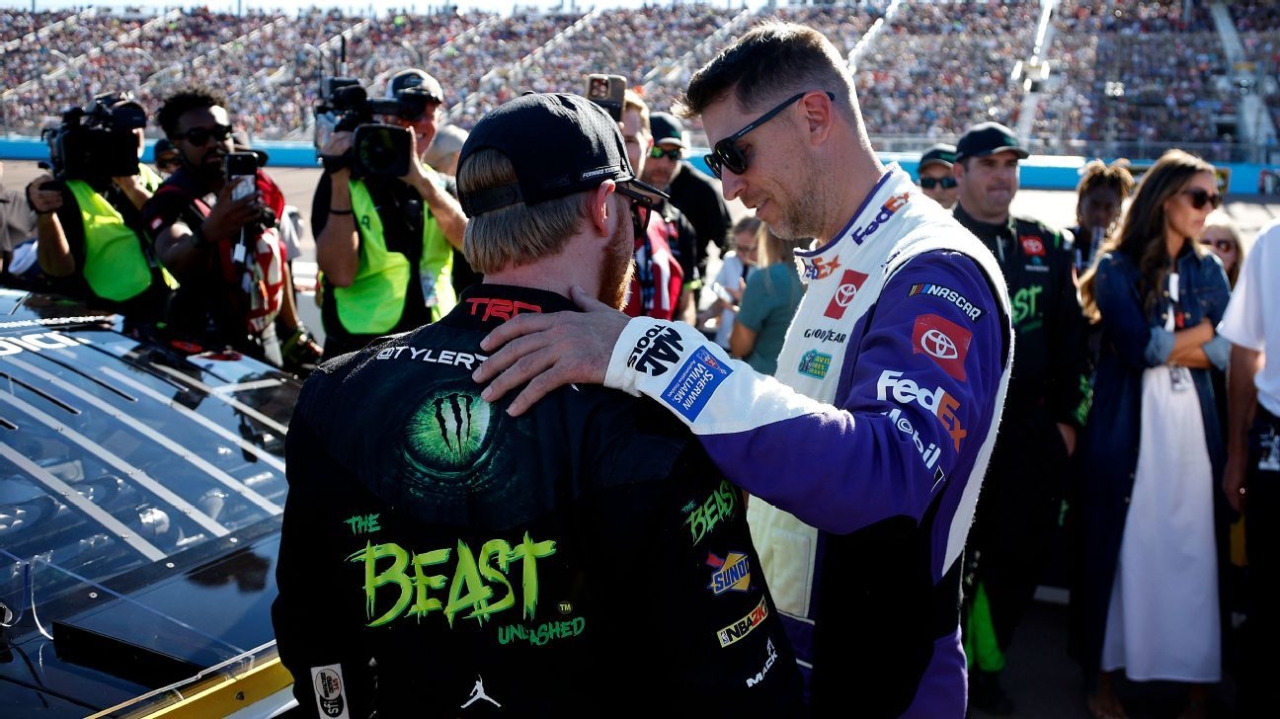
On November 2, 2025, as the sun set at Phoenix Raceway, Kyle Larson performed a burnout to celebrate his second NASCAR Cup Series championship with his Hendrick Motorsports team. He then proceeded to the frontstretch for further celebrations and interviews, at which point his emotions shifted.
“I finished up and noticed his car and team doing interviews, and it struck me like, ‘Oh, man. I can’t fathom what he’s experiencing right now,'” Larson later shared. “We’ve all faced our share of defeats, but I truly can’t comprehend what he’s going through. It must be something entirely different from any loss I’ve ever felt.”
“There’s certainly a significant part of me that feels quite bad and sorrowful, but at the same time, I’m happy. It’s such a strange sensation.”
Larson was alluding to Denny Hamlin. While Larson celebrated his championship, achieving it without leading a lap or winning the race, it was Hamlin who had been the day’s dominant force. In his 20th season, Hamlin was just three laps away from securing his first championship when a caution came out, prompting the field to pit road. Larson and his Hendrick Motorsports team outmaneuvered Hamlin and Joe Gibbs Racing with a superior tire strategy.
This unexpected turn of events left Larson juggling his celebratory feelings with his concern for his friend.
On one hand, this situation is understandable. On the other, it creates a complex dynamic when the individuals involved are professional athletes whose careers depend on their achievements.
It is an intensely competitive, results-driven environment.
“We’re definitely all self-serving, but I really felt for Denny Hamlin last year during the championship,” Zane Smith remarked. “Man, that’s tough, and he’s had a long career filled with success and numerous wins, and was in contention for one. It was literally [a few laps] to go with a significant enough lead to clinch his first championship, along with everything else happening in his life.”
“Man, I felt that one for him, but that’s racing.”
Hamlin was frequently referenced when discussing whether drivers can empathize with their fellow competitors. The garage veteran had come close to winning the Cup Series title in previous years, but nothing compared to the situation at Phoenix. Another factor was that Hamlin’s father, Dennis, was in poor health, and the driver recognized it was his last opportunity to win a championship that his father could witness.
Thus, if there is a discussion about drivers genuinely feeling compassion for one another, Hamlin sets a new standard.
It is not unusual for a race to be determined by an untimely caution or a poor pit stop, or even being involved in a crash not of one’s own making, and drivers often empathize with their peers whose potential victories have slipped away. Because sometimes circumstances arise; it’s never over until it is.
“I finished the race and thought, ‘Oh, he lost. Wow,'” Ross Chastain said regarding Hamlin. “I never expected to feel sympathy for that guy.”
Brad Keselowski, who has been in the Cup Series since 2009 and has experienced the full spectrum of racing’s highs and lows, “absolutely” finds himself feeling for others and believes this perspective has developed over time and experience.
“I’ve had races where I’ve felt for those who did everything right but it didn’t pan out,” he stated. “We’ll be racing and see someone performing exceptionally, and then it all unravels for them. You’re like, ‘Ugh. Man, I hope that’s not me.’ Particularly, the longer you participate and the more setbacks you encounter, the greater empathy you develop for others.”
However, not everyone shares this sentiment.
“I don’t feel bad for these guys,” Chastain stated, making an exception for Hamlin. “I feel happy for some of them. … I get excited for others. I don’t really feel bad for them.”
“I’m a professional loser. I’ve lost more races before I won — definitely before I secured my first victory in each series — than most of these drivers. Yeah, I don’t feel bad for them when they lose because I’ve been there, done that. Most of them have not faced as many losses before their victories, and I don’t believe many of them would have persisted as long as I did.”
Ricky Stenhouse Jr. acknowledged he was delighted for his friend Larson last fall, but he is also friends with Hamlin and felt for his loss. This was an exception to Stenhouse’s firm stance of, “I never really feel bad for anybody.” He believes that other drivers would likely express similar views.
NASCAR is a sport deeply rooted in community, as the same participants compete every weekend and often remain in close proximity to one another in the infield motorhome area. Although often referred to as a traveling circus, industry members, including drivers, teams, and crew members, become quite familiar with each other and, for the most part, Stenhouse noted, get along.
Nonetheless, the focus must remain on one’s own team. This is why Smith feels it is uncommon for a driver to genuinely feel sympathy for someone else.
“It’s challenging to have close friendships in this industry because we’re all competing against each other every week,” Smith explained. “But in that situation [with Hamlin] where I’m not vying for a championship, and I don’t have a teammate in contention, and you witness what transpired at the end of the race, you’re like, ‘Holy cow.’
Indeed, racing is a self-centered business. A racer’s livelihood relies on their performance. The prevailing emotion is typically influenced by one’s own successes or failures, but there are moments, rare it seems, when feeling something significant, as in Hamlin’s case, outside their own sphere can emerge.
Source: espn.com
