
Gen Z is disrupting the established hierarchy of Millennial and Gen X in IndyCar.
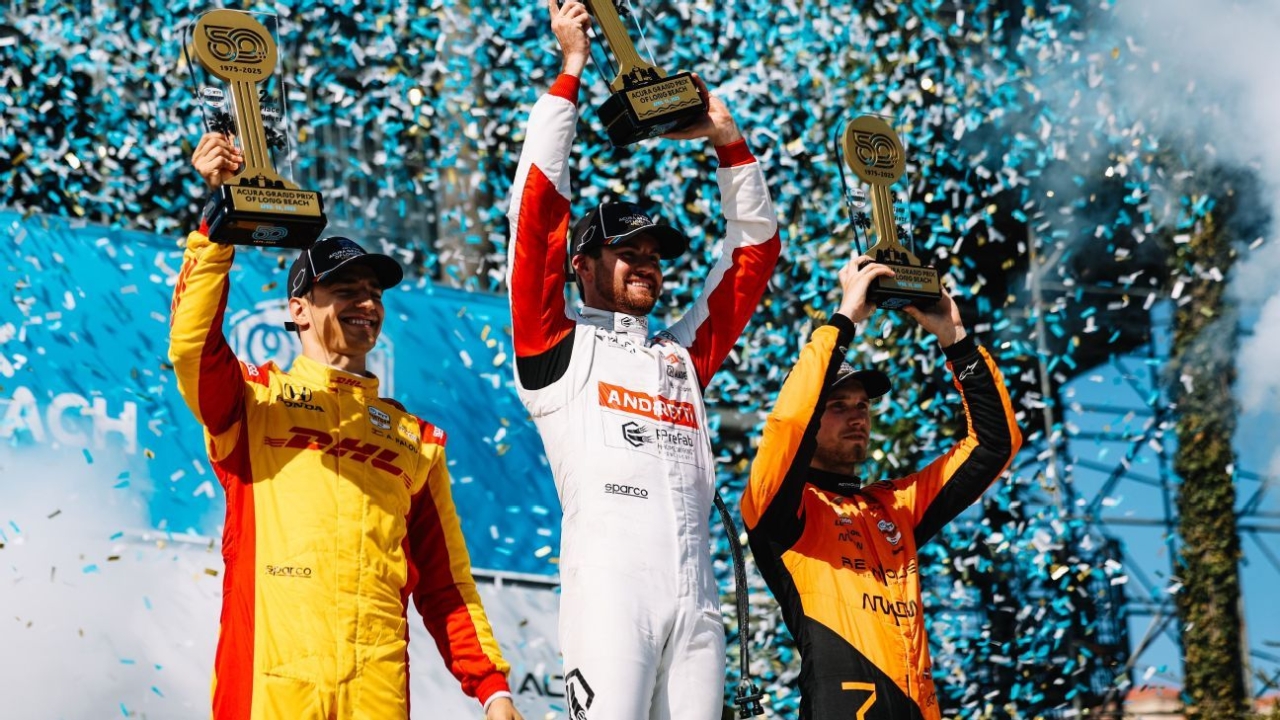
IndyCar is currently experiencing a shift towards a younger generation.
As the Grand Prix of Long Beach approaches on Sunday, a notable generational transition has emerged as the primary narrative of the early season, with the top four drivers in the championship all born between 1997 and 2001. In total, six of the top ten competitors hail from this new-century era.
Historically, in IndyCar’s century-long history, younger drivers were expected to spend considerable time with smaller teams, gaining experience and proving themselves before being considered for significant roles with larger teams. In recent years, two champions of IndyCar have been 40 or older; the prevailing belief was that seasoned drivers were better suited to handle the complexities of multi-discipline racing across road courses, street circuits, and various oval sizes, rather than relying on younger talents who might struggle.
However, this perspective has shifted with the arrival of these digital-native drivers. This change marks a significant evolution in a series where age and extensive experience were traditionally seen as advantages.
The current season has illustrated that this notion is evolving.
After four races, the championship standings reflect this change, with Kyle Kirkwood (born in 1998) leading, followed by four-time IndyCar champion Álex Palou (1997) in second, and emerging talents Christian Lundgaard (2001) in third and David Malukas (2001) in fourth. Additionally, Pato O’Ward in sixth (1999) and Marcus Armstrong in ninth (2000) contribute to the Gen Z presence, as established veterans strive to retain their competitive edge.
Kirkwood has positioned himself as the frontrunner at Andretti Global. Palou took charge of Chip Ganassi Racing at just 24 years old as a sophomore and has maintained his dominance, securing four championships in five seasons. Lundgaard and O’Ward represent both the present and future for Arrow McLaren, while Malukas, the youngest driver in the top four, has made a surprising impact as a newcomer to Team Penske.
“For sure the last two or three years, you see the difference with the younger generation coming along, and like Pato has been this guy for a long time, and even I am beginning to feel old,” Palou remarked to ESPN. “[Kirkwood] is so strong, and now Malukas is getting one of the best seats, being super young, and with an amazing future ahead. And Lundgaard has already been there the last two years, up there and fighting. I feel like you can see the trend.”
Technology has been pivotal in advancing this group to the forefront of the competition.
What we are witnessing is the simulator generation realizing their potential at an accelerated pace. This is the first cohort of drivers who have grown up with iRacing in their homes. For earlier generations, driving education was primarily limited to weekends and available test days while they awaited their next karting event to hone their skills and learn from their errors.
Thanks to simulators, IndyCar’s Gen Z talents have never faced that downtime. This group has only experienced the advantages of virtual driving—utilizing its 24-hour accessibility—to bridge the experiential gaps while waiting to return to the track. Unlike the traditional three days on and four days off, the simulator generation—similar to young athletes in other sports who are constantly developing—has the opportunity to improve daily in ways that were previously unattainable for their predecessors.
They are also the first to utilize on-board data systems, both virtual and real, as lifelong learning tools. Through computer systems linked to their karts or those replicated in simulators, they have been accumulating detailed knowledge of the cars and their engineering principles, enhancing their driving skills through data analysis since their initial laps.
When combined, these factors make Gen Z the most knowledgeable group of drivers to enter IndyCar, which explains why their top representatives can achieve front-running readiness at a significantly quicker pace than their Gen X or Millennial counterparts.
“I’ve been with technology my whole life,” Malukas shared with ESPN. “Being born into technology advancements growing up, that’s definitely where I think a lot of our successes come from, and it’s just nonstop. I can’t even remember when I wasn’t learning data, understanding how to examine it. Me and [Kirkwood], I raced with him in go karts ever since I was playing with Hot Wheels and picking my nose, and even back then, we were looking at data.
“So by the time we come to IndyCar, we’re just so familiar with everything we’ve been doing pretty much our whole lives. It’s just an everyday thing. You go on a simulator, you keep looking at data, in and out of the car, no matter what.”
The generational divide between digital- and analog-era drivers is expected to widen in the coming years as many of IndyCar’s prominent figures begin to retire. The shift towards an entirely Gen-Z IndyCar field is on the horizon, but the series’ championship leader warns that his cohort should not underestimate the challenge posed by mid-to-late-career veterans like Josef Newgarden (35), Graham Rahal (37), Will Power (44), and Scott Dixon (45) to their aspirations.
“It’s a privilege to be part of this generation,” Kirkwood stated to ESPN. “It’s weird how it comes in waves like this where it feels like there’s this change all at once, but also, there’s nothing to take away from the older guys, right? They’re still beating us up on race weekends. [Rahal] was just on the podium at the last race and Power’s already got a podium and could have won at least once. [Newgarden]’s won this year, and Dixon, we all know he can win any race he’s in.
“That’s also maybe something else we’ve never seen, right? Where so many of the older drivers—older than me, at least—are so competitive. There’s no real fading going on. Alex Rossi is another one. It’s a weird time to be alive, right? It’s like, you’re part of the next generation, but there’s two other generations going at the same time and everyone can still win. But now we’re starting to have the younger drivers show our strengths. It’s cool to see.”
Source: espn.com
