
Seattle Kraken’s ‘Try Hockey For Free’ Program Thrives as City Embraces the Sport
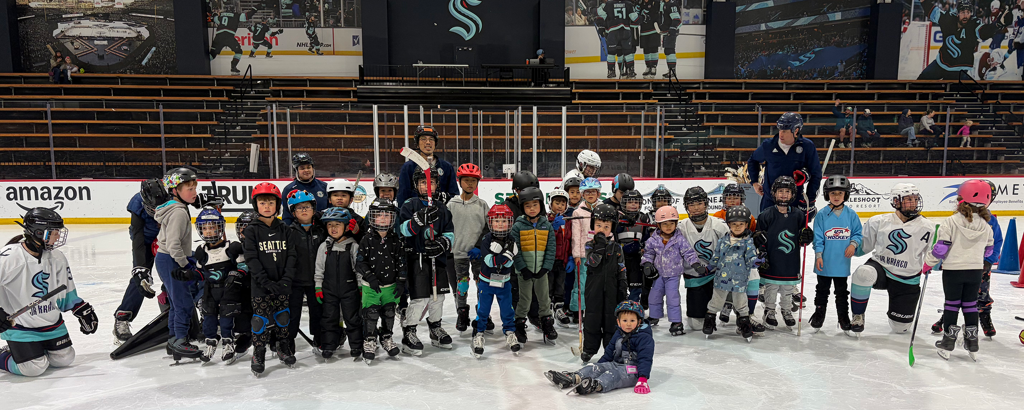
During “Try Hockey For Free” events, the Seattle Kraken prioritize providing as much equipment as possible to participants.
The reasoning is simple: the Kraken do not want children to resemble Randy from “A Christmas Story” when bundled up for the cold, with arms extended like a scarecrow and restricted movement.
This attention to detail is part of the Kraken’s approach to “Try Hockey For Free,” a program presented by Discover and USA Hockey designed to generate interest in the sport nationwide. One of the two annual sessions was held on October 3, with the next scheduled for February 27.
“It’s just easier, especially for kids 9 years old and younger,” said Martin Hlinka, the Kraken’s director of youth hockey. “When you put gear on them, it’s really hard to move around, so you feel like a snowman, and we want to eliminate that. We want to ensure they feel free to move.”
The Kraken aim to create a positive early experience with hockey. Since the NHL club’s inception in the 2021-22 season, they have hosted two sessions annually: one for mixed youth (boys and girls) and another exclusively for girls. Hlinka reported 90 sign-ups, with 60 children attending the sessions, which last approximately one hour.
Once children are properly fitted with gloves, helmets, skates, and other necessary gear, they receive a brief introduction before hitting the ice, many for the first time.
“We provide instructions on how to fall safely, how to get back up, and the freeze position, similar to ‘Learn to Skate’ lessons on balancing and lifting a leg if needed,” Hlinka explained. “We do this briefly off-ice and then repeat the instructions at center ice. For those ready to move, we hand out sticks and set up stations covering shooting, skating, and stickhandling to introduce them to all aspects of the game.”
Hlinka noted that the sessions were highly successful. Participants ranged in age from 5 to 13, with the majority being 10 years old or younger. Registration numbers were consistent across sessions, with 50 sign-ups for the combined youth group and 40 for the all-girls session.
The mixed session featured many girls, often siblings, while the girls-only program saw strong attendance.
These figures are encouraging for Seattle’s growing youth hockey scene. “Kraken fever” is contagious, and the city now hosts the Seattle Torrent of the Professional Women’s Hockey League (PWHL), which debuted last season. The sport’s booming popularity has prompted the Kraken to build a second iceplex in suburban Kirkland, set to open next fall, adding two more sheets for youth and adult programs.
“More players playing hockey means we’re growing the game,” Hlinka said, emphasizing the importance of this initiative. “My job is to grow the game not just within our association, but across the state. I believe it is the best sport to watch live. If you watch it, try it, and succeed, you are likely to stay involved. In our facility, ‘Learn to Skate’ retention is about 90%; most kids re-sign for another program and remain with our building.”
Hlinka explained that the Kraken integrate the “Learn to Skate” program with “Try Hockey For Free” to build a ladder toward successful youth development. Through these various sessions, the Kraken recruit between 100 and 150 new players into youth hockey annually. This growth is aided by the Kraken’s rapid rise as a must-see NHL team.
“The goal is to make hockey accessible and welcoming for every family. The Kraken are promoting the idea that hockey is for everyone. ‘Try Hockey For Free’ offers the opportunity to experience the sport firsthand. For those who try it, like it, and move on to ‘Learn to Skate,’ it builds a strong foundation. It is exciting to see new families take that first step and become part of our community.”
Hlinka also noted a surge in interest this spring following Team USA’s success at the Olympics and Paralympics, where they swept all three gold medals.
Regarding the children’s experience during the “Try Hockey For Free” event, Hlinka highlighted a characteristic that bodes well for the Seattle area.
“There were lots of happy faces, and many kids wanted to come back,” Hlinka said. “That is a win.”
Story from Red Line Editorial, Inc.
