
Having experienced the hockey lifestyle that Tom Younghans has, he possesses numerous tales to share. His preferred venue for storytelling is the “Black Top Bar.”
The “Black Top Bar,” as described by Younghans, refers to any location with a parking lot where one can unload a cooler and grill from their vehicle to tailgate.
At 73 years old, Younghans now considers himself a handyman, undertaking various tasks from carpentry to plumbing and electrical work for anyone in need. He also acts as a caregiver, assisting individuals with dementia.
“And then I play hockey probably two to three times a week in the Twin Cities area,” Younghans remarked.
Growing up in St. Paul, Minnesota, Younghans fulfilled the aspirations of many children from the hockey-enthusiastic state. He played at the University of Minnesota before making his way to the NHL, where he spent five seasons and parts of a sixth with the Minnesota North Stars. In 1981, he contributed to the North Stars reaching their first Stanley Cup Final, ultimately losing to the New York Islanders. Early in the 1981-82 season, his former college coach, now with the New York Rangers, traded for him. That coach was Herb Brooks.
This past weekend, Younghans donned his skates in search of another championship to accompany the NCAA title he secured in 1976 with Brooks and the Golden Gophers.
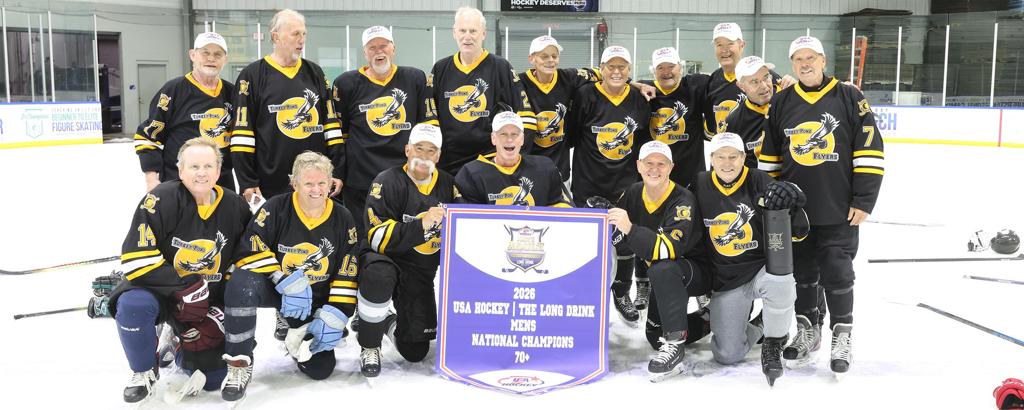
Younghans played for the Turkey Pond Flyers from Concord, New Hampshire, which took part in the 2026 USA Hockey-Long Drink Men’s Adult National Championships 70-plus division in Wesley Chapel, Florida. Competing against teams such as the Michigan Old Puckers and the Florida Elder Skatesmen, the Turkey Pond Flyers avenged a 3-1 loss in pool play to the Ironworkers with a 3-2 victory in the championship match.
Younghans has participated in this event numerous times. Most often, he played alongside another Minnesotan and former North Stars teammate Steve Jensen’s Heartland Hockey Camp. Jensen passed away in 2022, and other players either moved on or ceased playing hockey.
The Turkey Pond Flyers consist of several Heartland players and some from the Byfuglien Trucking team that Younghans played for last year.
“In the last two years, I’ve been with a couple of other teams that I’m not as familiar with,” Younghans stated. “But hockey players are easy to connect with, so it isn’t too challenging to integrate with what’s happening.”
And that is essentially how Younghans’ “Black Top Bar” originated.
After a regular game one Friday at a rink in Bloomington, Minnesota, Younghans was returning to his car when someone inquired about his destination.
“I’m heading out to the Black Top,” Younghans replied, instantly coining the term for what would evolve into a tradition wherever he plays.
The Black Top even boasts a slogan: “It’s where reality turns to fantasy.”
As one might expect, there is a great deal of lighthearted banter that occurs at the Black Top. Typically, it involves the 15 or so players from whichever team he is on, with wives and others joining in. Occasionally, the gathering expands, as it did over the weekend in Florida when another team was nearby in the parking lot enjoying a postgame gathering, leading to a merger of the two groups.
Younghans noted that hockey and softball are the perfect sports for a “Black Top Bar.” Simply hanging out is the primary draw, which is why he remains engaged with hockey.
He retired from scouting for the NHL’s Chicago Blackhawks about ten years ago but continues to be involved in the sport. He acknowledges that he is a step or two slower than some of the younger players he skates with and that his hands are “made of cement,” yet Younghans still thoroughly enjoys being on the ice.
“I love the whole atmosphere of it,” he expressed. “It’s enjoyable to play as long as you’re with the right people. I skate with some younger players. It’s quite challenging for me because I’m on the bubble when playing against someone who is 60 years old. There is a significant difference after being 10 or 13 years older. But that’s when I play at home with our Friday group or Monday group, whichever it is. It’s good hockey, but it’s the camaraderie that matters.”
He has been around many players and coaches. During his NHL career, which spanned from 1976 to 1982, he was a quintessential hard-working forward, accumulating 44 goals and 41 assists in 429 games, achieving a peak of 10-goal seasons twice. He represented the U.S. at the World Championship every year from 1976 to 1978 and at the 1981 Canada Cup.
Spending most of his final season with the Rangers was significant because it was alongside Brooks. Younghans’ journey to his first experience with Brooks was not conventional. After graduating from St. Agnes School in St. Paul, Younghans was being recruited to play Division I at Colorado College. However, Don Joseph, his coach at the time, accepted a position at Division III St. Mary’s University in nearby Winona.
Joseph issued Younghans a 24-hour ultimatum, and the personal connection prevailed. Younghans played at St. Mary’s for two years before Joseph moved to a job at the University of Wisconsin-River Falls, taking Younghans with him. However, that situation did not suit Younghans, who had to sit out due to transfer regulations, prompting Joseph to contact Brooks, who welcomed the player without hesitation.
He recorded 32 goals and 39 assists in 66 games during his junior and senior years, including a goal in the national semifinals and an assist in the championship game in 1976.
Younghans remarked that Brooks was much like the portrayal by Kurt Russell in the film “Miracle” even before the 1980 Miracle on Ice team secured the gold medal. He was not very talkative, was intense, and extracted an extra level of talent from each player. However, there was a personal touch to Brooks that made everything work.
“He had the ability to bring people together and discover the right chemistry,” Younghans stated.
Story from Red Line Editorial, Inc.
