
Fostering Experiences and Expanding the Sport at Camp Jamie
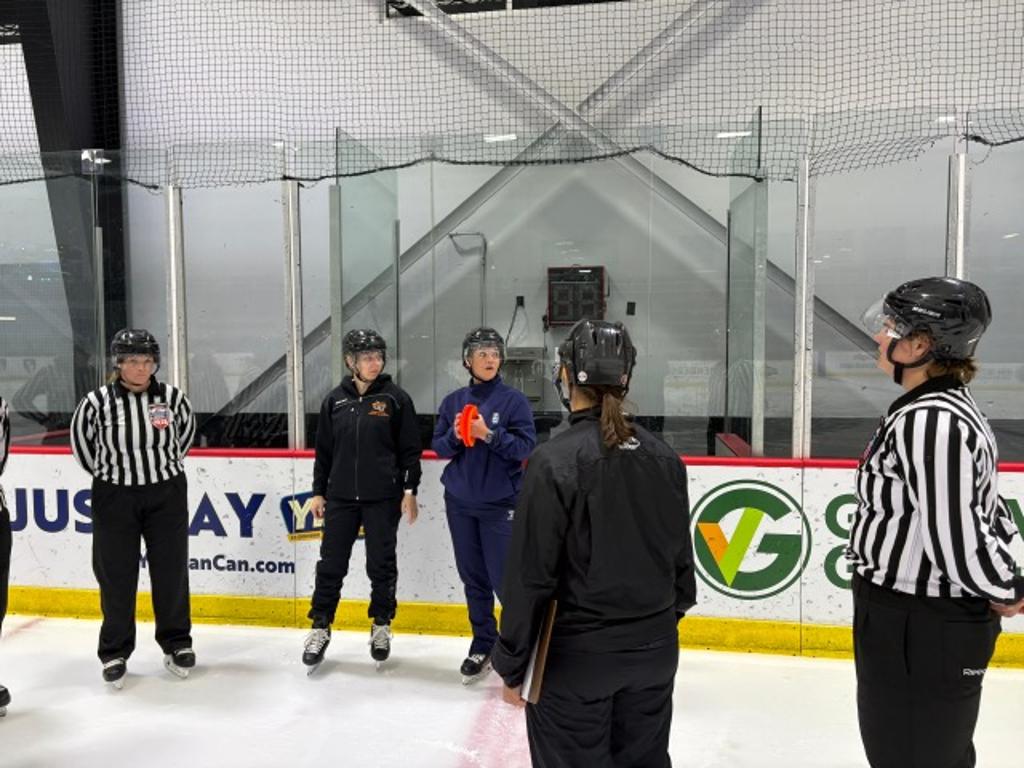
The Jamie Huntley-Park Women's Officiating Camp, commonly referred to as “Camp Jamie,” is an annual educational retreat – most recently conducted in Nevada – designed for registered female USA Hockey officials. It stands out as one of the few officiating camps exclusively for women in the country.
Typically held in May or June, approximately 15 participants come together for a weekend filled with classroom instruction, on-ice and off-ice training, and the chance to gain insights from some of the most esteemed female officials in the sport. Attending the camp also aids in meeting specific USA Hockey seminar prerequisites. This summer, the camp took place at America First Center Arena in Henderson, Nev., alongside the Western Region High Performance Girls Camp, which includes players from the Pacific, Rocky Mountain, and Northern Plains districts.
Camp Jamie is named in honor of Jamie Huntley-Park, a promising officiating talent who was part of the USA Hockey Advanced Officiating Development Program and was chosen to officiate at the 2022 Beijing Winter Olympics. Tragically, Huntley-Park lost her life in a motorcycle accident before she could fulfill her Olympic aspirations.
Dan Ellison (Pacific District Referee-in-Chief, who played a key role in establishing the first all-female camp for the Pacific District in 2018, where Huntley-Park served as an instructor) and Teresa Owens (Camp Jamie director and Pacific District’s Women’s Officiating Coordinator) shared insights about Camp Jamie and its significant influence on the women’s hockey community.
Q&A with Dan Ellison
USA Hockey: How did Camp Jamie originate?
Ellison: Several years ago, when Steve Stevens was the Referee-in-Chief for the Pacific District, we collaborated to develop a plan for an officiating camp, as there were none available at that time. We opted to initiate a women’s officiating camp, which I believe began in 2018. Given the predominance of male officials in the sport, it was important to concentrate on women and the unique challenges they encounter. At our inaugural camp, Jamie Huntley was emerging as a future officiating star, enthusiastic about contributing to the community. She served as an instructor at one of our first camps, which was very successful. Our first event took place in Tacoma, Wash., and despite relocating it several times, she consistently participated as an instructor. She collaborated with Jackie Spresser, Kendall Hanley, and Alicia Hanrahan, forming a strong core of instructors who were active in women’s officiating, which contributed to the camp’s growth. Given Jamie’s crucial role in launching the camp, it was a natural decision to name it in her memory after her passing.
USA Hockey: What is the mission of Camp Jamie?
Ellison: The main objective is to foster the growth and development of female officials, in collaboration with multi-district girls camps, including Rocky Mountain, Pacific, and Northern Plains. We have opened the camp to women from across the United States. The presence of instructors with Olympic experience or international licenses enhances the learning experience. These instructors are currently officiating at levels that the younger campers aspire to, providing them with a clear example of what the next tier of officiating entails.
USA Hockey: From the district’s viewpoint, what are your goals and how do you assess success?
Ellison: Initially, it’s about identifying new, young officials. Success is measured by how many women progress to officiating at the college or international levels. For many participants, this camp represents their first opportunity to travel. Several attendees have gone on to participate in district and national championships. It is gratifying to receive positive feedback from head officials at various events regarding the officials who have attended Camp Jamie and subsequently worked at these competitions.
USA Hockey: Does it make you and the staff particularly proud to honor Jamie in this manner while also contributing to the advancement of women in officiating?
Ellison: That’s what I find most rewarding. The expansion of women’s and girls’ hockey is remarkable. I wish there were more opportunities available for women. We have collaborated with the NHL to focus on recruiting and developing female officials in various regions, which has proven successful. We also aim to reignite discussions encouraging female players, as they transition out of college hockey, to consider officiating.
USA Hockey: Why do you believe camps like Camp Jamie are crucial to the officiating profession as a whole?
Ellison: Everyone aspires to excel in their profession. There is a significant amount of hockey played daily that lacks formal coaching. Our country is vast, and some districts are quite concentrated. Unless individuals are exposed to the game frequently, they may not recognize the opportunities available. With the rise of women’s hockey at the collegiate level, I see a chance for many women to embark on officiating careers, develop their skills, and gain recognition to advance to higher levels. Historically, the men’s side has had juniors, minor pros, and international circuits. In women’s college hockey, male officials have often been brought in. For a long time, the pathway for women was to obtain an international license and aim for the Olympics, which was seen as the pinnacle. However, many women in their late 20s reached the Olympics without further opportunities afterward. This camp serves as a platform for women to connect, recruit, and support one another, thereby increasing female representation in hockey officiating.
USA Hockey: What has the feedback been like from participants?
Ellison: The response has been overwhelmingly positive. Several campers have returned two or three times, which is encouraging. Many have leveraged the experience to advance their careers and pursue greater opportunities. It’s rewarding to witness.
USA Hockey: What are your aspirations for Camp Jamie in the future?
Ellison: I hope it continues to thrive. It is already doing well, and I wish for it to keep growing along its current trajectory. This year, we had new instructors, which is a positive sign. It indicates that there are individuals eager to contribute as instructors at the camp. There is a desire to learn, and it is facilitating the ongoing growth of the game.
Q&A with Teresa Owens
USA Hockey: How did you become involved with the camp?
Owens: I was previously a participant at the camp and am now assisting in its management, alongside instructors like Jackie Spresser, Kendall Hanley, and Alicia Hanrahan, who were also close friends of Jamie.
USA Hockey: What does the camp schedule entail?
Owens: It is a three-and-a-half-day camp for registered officials of all ages, running from Thursday to Sunday. Each day includes on-ice sessions, game experiences, and classroom instruction. We conduct on-ice assessments and off-ice evaluations. We also record and share game footage and provide immediate feedback in the locker rooms after games, similar to what one would receive from an instructor or supervisor at a district or national tournament.
USA Hockey: What topics are addressed in the classroom sessions?
Owens: We cover a significant amount of Level 1 and Level 2 material, including USA Hockey Rule 601 and the curriculum required for all seminars. Discussions include de-escalation techniques and penalty calls. We review videos, engage in pre- and post-game discussions, and examine the 3-official system from both the linesperson and referee perspectives, as well as the 4-official system.
USA Hockey: What specific skills are being developed on the ice?
Owens: Over the years, we have introduced a variety of new drills, placing a strong emphasis on power skating and IIHF testing, so participants understand the requirements for advancement. While we incorporate games and enjoyable activities, the focus is more advanced than simply teaching how to drop the puck. It emphasizes the flow of a linesperson, maintaining awareness of your lines-partner, and engaging in group drills. Skills such as goal line positioning, making calls, and executing proper signals are also prioritized on the ice.
USA Hockey: What additional outcomes do you hope campers achieve from the experience?
Owens: Our goal is to inspire female officials to improve and assist them in navigating their career paths. We aim to guide them toward their aspirations or even introduce them to opportunities they may not have considered. Additionally, we hope they form friendships and connections during the camp, along with gaining knowledge and experience that encourages them to become better officials.
The camp effectively prepares them for the next phase of their officiating careers, whether that involves Futures or participating in state tournaments or districts the following year. It provides a fun weekend for these women to connect and build relationships, as this group will accompany them throughout their officiating journeys. Some of my closest friends are from Camp Jamie. Participants also have the chance to connect with instructors from their districts. We strive to have a district representative from all three districts present at the camp, ensuring they have someone to reach out to for guidance throughout their careers.
USA Hockey: What made Jamie Huntley-Park so remarkable?
Owens: I knew Jamie for a brief period, about a year, before her passing. I had the honor of competing against her in college, albeit unknowingly. After her playing career, she transitioned into officiating and worked out of San Diego. She was genuinely passionate about hockey and building relationships. She cherished the connections she made and always sought the best for others. In my interactions with her, it was clear that she loved officiating and was dedicated to supporting the women advancing through the ranks. I know she was set to attend the Olympics with Jackie and Kendall, but unfortunately, that opportunity was lost. She is someone many people look up to.
USA Hockey: Do you have any special tributes to honor Jamie’s memory during the camp?
Owens: One meaningful tradition we uphold in memory of Jamie is the presentation of a “Jamie Award.” This award is given to the camper who embodies Jamie’s spirit the most, both on and off the ice. We showcase a video commemorating Jamie and Jackie (Spresser) provides an overview of her life. This allows campers to connect with Jamie’s essence during the camp. I still find myself emotional each year when we discuss Jamie. She had a unique ability to make everyone feel like they were her best friend instantly. She was caring and genuine, and her passion was unmatched. I know that when these women leave camp, they have a deeper understanding of who Jamie was and the purpose behind the camp.
