
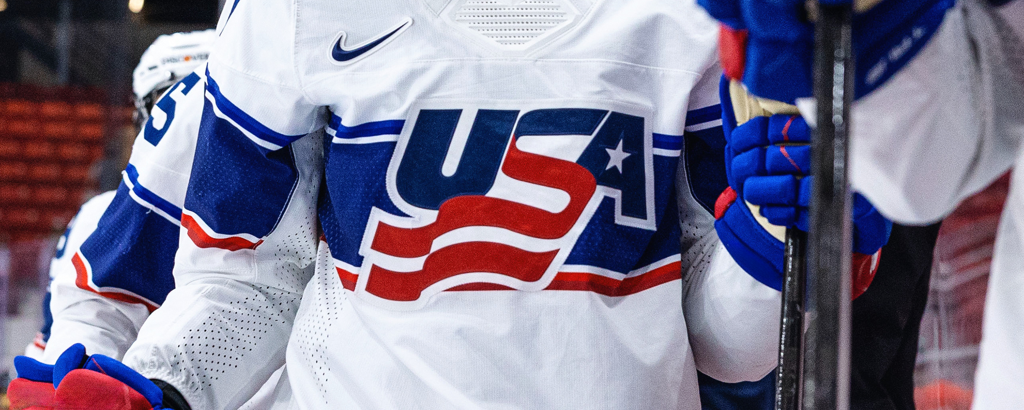
Earlier this month, 46 athletes took part in USA Hockey’s Women’s National Festival in Lake Placid, New York, aiming to secure a position on the U.S. Collegiate Women’s Select Team.
The group of 46 players was narrowed down to 25 on Monday, completing the roster that will compete against Canada in a three-game series this week in Richmond, British Columbia. The teams will meet on Aug. 12, 13, and 15.
The lineup includes eight athletes from last year’s Collegiate Series and represents 13 different college programs. Ava McNaughton, a goaltender and 2026 Olympic gold medalist, is also part of the team.
With limited international opportunities for players between U18 and the senior U.S. Women’s National Team, this series plays a crucial role in the development of collegiate athletes and may act as a pathway to future participation in a World Championship or the Olympics.
The most recent World Championship roster included nine collegiate players, and seven college athletes contributed to the U.S. winning gold in Milan, Italy, earlier this year.
“These are incredible experiences for player development,” stated U.S. coach John Wroblewski. “Whenever you bring the best together, iron sharpens iron.”
Given the limited time on the ice together each summer, Wroblewski noted that the Women’s National Festival and the subsequent Collegiate Series provide an opportunity for coaches to assess how players have progressed since their last time on the ice together.
“For players to continue representing the jersey, they must demonstrate improvement from the previous year,” Wroblewski remarked.
When players arrive at camp, Wroblewski expects them to showcase the effort they have invested. Then, during the brief time he and the coaching staff have with the players, the objective remains consistent across all levels of the women’s national team: to help players become an enhanced version of themselves during their limited time together.
The camp and matches against Canada’s top collegiate players provide the U.S. coaching staff an opportunity to assess players and gauge how they perform against high-level competition. These two weeks are also vital for observing how a player responds in game situations when time and space are constrained. This is one of the primary aspects Wroblewski focuses on during player evaluations.
A defining characteristic of the program under Wroblewski has been speed. He emphasizes predictability within the senior team, seeking players to be in harmony with one another because, as he stated, predictability reduces hesitations, which can enhance players’ speed and intelligence on the ice. A player can distinguish herself in this series by demonstrating her understanding and adaptation to that philosophy.
“Does she exhibit national team potential in terms of habits and details? Does she implement the information from the meetings? Or even better, is it instinctive?” Wroblewski inquired.
Since the players have very limited time together before engaging in competitive matches, having a strategy that reinforces their confidence in their support system provides them with a foundation to build upon, he explained.
This approach appears to be effective for the Americans, who have experienced success in this series, particularly over the past decade. This will mark the 20th edition of the collegiate series. The U.S. has claimed victory in the series 11 times, including the last six consecutively and nine of the last ten.
In last year’s series in Lake Placid, Team USA secured a regulation win, a shootout victory, and a shootout loss, achieving 4-1 and 4-3 wins before suffering a 7-6 shootout defeat.
This year’s team aims to build on that success and secure more regulation wins; last year’s matches included a total of 20 rounds in the two shootouts.
Story from Red Line Editorial, Inc.
