
Athletes of Various Ages Can Aspire to Achieve Paralympic Gold at Local Sled Hockey Camps
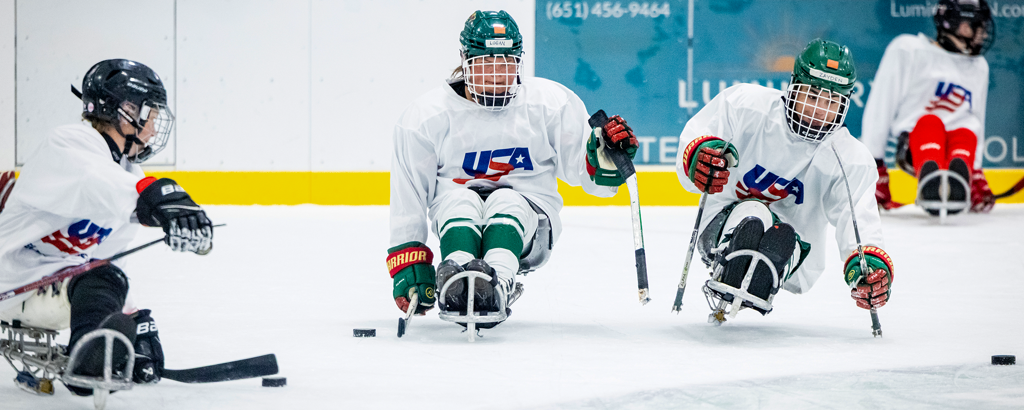
Evan Nichols acknowledges that it is somewhat gratifying to be regarded as a Paralympic role model by young athletes just starting in the sport, although he never anticipated finding himself in such a role.
This is the outcome of being a member of the gold-medal-winning U.S. Paralympic Sled Hockey Team—children as young as elementary school age admire you while they engage in a regional sled camp.
The camps, five of which are scheduled for 2026 at different sites nationwide, are part of USA Hockey’s sled hockey player development framework that is rapidly establishing a talent pipeline for the national team. An exciting aspect for the campers is the opportunity to skate alongside national team athletes like Nichols.
“I never imagined I would be in such a position,” remarked Nichols, a 21-year-old from Haymarket, Virginia. “I never thought people would seek my guidance. I have to share as much knowledge as I can. That aspect has been enjoyable.”
However, while the camps, now in their third year, may foster a pathway to greater Paralympic success, Chuck Gridley, USA Hockey’s New York District Coach-in-Chief, emphasizes that their primary focus is on developing skills that players can take back to their local rinks and contribute to the grassroots growth of the sport.
“Most players involved in the game are at the recreational level, playing in their hometowns,” stated Gridley, one of the coaches at these camps. “We have participants who are 8, 9, and 10 years old; we also have teenagers, and those with the best chances of making the national team are aged 15 to 20.”
It is important to note that anyone interested in enhancing their sled hockey skills is welcome to join. This means campers can be as old as 40 or older.
USA Hockey conducted regional sled camps from June 5-7 in Denver and June 12-14 in Eagan, Minnesota. Upcoming camps are set for July 17-19 in Fishers, Indiana, August 7-9 in Amherst, New York, and August 28-30 in Reno, Nevada.
“We’ve aimed to distribute these camps widely, making it geographically accessible for as many players as possible, and to ease the financial burden,” Gridley explained, noting that the fee is $125 for a three-day camp.
Gridley and U.S. National Sled Hockey Team head coach David Hoff oversee the on-ice activities, and Hoff expressed his enthusiasm for the role.
“There are kids present who are recreational players enjoying themselves and eager to improve,” Hoff noted. “We have participants who want to take skills back to their local associations. That’s the exciting part. They have the chance to see someone they aspire to emulate. There is a pathway or opportunity to achieve that. The improvement in skill levels has been remarkable.”
In the structure of development, local sled hockey serves as the foundation, Hoff indicated. The regional camps represent the next tier, followed by the invitation-only USA Hockey National Sled Player Development Camp, scheduled for July 19-25 in Columbus, Ohio.
Following that are the tryouts for the U.S. National Sled Team and the U.S. Women’s National Sled Team. The national teams, which include Paralympic gold medalists like Nichols, are at the pinnacle of the structure.
Almost all national team players assist at one or more camps, Gridley mentioned. This means a young athlete, or even an older participant, may arrive at a regional camp and encounter figures like Declan Farmer or women’s sled star Erica McKee on the ice.
“Many national team players contribute to the camps and give back,” added Dan Brennan, director of sled national teams. “Thus, a young athlete is likely to look up to Declan Farmer rather than Dan Brennan for hockey advice. We’ve seen numerous young players travel from all over the United States. That’s what makes our sport truly special.”
Gridley further remarked: “They recognize the importance of giving back. They understand the impact it has on the players and the effect it has on themselves as well.”
Naturally, winning five consecutive Paralympic gold medals will only enhance the development structure due to increased visibility.
“Absolutely,” Brennan affirmed. “It’s our new approach. We aim to expedite the development of our players.”
Nichols noted that he observes significant potential among the children at the camps and receives numerous inquiries about life on the national team. When he describes the extensive skating and training necessary to maintain a position on the team, “that is often met with astonishment.”
He also receives unusual questions, such as what foods he dislikes. (He does not consume coffee.)
While the camps are enjoyable, they also serve a meaningful purpose, Nichols stated.
“You can really see the determination of those who aspire to reach that level, and that is a significant part of the challenge,” he said. “Going forward, it’s about the effort they invest. Observing their motivation to join that team is the key factor, and we are witnessing much more of that.
“A lot of attention is on hockey in general, and we are working to build that momentum.”
Story from Red Line Editorial, Inc.
