
Tyden Bergeson’s passion for hockey began during the 2014 Winter Olympics held in Sochi, Russia.
At just 6 years old, Bergeson observed as talented athletes glided across the ice with remarkable agility, finesse, and speed.
Although Team USA did not secure a medal, losing to Canada in the semifinals and to Finland in the bronze medal match, Bergeson became captivated for life.
“I was just glued to the TV. I fell in love with the game and just kind of went off from there,” Bergeson recalls. “The way they moved the puck and scored at that level amazed me. I wanted to do that, too. I just kind of fell in love with it.”
Fast forward 12 years, and Bergeson has just claimed his second consecutive Minnesota boys high school hockey state championship with Moorhead, a weekend made even more special by his recognition as the state’s Mr. Hockey.
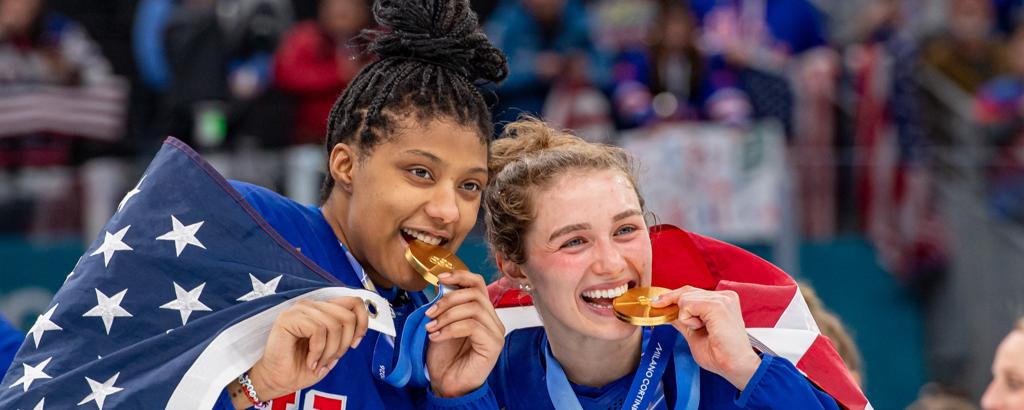
During Moorhead’s late-season momentum, Bergeson watched Team USA once more—this time as they captured gold in both men’s and women’s hockey at the Winter Games in Italy.
Unbeknownst to him at the time, both he and USA Hockey were on parallel paths since 2014, connected by a common thread.
The American Development Model, introduced by USA Hockey in 2009 and embraced by the USOC prior to the 2014 Games, represented a new perspective on the development of both individuals and the sport of hockey.
While the ADM is just one aspect contributing to USA Hockey’s growth and achievements, it plays a significant role. As both Bergeson and USA Hockey celebrate their successes while looking ahead, examining the ADM’s influence on both reveals a narrative about the evolution and expansion of hockey in this nation.
The Origin of the ADM
Bob Mancini and Guy Gosselin are two individuals deeply entrenched in hockey who have been involved with the American Development Model since its inception in 2009.
Initially, both served as regional managers for the ADM, focusing on educating coaches and implementing innovative approaches in various regions of the country. Mancini currently holds the position of USA Hockey’s assistant executive director of hockey development, while Gosselin is a player development manager.
From recent discussions with both individuals, it is evident that they possess both pride and humility regarding the developments within USA Hockey over the past 17 years.
“I would never claim that the ADM is the sole reason for the gold medal-winning teams, but I would assert that the ADM was a significant step in the direction of the growth of USA Hockey and the advancement of the American hockey player,” Mancini states, acknowledging that increased participation and the creation of the National Team Development Program were also crucial factors along the way. “These are indicators as our sport continues to expand. As more children engage, and as more coaches enter the field, it was a natural progression in our evolution.”
The motivation behind the ADM was not singular; however, in numerous discussions about it over the years, several key elements have emerged.
Hockey in the United States, especially at the youth level, required a shift from a model where players were instructed within rigid frameworks. Coaching needed to adapt alongside the sport, and a stronger focus had to be placed on the holistic development of the athlete while ensuring that enjoyment was promoted to retain players over the long term.
“Age-appropriate training comes to mind immediately,” Gosselin remarks when asked to outline some of the fundamental principles the ADM aimed to establish from the beginning. “Am I doing what’s best for kids and for long-term athlete development? It’s about fostering physical literacy and ensuring the right actions are taken at the right times for these kids, creating a better environment.”
Through the efforts of USA Hockey leaders like Mancini and Gosselin, a new approach was meticulously developed. If the traditional method involved instructing players on what to do and having them line up during drills, the new approach encouraged them to discover solutions in a guided manner.
<p“That changed a little bit,” Gosselin notes. “I believe we’ve made a difference in that regard. People have embraced it.”
If there was any resistance, it often stemmed from two factors: the ADM was different, and change is challenging for everyone, particularly those accustomed to a different methodology; and there was a misunderstanding that wins and losses were no longer significant at the youth level to USA Hockey officials.
Mancini clarifies that was never the case, although coaches were encouraged to prioritize long-term development over immediate results.
<p“This is a marathon, not a sprint,” he explains. “It’s about age-appropriate development over time, which will guide the majority of our players to where they need to be, when they need to be there.”
The benefits of this approach have been evident at various major tournaments as the U.S. has established itself as a formidable force. However, there’s nothing quite like having the message reinforced by two gold medal-winning teams at the Olympics.
Many of the athletes on Team USA were youth players during the early days of the ADM’s implementation, and the principles it promotes were clearly demonstrated.
<p“We certainly want to teach technical skills, and then how they can apply those skills in game situations,” Mancini states. “Then there’s awareness—call it hockey sense if you will. It was about awareness, decision-making, and hockey sense, and those elements all intertwined as the next step in the evolution of the American hockey player.”
Hockey transitioned from being a regional pastime—where Minnesota, Michigan, and New England dominated while areas far from those regions were overlooked—to a national sport. USA Hockey worked to unify players, strengthening the connections that would form their national teams. They also intentionally aimed to “lift all boats,” as Mancini described it, to enhance all levels of youth play.
Bergeson experienced this as a youth player in Moorhead. In a different era of American hockey with an alternate approach, he might not have developed into the player he is today. He began on the B1 team during his first year in Pee Wees. Now, he is recognized as Mr. Hockey, the state’s top senior.
<p“When I was younger, I didn’t make all the top teams. In those early stages, I wasn’t always the best player on the ice,” Bergeson reflects. “But as long as you kept working, and stayed focused on what you could do, you’d eventually succeed.”
Age-Appropriate Training
As Mancini considers the principles that define what the ADM aims to impart at various youth age levels, he expands the categories beyond the typical classifications of 6U, 8U, 10U, 12U, 14U, and 16U.
<p“For 6U and 8U, I would say that passion and enjoyment are the most important aspects. We want to cultivate passion in our players because we aim to keep them engaged in hockey and support their development,” Mancini explains.
He emphasizes, however, that fun and enjoyment should not diminish or be deprioritized as players progress through the ranks. “Hockey must remain enjoyable at every age,” he asserts.
Engaging in cross-ice or half-ice games contributes to this. When players have more opportunities to handle the puck, as they inevitably do when the playing surface is appropriately sized for them, they become more involved and engaged from an early age.
<p“It is effective, and we’re retaining more players,” Gosselin states. “We hope to create a better experience for all our players.”
Mancini also highlights that the ages of 9 to 14 are often regarded by USA Hockey as the golden age for skill development.
During this period, players acquire a multitude of skills, both technical and related to hockey sense.
Bergeson attributes his skill development to his youth coaches who provided him the freedom to cultivate those abilities.
<p“I was fortunate to have excellent coaches when I was younger and throughout my entire hockey journey,” he shares. “They allowed me the freedom to make plays and attempt different moves that you might not typically consider.”
After that? The focus intensifies.
<p“And then starting at 15 and above, that’s really where the emphasis shifts to high-level player development,” Mancini adds.
Enhancing that experience is part of the next phase for USA Hockey, which will be discussed further later.
The Olympic Moment
Age-appropriate training is crucial for several reasons, but one in particular stands out: it provides players with what they can manage at that moment and allows them to build upon it over time.
Eventually, a select few of them become Olympians, making it even more significant.
<p“That was high-level competitive hockey, and those players were where they needed to be when they needed to be there,” Mancini remarks. “They didn’t need to be there at ages 12, 13, and 14, and certainly not at ages 6, 7, and 8.”
It requires time and patience. Some of those Olympians participated in programs that were early adopters of the ADM.
<p“All of this was coming together,” Mancini states.
It manifests in small instances and in significant moments, such as defenseman Quinn Hughes scoring the overtime winner against Sweden in the quarterfinals and 23-year-old blue-liner Caroline Harvey leading the entire women’s tournament in scoring.
Hughes and Harvey were prepared for these moments, but the groundwork was laid long ago.
<p“We can’t develop hockey players solely for what the game is at this moment,” Mancini explains. “We must focus on developing hockey players for what the game will be in the future. And certainly, Quinn Hughes and Caroline Harvey exemplify players who developed with an eye on the future.”
Thinking About the Future
Celebrating victories is gratifying, and USA Hockey has earned its share following its Olympic successes. However, it is also evident that they are already contemplating what lies ahead.
USA Hockey is set to introduce a new elite Development League in 2027, focusing on 15U and 17U boys players. Applications for this high-level league will open on May 1 and close on June 30, with the league expected to commence play in the 2027-28 season.
Mancini views this as the next phase in an ongoing evolution that already includes the National Team Development Program and the ADM serving its youth players.
After all, the U.S. experienced a 46-year gap between gold medals in men’s hockey and would prefer not to endure such a wait again.
<p“This progress doesn’t happen overnight. And it won’t happen again if we don’t continue to evolve,” Mancini asserts. “We must remain at the forefront of player development, and we need to look toward the future, because even in four years, the next Olympics will differ from this one, and it will certainly look different in eight years, twelve years, and sixteen years. Some of the initiatives we are implementing now will have a long-term impact.”
Gosselin adds, “The battle is not over. We still have a lot of work ahead.”
Nonetheless, there is a prevailing sense that USA Hockey is currently in a very favorable position.
Just a few weeks ago, Bergeson had a multitude of fans astonished by his performance for Moorhead. In more private moments, while watching his hockey idols in the Olympics, it felt as if he were 6 years old again.
<p“It was unreal,” Bergeson states, who has committed to play Division I college hockey at Augustana. “The skill those players possess is unparalleled. Witnessing what they can accomplish with the puck at that elite level is simply incredible.”
Who knows? Perhaps in another 12 years, he will find himself on that stage as well.
<p“If we’re not doing what’s right for those players, they won’t reach their potential when all those factors align,” Mancini concludes. “When all those circumstances converge, we talk about being in the right place at the right time.”
