
Rory McIlroy and the Northern Irish town that remains integral to his narrative
HOLYWOOD, Northern Ireland — Nestled on a steep hillside above County Down, with a view of Belfast Lough, lies the 6,100-yard parkland course from which Rory McIlroy launched his career.
Regardless of how high he ascends or how far his influence spreads, or how long it takes until his next return, Holywood Golf Club will forever be his home.
In the Emerald Isle, golf transcends mere sport. It serves as a bond among families, friends, and generations. Here, there exists a unique respect for history. It is palpable.
Locals recount that the roots of golf in Northern Ireland trace back 145 years to Royal Belfast, located just down the hill. Holywood was established in 1904, and by 1994, it recognized the talent of a young player in its midst.
“I collaborated closely with a professional in the youth section, who informed me about a young boy destined for greatness,” said Eddie Harper, a gentleman recovering from a recent knee operation, who managed Holywood’s junior program for many years. “[Rory] was just 5 or 6.”
The professional he referred to was Michael Bannon, who later became Rory’s long-time coach. In 1996, Bannon approached Harper with a request: Allow the boy to join the club. He was too talented to be overlooked. The minimum age for membership was 10, but Rory was only 7.
“I brought Rory in for an interview; he wore a dark suit, red tie, and white shirt, and sat politely before me,” Harper recalled. “We discussed conduct and etiquette, and he interjected, saying, ‘Mr. Harper, if you admit me to this club, I won’t slow anyone down. I know all the golf rules and I’m a very fast player.’ He was accepted. The rest is history.”
In the realm of golf, it is perhaps the most extraordinary history. Only six individuals have achieved the career grand slam, winning all four major championships: Gene Sarazen, Ben Hogan, Gary Player, Jack Nicklaus, Tiger Woods, and — as of April 2025 — Rory McIlroy.
IN MARCH 2026, McIlroy enters the dimly lit living area of a rental property at Bay Hill. The house contains three rooms, all filled with television crews and their equipment. ESPN is first in line.
We exchange pleasantries, but I quickly ask to begin. McIlroy is consistently candid and considerate with the media, thoughtful in his replies and genuinely inquisitive. He often allocates time he cannot spare. Today, I have 10 minutes.
He begins by briefly outlining his experiences in major championships.
“I secured the first three quite swiftly in my career,” McIlroy states. “That last one was my kryptonite.”
After carding an 80 in the final round of the 2011 Masters, relinquishing a four-shot lead, McIlroy bounced back to win the 2011 U.S. Open at the age of 22, navigating Congressional Country Club in historic style. He added the Open Championship and the PGA Championship by the age of 25. It appeared nothing could hinder his progress.
However, each year in early April, as the azaleas bloomed at Augusta National, McIlroy consistently faltered.
“I just couldn’t — I couldn’t find a way to succeed,” McIlroy reflects. “And I kept trying. I kept returning. Since 2011, I’ve driven away from Augusta National every Sunday night feeling disappointed, and …”
He pauses.
“Devastated?” I propose.
“Devastated,” McIlroy agrees.
There were some highlights. He mentioned 2022, when he recorded a career-best 8-under 64 at the Masters Tournament and holed out from the right greenside bunker to finish as the runner-up to Scottie Scheffler.
“That was probably the least disappointed I felt at any point leaving there,” he noted.
For 16 years, Holywood and all of Ireland witnessed their local hero struggle at Augusta. Time after time, they shared in his heartbreak.
“It felt like a cloud had descended; we were all quite disheartened,” Harper said, leaning against an indeterminate age brick wall across from the Holywood first tee. “It took a long time before he won something, and rumors began to circulate — would he ever win another major? Doubts started to creep in.”
McIlroy had come so close on numerous occasions. There was the 2023 U.S. Open at Los Angeles Country Club, where he finished second to Wyndham Clark after failing to make a birdie over the final 17 holes. And the 2024 U.S. Open at Pinehurst No. 2, where he held a two-shot lead with five holes remaining but missed a couple of short putts over the last three holes, allowing Bryson DeChambeau to claim victory.
Yet, as painful as those instances were, Augusta always felt worse. Final challenges often seem more daunting, especially when they symbolize the barrier to achieving a childhood dream.
“I’ve always been a dreamer, with big aspirations and ideas. I’ve never lost that,” McIlroy stated. “I’ve never allowed the world to take that away from me. The world can make you quite cynical if you let it.
“I would say [the Masters] was the — burden isn’t the right term — but I was carrying this lifelong dream of winning all the majors, you know? I expressed that to anyone who would listen when I was 7 or 8 years old.”
IN 1998, WHEN McIlroy was 9, he won the junior under-10 world championship at Doral. That was the pivotal moment.
“Well, his fame, if that’s the appropriate term, had spread throughout the club,” Harper remarked. “He won the world under-10 championship, which placed him in the spotlight. He appeared on [Gerry Kelly’s show] in Belfast, hitting golf balls into a washing machine, which generated significant interest. Consequently, word spread throughout the country about Rory, and it placed considerable pressure on him as people expected him to excel.”
“The club essentially said, we need to support this young man because there is something special about him,” club president Tony Denvir stated. “Clearly, his father, uncle, and grandfather were all exceptional players. It’s in the McIlroy family’s genes, without a doubt.”
As a young boy, Rory was here, hitting plastic golf balls through hallways, often to the annoyance of the members. He was here at 9, winning tournaments on distant continents. He was here as a teenager causing mischief. He was here as a 22-year-old major champion. And he was here last April when he completed the grand slam.
And that is why I am here: to uncover the how behind the who. Within a few hours, one understands why Rory is who he is.
Part of this is attributed to his parents’ work ethic and their understanding of the sacrifices they made for his aspirations.
“Gerry and Rosie kept him grounded; they instilled in him a remarkable work ethic through their efforts,” Ruth Watt, HGC lady captain, remarked. “They worked tirelessly, traveling extensively across the country.”
The McIlroys sacrificed greatly for Rory’s career. His mother, Rosie, worked night shifts at a factory in Bangor, packing rolls of tape into cardboard boxes. His father, Gerry, was a bartender at various establishments, including the one where I sat with Denvir and former HGC club president Stephen Tullin, casually discussing the weather.
The bar features polished granite, located just inside the entrance from a parking lot reserved for dignitaries. Rory has his own designated parking space, closest to the pro shop. Denvir and Tullin meet here daily to enjoy 5 o’clock pints of crisp lager. They tell me it has been three months since they last saw the sun.
“Thanks for bringing the good weather with you!” they exclaim.
We toast and nod. It’s Ireland.
Today, they welcome an outsider, one of the estimated thousand-plus who have visited in the past year to immerse themselves in a historical experience unique to them: Rory’s roots.
During a half-hour conversation that swiftly shifts from rain to identity, they oscillate between laughter and nostalgia. One moment, they are filled with joy, and the next, they reflect with misty eyes. They have grown accustomed to disappointment.
McIlroy is the pivot on which these emotional extremes balance. He is the pride and joy of this establishment, this town — and in many respects, this country.
Denvir is seated to my left, Tullin to his left. Denvir has short gray hair, a wry smile, and a thoughtful demeanor. Tullin is quick with humor and infuses his sentences with bits of Irish charm. As I teach them the proper use of “y’all,” they share Rory anecdotes.
Tullin: “There used to be a table tennis table here, and I played him for a tenner. He won, so I had to give him a tenner. That’s my claim to fame — playing Rory at anything.”
Denvir: “Meeting him for the first time. When he won his first major, [the 2011] U.S. Open at Congressional, he returned here, and I was unsure what to expect. But he was just such a genuine person; I shook his hand and had a brief conversation with him. I thought, ‘I’m speaking with one of the best golfers in the world. This is incredible!’ He’s just a great guy.”
It seems everyone here has a Rory story. Patrons at the cash-only Maypole Bar. The rental car attendant at Belfast City Airport, who inquired about our visit and immediately recounted a round he played against the Grand Slam champion. The teachers at Rory’s secondary school, Sullivan, fondly remember the shaggy-haired boy with big dreams and extraordinary talent.
“Rory’s journey demonstrates to people that with commitment and hard work, they can achieve their goals,” Sullivan golf organizer Andy Cave stated, as his students peeked curiously from the hallway through the small square windows in the door at this unusual American camera crew sitting at their desks in history class. “And it doesn’t require coming from a highly privileged background. I believe the fact that he has accomplished this, while also remembering those who supported him along the way, is something that should inspire many.”
This includes “The Girls,” a collective name given by Gerry to a group of ladies who frequently gather for wine and golf outings.
“I recall once when we were dining in the restaurant, and we were watching Rory and some of his friends chipping onto the 18th green — which, of course, is not allowed,” chuckled Eileen Patterson. “Gerry never said anything, but he disappeared. He realized that [Rory] was breaking the rules and didn’t try to intervene for Rory. He took away the clubs for 10 days. That was the worst punishment imaginable.”
McIlroy’s presence is ubiquitous here. Ball markers, towels, even the Wi-Fi password (sorry folks, might need to change it now). After he achieved the Grand Slam, fans from around the world flocked to experience it. So many, in fact, that the club introduced a Rory Tour.
On a beautiful Friday morning, I met lady captain Watt at the Holywood entrance to embark on the tour. She highlighted the names of generations of McIlroys on the Club Champion plaque, numerous photographs from Rory’s youth, and replica trophies from three of Rory’s major championships. Representing The Masters title was an autographed yellow Augusta pin flag.
“It would be wonderful to have a miniature of the Augusta clubhouse, but I believe that is not feasible,” Watt remarked. “When he won the Masters, it was magical. The clubhouse was electric for days. Truly. It was a late night here, past midnight, when it concluded.
“Tears were the first reaction. After dropping all those shots and reaching a playoff, which we never anticipated. We thought he would just sail through. But that’s golf.”
“It was the most stressful 5½ hours of my life,” Cave recalled. “Midway through the round, he pulled ahead a bit — and we were almost starting to believe.”
THAT SUNDAY, PAIRED once more with DeChambeau, McIlroy approached the 13th tee with a two-stroke advantage. After a solid tee shot and an accurate second shot, McIlroy was 86 yards from the pin, with Rae’s Creek guarding the green ahead.
“I wouldn’t say I let my guard down, but perhaps I relaxed a bit,” he reflected.
His third shot came up short and rolled back into the water. He recorded a double bogey, opening the door for his competitors. Among them was Justin Rose, who, ahead, would ultimately card a 66. (Rose later suggested that Sunday at Augusta might have been the best round of his life).
“After 13, it helped me refocus on the mindset of, ‘nope, you haven’t won this yet,” McIlroy stated. “You are nowhere near winning this, yet. I snapped back into the realization that I was not going to win the Masters.”
He would bogey the 14th, handing Rose the outright lead. Then on 15, he pulled his drive left, setting up one of the most remarkable golf shots of his life. Facing a challenging right-to-left draw around a row of Georgia pines, McIlroy selected an 8-iron. The wind picked up, and after DeChambeau hit his shot into the water, McIlroy adjusted to a 7-iron. The ball soared high and left, landing quickly on the green and rolling out to 6 feet. CBS’ Jim Nantz enthusiastically described it as “the shot of a lifetime.”
A birdie at 17, thanks to a blistering approach shot, meant McIlroy approached the 18th tee as the outright leader. He missed a par putt just under the hole and recorded a bogey, setting up a playoff with Rose. He exited the 18th green, kissed his wife, Erica, and daughter, Poppy, and walked to the clubhouse with a stoic expression through thousands of cheering fans.
“The roller coaster of the shot on 15, the shot on 17, a five in regulation on the last,” McIlroy recalled earlier this year at Bay Hill, slouching slightly in his chair. “And that interval between signing your card and returning to the 18th tee. I had a lengthy wait on 18, Justin Rose, the entire situation.
“I had to concentrate on staying present and not getting distracted by the roars up ahead, wondering what that meant. What did he do? Looking at the leaderboard. I’m genuinely proud of myself for remaining in my own little — my own little world.”
During a golf cart ride back to the 18th tee for the playoff, McIlroy’s caddie and best friend, Harry Diamond (whose 2002 Ulster Boys Championship photograph also adorns the wall at Holywood), simply said, “Well, pal, we would have taken this on Monday morning.” It was the mental reset McIlroy required.
“When I reflect on that day and everything I had to navigate, I take the most pride in the fact that I didn’t let the moment overwhelm me, either way, if that makes sense?” McIlroy stated.
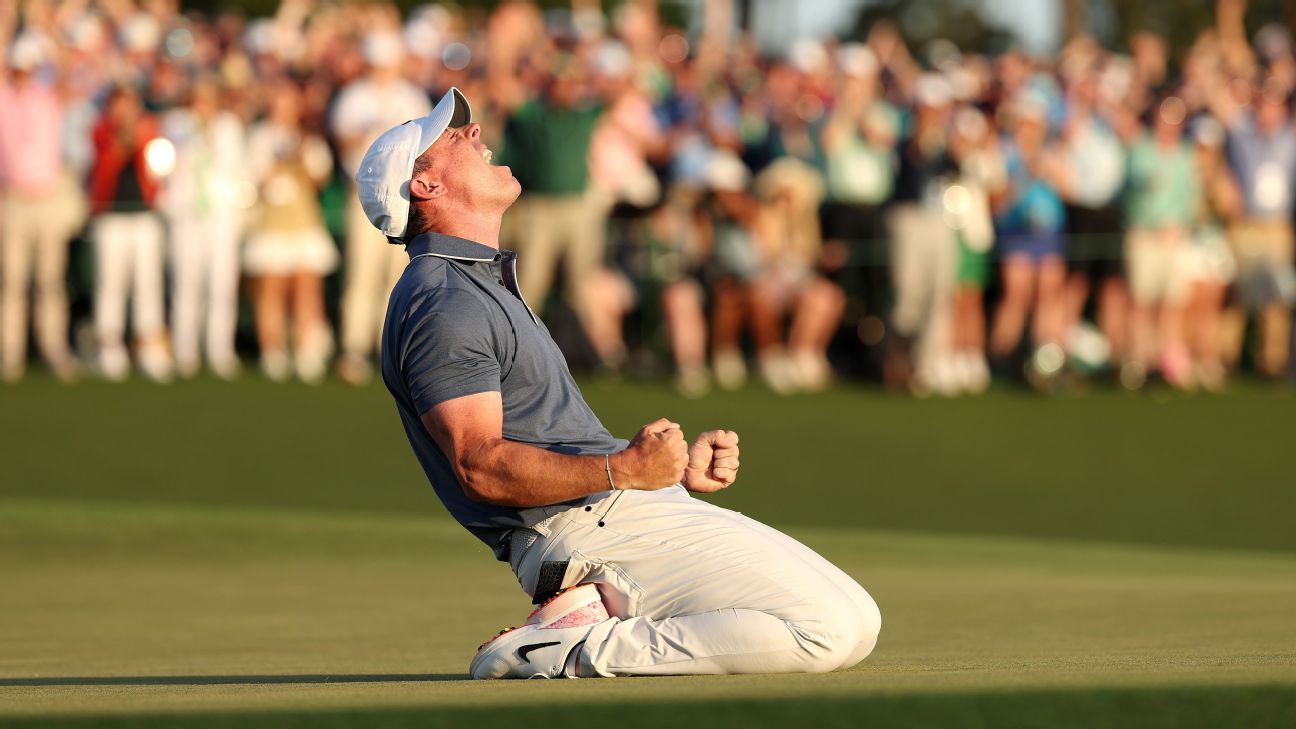
In the playoff, McIlroy was exceptional. He placed the approach to 3 feet, then walked up the 18th fairway to raucous cheers of “Ror-y! Ror-y!” Rose narrowly missed his birdie putt. McIlroy made his to finally claim the title: Masters champion.
When the putt fell, McIlroy tossed his putter into the air, began to weep, and dropped to his knees.
“The release was my expectations, everyone else’s expectations, the narrative that had surrounded me at that tournament for 15 years,” he explained. “And recalling who I was as a young boy in Holywood, with this dream and making it a reality.”
IN THAT MOMENT, the people back in Holywood were celebrating and crying alongside him.
“It is emotional because he is one of us,” Denvir stated. “Born and raised in Holywood. Considering the size of this country, it is quite small. Holywood is a very tiny place. And his entire family is just so down-to-earth. They are simply normal, humble people.”
Stephen Tullin nodded with his pint.
“It genuinely feels like he is one of us. We haven’t achieved it, but certainly being associated with what he has accomplished is remarkable for this golf club, this town, and the country,” Tullin remarked. “Rory is just Rory. He remains unchanged. He comes up and engages with everyone. He gives everyone his time. And he is very generous to the club.”
Beyond the numerous donated clubs, bags, flags, and trophies, the most notable example of McIlroy’s generosity is the state-of-the-art workout facility he contributed, featuring five golf simulators, three of which include Trackman shot data technology. The gym has created a new revenue stream for the club. As Ruth Watt noted, dozens of new members joined HGC solely to utilize the workout room. Meanwhile, the sim room allows members to gather for nine-hole rounds when the weather outside is unfavorable.
The prevailing estimate among members at Holywood Golf Club is that McIlroy contributed £750,000 (nearly $1 million) of his own funds to help establish the facility.
“We all adore Rory, and we are immensely proud of him,” Helena Campbell, one of The Girls, stated. “He has brought such recognition to Holywood Golf Club and to Holywood itself. There isn’t a person in Holywood [who] wouldn’t speak highly of Rory McIlroy and his family.”
Days after Scottie Scheffler ceremonially draped the green jacket over his shoulders, McIlroy boarded a private jet with Poppy and brought it back to Holywood. His parents, who Rory explained were busy relocating to a new home in Ireland, were not present to witness their
