
USMNT receives wake-up call from Doku and Belgium prior to World Cup
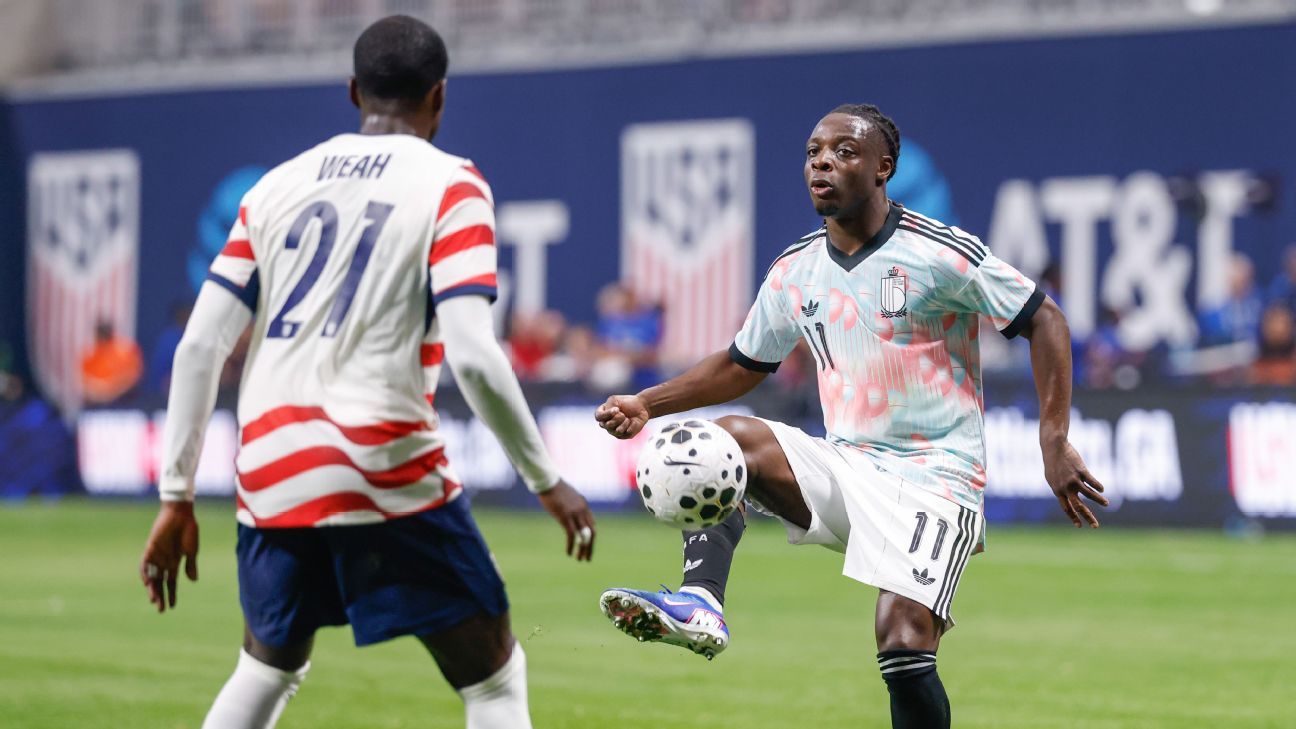
ATLANTA — The United States men’s national team is now in the final stages of its preparation for the World Cup. Both individual performances and overall team cohesion will be closely examined.
Consequently, Saturday’s encounter with Belgium offered a stark evaluation of the current state of the USMNT, as the Americans suffered a significant 5-2 loss. While it was just one match, the U.S. appears far from ready for the competitive matches that will commence in June.
The U.S. displayed competitiveness during the first half. Weston McKennie maintained his strong form, netting the Americans’ goal to give them a 1-0 lead. However, although the U.S. defense held firm into the second half, it struggled to cope with the dynamic performance of Belgian winger Jérémy Doku, resulting in the end of their five-game unbeaten streak.
– USMNT player ratings: Weah poor as U.S. suffer heavy Belgium defeat
– O’Hanlon: Can USMNT’s depth at the 2026 World Cup make a difference?
– USMNT players speak up about what Mauricio Pochettino is like
The match highlighted the positioning of the USMNT’s center backs as a key area of concern. FC Cincinnati’s Miles Robinson and Crystal Palace’s Chris Richards were both sidelined due to groin and knee injuries, respectively, while FC Augsburg defender Noahkai Banks remains uncertain about joining the U.S. squad. Additional worries about the defense include Charlotte FC’s Tim Ream, who has not performed at his best this season, and Mark McKenzie, who still needs to improve his consistency with the USMNT. These issues led manager Mauricio Pochettino to revert to the familiar 4-3-3 formation, with Ream and McKenzie forming the defensive line.
Ultimately, the center backs were not the sole problem. This was a collective setback that is unlikely to boost confidence in the U.S. team. Notably, the Americans’ defense on the flanks was poor. Belgium frequently found Doku isolated on the wing, whether during transitions or through a significant switch in play, and even when double-teamed, he managed to trouble the USMNT. A prime example was Amadou Onana’s go-ahead goal in the 53rd minute. McKenzie did reasonably well to contain Doku’s run, but the Belgian drew nearly the entire U.S. defense toward him, creating space for others. Doku passed to Charles De Ketelaere, who then set up Onana to score.
It should be acknowledged that Doku is an exceptional player, as evidenced by his association with Manchester City. However, this is a USMNT squad that has set ambitious objectives for the upcoming World Cup. To achieve a deep run, the U.S. will need to overcome teams of Belgium’s quality, likely more than once. It is somewhat surprising that Timothy Weah was often targeted by Doku, considering he has played as an outside back numerous times this season. This raises questions about whether anyone else on the U.S. roster could have performed better. Alex Freeman certainly could not have done worse.
That being said, the U.S. also needed to improve its support on the flanks while effectively tracking late runners into the box, rather than merely watching the ball. This responsibility falls on the entire team, not just the defense, and is a fundamental defensive principle. The U.S. appeared unable to execute this aspect, which is likely the most troubling element of the performance. A return to a three-man backline—despite the limited availability of center backs—may be necessary.
Questions also arise regarding the U.S. midfield. With Tyler Adams not traveling due to a quad injury, an opportunity arose for Johnny Cardoso. After a challenging start to the season with Atletico Madrid due to his own injuries, Cardoso has improved his performance level to the point of becoming essential for his club. The issue for the USMNT is that Cardoso has yet to replicate that form on the international stage.
On Saturday, Cardoso displayed some promising moments. He completed all 13 of his passes successfully. His intelligent play allowed McKenzie to break free for his goal and redirected Antonee Robinson’s corner. He also made a crucial tackle in the 17th minute that disrupted a Belgian counterattack. It was unexpected to see him substituted at halftime for Cristian Roldan, although Pochettino clarified post-match that the change was pre-planned due to some discomfort Cardoso experienced earlier in the week.
For a team that struggled with ball possession in the first half, this decision was peculiar and raises questions about the depth of the squad. The second half saw Belgium score multiple goals as the U.S. continued to struggle with one-on-one defensive situations. Goalkeeper Matt Turner, who was a surprising starter in place of Matt Freese, was frequently left vulnerable. Pochettino may also be concerned that despite utilizing his bench extensively, the situation deteriorated further. The only positive moment came when Ricardo Pepi deflected a pass from the back, enabling Patrick Agyemang to score a consolation goal.
Is there cause for alarm? Not yet. Four years ago, the U.S. lost 2-0 to Japan in its penultimate friendly before the 2022 World Cup, a match that was not as close as the score suggested. In that instance, then-manager Gregg Berhalter gained insights into who he could rely on for the World Cup and who he could not. Pochettino will need to gather similar information.
