
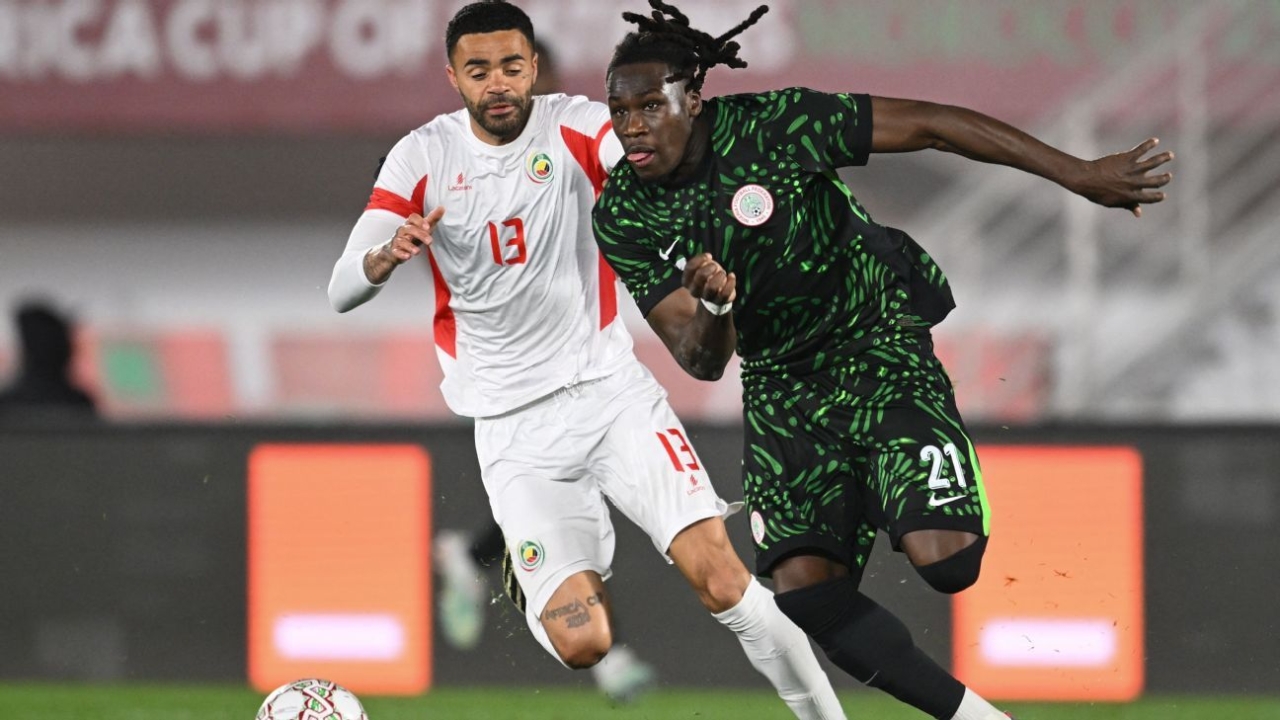
Nigeria steamrolled their way past Mozambique in what was no doubt their best performance of the tournament so far, winning 4-0 as they book their spot in the quarterfinals of the 2025 Africa Cup of Nations.
Star forward Victor Osimhen helped himself to a brace, Ademola Lookman and Akor Adams weighed in with the other two, but Alex Iwobi was the orchestrator in chief from deep as the Super Eagles never looked like they were ever in any danger of conceding, let alone losing.
After his wholesale changes in the final group game against Uganda, Nigeria coach Eric Sekou Chelle restored all of his starting eleven to the side, and they wasted no time establishing their superiority, racing in two a two-goal lead within the opening 25 minutes.
Such was the dominance of the Super Eagles that by the time they scored their third, there was still plenty of time left, but the Mambas had checked out.
A clean sheet, at last
A four-goal win and we start with the defence? Yes.
Chelle has been building a Super Eagles team that is exciting to watch, scoring goals, and winning football matches. But the one thing he has been unable to do so far was stop his team from leaking goals.
The last time they kept a clean sheet was in the World Cup qualifying win over Benin Republic in last October. Incidentally, just like on Monday night, they also scored four goals on that day.
In the five games that followed, they have let in at least one goal. In total, out of the 15 games under Chelle (including the pre-Afcon scrimmage with Egypt) the team have only kept a measly three clean sheets. Two of those were against Rwanda in World Cup qualifying. It is partly that inability to keep a clean sheet that contributed to their failure to make the World Cup.
What was more annoying about those goals was the avoidable manner in which they were let in. No team can expect to be a championship contender if their backdoor is always open for sneak entries.
Ahead of this round of 16 game, defender Calvin Bassey talked about their determination to cut out the errors and play for a clean sheet. That was exactly what they did, although in fairness, the Mambas lack of ambition may have helped some. They were not allowed to have a single shot on target, and the best of their attacks were snuffed out well before they got to the final third. Stanley Nwabali might as well have been on vacation.
It may be only Mozambique, but this is the team that limited Ivory Coast to just one goal, put three past Gabon and scored one against Cameroon. Bassey, the leader of the back four, should feel much better going into the quarterfinals.
Terrifying three
For the last five years or so, Nigeria’s abundance of attacking talent was the major talking point whenever the Super Eagles went into a game or tournament.
Until now, translating that talent into goals has proved to be a level of difficulty too hard for previous coaches to navigate, leaving Victor Osimhen as the main source of goals. Whenever the striker was present, the team scored goals and won game. When he was not, they struggled to score or win.
Under Chelle, that appears to be changing. They have scored two goals or more in nine of the 16 games under Chelle, including Monday’s win against Mozambique, and have three four-goal games in three of the last eight including back-to-back games against Benin and Gabon where they scored four.
Prior to that, the last time the Super Eagles scored four goals and above was in 2023 against Sao Tome e Principe in a Cup of Nations qualifier.
To get around the problem, previous coaches have found other ways to not depend on the abundant ordnance that were firing blanks. At the last AFCON, Jose Peseiro chose instead to rely on a foundation of defence in his run to the final, which saw the team score just three goals in the group stage, and eight overall for the tournament. Chelle’s team matched that number in just the group stage alone.
But it is not just about the goals, but in the way they are doing it. The starting front three of Osimhen, Ademola Lookman and Akor Adams have looked irresistibly unplayable. Their movement pulls defenders in directions they are reluctant to tread, the quality of their footskills gets them sees them ghost past defenders, and each can finish in different ways. Then there is the arriving goalscoring threat of Raphael Onyedika from midfield, and Semi Ajayi from set pieces.
All of this, without even mentioning the threats offered by substitutes like Samuel Chukwueze, Moses Simon, Paul Onuachu and Chidera Ejuke.
In their four games so far, they have outshot the opposition 62-20 and dominated possession by a total of 106 percentage points, an average 40% spread across four games.
Chef Chelle cooking up records
Speaking of what Chelle has done, the Malian is breaking and setting records with Nigeria almost every game now.
His three wins out of three in the group phase equalled Nigeria’s best performances at that stage of the tournament, but his team’s eight goals were the most of any Nigerian team in their history at AFCON.
Beating Mozambique by four was also the biggest margin of victory of any Nigerian team in AFCON history. The previous margin has been three goals. Four goals scored also tied the country’s most goals scored by Nigeria in one AFCON game. Their 4-1 win over Mali in the quarterfinal of 2013 tournament was the other.
Those four goals against Mozambique also took the Super Eagles to 12 goals in total, tied for the most goals ever scored at a single tournament by the country. The last time the Super Eagles scored 12 was at the 2000 tournament they co-hosted with Ghana.
To put the cherry on top, there is one record that Chelle’s team have now set and hold solely on their own. By winning on Monday, they became the first Nigeria team to win four consecutive games at the Africa Cup of Nations. Other iterations of the team have won four (1992, 2006, 2013) and even five games (2023), but none have done so consecutively before now.
A bouquet for Iwobi
Nigeria’s first three goals will not show Iwobi’s name on the stat sheet. Even if it was a basketball game, where the box score shows detailed stats of player contributions, it would still be tough to figure out from the numbers alone just how influential the Fulham man was to this game, and not for the first time.
Nigeria’s first attempt on target came from him, forcing the goalkeeper into a diving save from range.
It was his slicing vertical pass to Akor that cleaved the defence and allowed the Sevilla man to break free and release Lookman with the cutback. He did it again for the second goal, from a similar position deep in his own half. His perfectly weighted raking ball sliced through the entire Mambas defence to find Lookman, who crossed for Osimhen to finish. Adams could have got himself on the scoresheet much earlier when Iwobi found him with a short diagonal ball just before the half came to a close but his shot was pulled wide.
Guess who delivered again on the third goal in the second half? From the same left channel, he chipped a delightful little loft into the path of Lookman, who beat a couple of defenders before teeing up Osimhen for his second of the game and third of the tournament.
Beyond his goal contributions, Iwobi was one of the best players on the pitch for Nigeria. His passing, movement and willingness to make himself available for the ball at any time, not to mention the vision, to see a teammate in space and make the quick release was pivotal to the Super Eagles win.
Lookman claimed Man of the Match, his second of this tournament so far, but Iwobi could have so easily been the recipient and there would have been no argument.
On the down side: Osimhen tantrum plus yellow card
This was trending to be a perfect A+ for the Super Eagles in every way, but it was not to be.
Osimhen’s decision to berate Lookman vociferously for taking a shot when he was open has left something of a cloud around the result. Worse, Osimhen appeared to demand Lookman leave the pitch and then asked for his own substitution soon after.
He looked morose on the bench and then stormed off alone into the dressing room at the end of the game while the team huddled together on the field. Both coach Chelle and Lookman deflected the issue in their post-game comments.
“No, I’ve not seen him,” Lookman said when asked about the incident. “But I don’t think that’s really important. The team won 4-0, he’s our number one guy, everyone knows this. He’s a top striker, top player, the rest is not really important.”
Chelle said the issue would be addressed internally.
“This is the question about my management and what happened on the pitch, it will stay in the group, I don’t need to tell you what happened or what will happen.”
However it is handled, it was neither a good look for Osimhen nor the team, and the forward will need to learn to control his emotions.
The other issue was the three yellow cards picked up by the Super Eagles. Wilfred Ndidi was first to go in the book for what looked like an innocuous extension of his arm as he won the ball. A warning would probably have sufficed but Cameroonian official Abdou Abdel Mefir flashed a card. The bookings of Frank Onyeka and Calvin Bassey were less defensible.
Bassey’s card was especially bad as the Fulham man is the heart of Nigeria’s central defence and another yellow card in the quarterfinal could lead to suspension for the semifinal.
