
Mohamed Salah concludes with another memorable moment in the Merseyside derby as this chapter comes to an end.
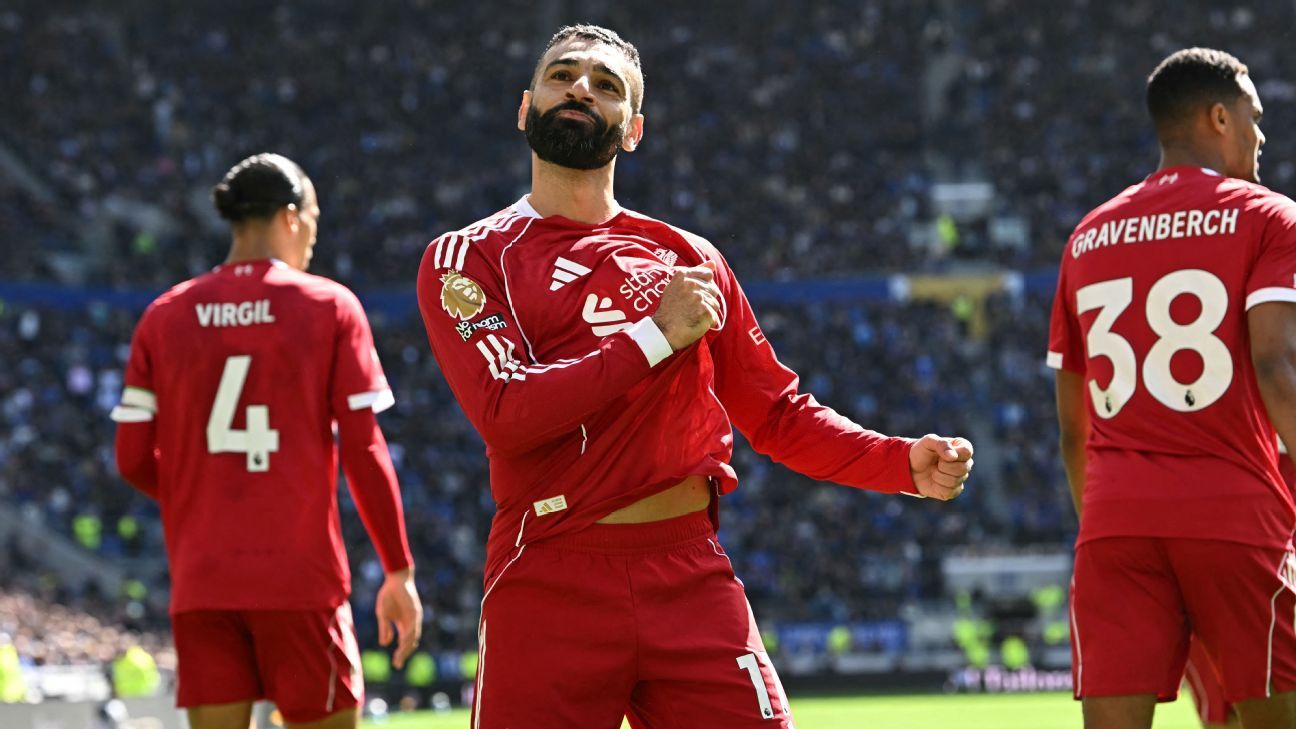
The final Merseyside derby for the last African King took place this weekend, as Mohamed Salah continued his routine in a new setting.
Sunday’s match marked the inaugural derby at Everton’s new Hill Dickinson Stadium, ushering in a new era in this longstanding rivalry after more than 130 years at Goodison Park.
With a new venue and the same familiar breeze from the Mersey, Salah was determined to maintain his established practices. He found the net once more, Beto equalized, and then… in the 100th minute… Virgil van Dijk emerged from the chaos to secure a 2-1 win for Liverpool, quieting the blue half of the city.
The evening was one of celebration, although the afternoon was tinged with farewell, as Salah, in his last derby, etched his name into the record books once again… tying Steven Gerrard for the most goals scored in the Merseyside derby during the Premier League era.
The goal came in the 29th minute; Salah, with a potential exit from Liverpool looming, disregarded the criticism to strike against the Toffees with his characteristic precision.
Everton started the match strongly, pressing and reminding Liverpool of their recent struggles against Paris Saint-Germain and Manchester City. However, Dwight McNeil, under pressure, miscalculated his teammate’s run and passed the ball directly to Cody Gakpo.
Gakpo acted swiftly, causing panic among the Everton players, and Salah was found by a brilliant defense-splitting pass inside the box. Despite discussions about the 33-year-old’s declining abilities, his anticipation and speed were evident as he raced onto Gakpo’s exquisite pass ahead of his marker and shot decisively past Jordan Pickford.
Salah had previously made his mark in the last derby at Goodison Park in February of the previous year, appearing to score the winner with a late shot, only for James Tarkowski to equalize deep into stoppage time, resulting in a 2-2 draw for the Toffees.
A new stadium, fresh steel, yet the same old scene persists; while some players thrive in familiar surroundings, Salah finds the net regardless of the architecture. This goal marked his ninth in the derby. Only legendary figures like Ian Rush, Dixie Dean, and Alex ‘Sandy’ Young stand ahead of him and Gerrard in the history of this fixture.
Salah has now scored at 42 different stadiums for Liverpool, with only three players having netted at more venues in the club’s history.
Recently, we analyzed his performance in crucial matches at Liverpool, one of the few criticisms that can be directed at the forward during his remarkable tenure on Merseyside.
Football creates unique narratives, and while Salah’s consistency is nearly unmatched, those rare occasions when titles are on the line or European ties are decided seem to weigh heavily against him.
Critics often echo the same sentiments: ‘Prolific, indeed, but where is he in the significant matches?’
The derby has become part of Salah’s response.
His brace in a 4-1 victory at Goodison Park during the challenging 2020-21 season, or another two goals at Anfield in October 2023, will be particularly memorable.
Throughout his time at the club, the derby may not have featured silverware or titles at stake, but the pressure of a city divided cannot be overlooked; these matches are where form yields to emotion and tactics give way to feeling.
Salah’s statistics in this context, this most historic of English derbies, are telling. Nine goals reflect a consistent dominance amid civic pressure, showcasing his ability to excel in both intimate and significant environments.
“I’ve felt fear going into every derby,” Gerrard stated in 2014. “The fear of losing. It’s not nerves or butterflies, but it is present in the days leading up to the match.”
While numerous other African players have participated in the derby over the years and had their moments—such as Johannesburg-born Gordon Hodgson’s brace against the Blues in 1935, Bruce Grobelaar’s own goal in 1984, and Joseph Yobo’s goal in 2009—none have matched Salah’s influence.
Sadio Mane scored four times in the Merseyside derby, often treating the date as a personal occasion. He notably netted after just two minutes and 15 seconds in October, setting a record for the fastest Liverpool goal in the fixture, and also clinched the 227th derby with a 94th-minute goal on his first appearance at Goodison.
Everton was relieved to see him depart, and they will likely be just as pleased to bid farewell to Salah as well. The African contributions to the derby from Everton—similar to this weekend—have often stemmed from hard work, determination, and disruption rather than headlines.
Idrissa Gana Gueye, still performing strongly, remains a formidable presence in these matches, a master of traditional midfield skills, while Abdoulaye Doucoure brings energy, physicality, and confrontation, and Iliman Ndiaye adds creativity, flair, and cunning in the attacking third.
He believed he had scored on Sunday, only for an offside call to nullify his goal, and he appears to be the most likely candidate to step into Salah and Mane’s roles as the next African star of the Merseyside derby.
Neither Ndiaye nor the others have impacted the scoreboard like Salah. They may participate in a derby, they may influence it, but they cannot replicate what he has achieved.
Who will rise to the occasion now?
Everton will certainly hope it is Beto, who continued his resurgence under David Moyes by equalizing with a brave lunge to meet Kiernan Dewsbury-Hall’s 54th-minute cross, giving the hosts a glimmer of hope for a positive result.
If the School of Science continues to stabilize, if service improves, and if confidence withstands its usual challenges, he could become the primary African figure in this fixture for the years ahead.
Ndiaye is a complementary player, but Beto’s physicality, his ability to elevate his game in tough situations, and his knack for unsettling defenders with sheer strength rather than subtlety, align well with the Merseyside derby.
Liverpool will be relying on Rio Ngumoha, who was brought on as a 72nd-minute substitute for Alexander Isak on Sunday, to pen the club’s next African chapter in this historic fixture.
The Anglo-Nigerian’s introduction made him the youngest player to participate in the derby, as he continues—like Salah before him—to break records for the Reds. His performances thus far suggest a talent capable of rising to significant moments, although whether he can translate his prolific youth form to the highest level remains to be seen.
Certainly, Liverpool fans speak his name with the hope reserved for those who have yet to disappoint.
For now, at least, the chapter closes on Salah’s derby contributions. No African has had a greater impact on this fixture, and it is difficult to envision any player doing so in the foreseeable future.
Records cast long shadows, and Salah leaves behind more than mere statistics.
He departs with a legacy of consistent excellence across seasons, managers, and venues. He scored when Liverpool pursued titles, he scored when they sought recovery, he scored at Goodison, at Anfield, and at Everton’s new home.
This rarity is why we are discussing a chapter at all.
Cities may rebuild docks, rename stands, and replace their spiritual homes… yet they cannot easily replace a habit.
Liverpool has sought a significant Salah moment in the derby for the past nine years. On Sunday, they witnessed it: McNeil’s mistake, a glimpse of space, a flash of red, that left foot, the net rippling.
Now, the door closes behind the last African king of this fixture, as younger footsteps gather in the corridor.

