
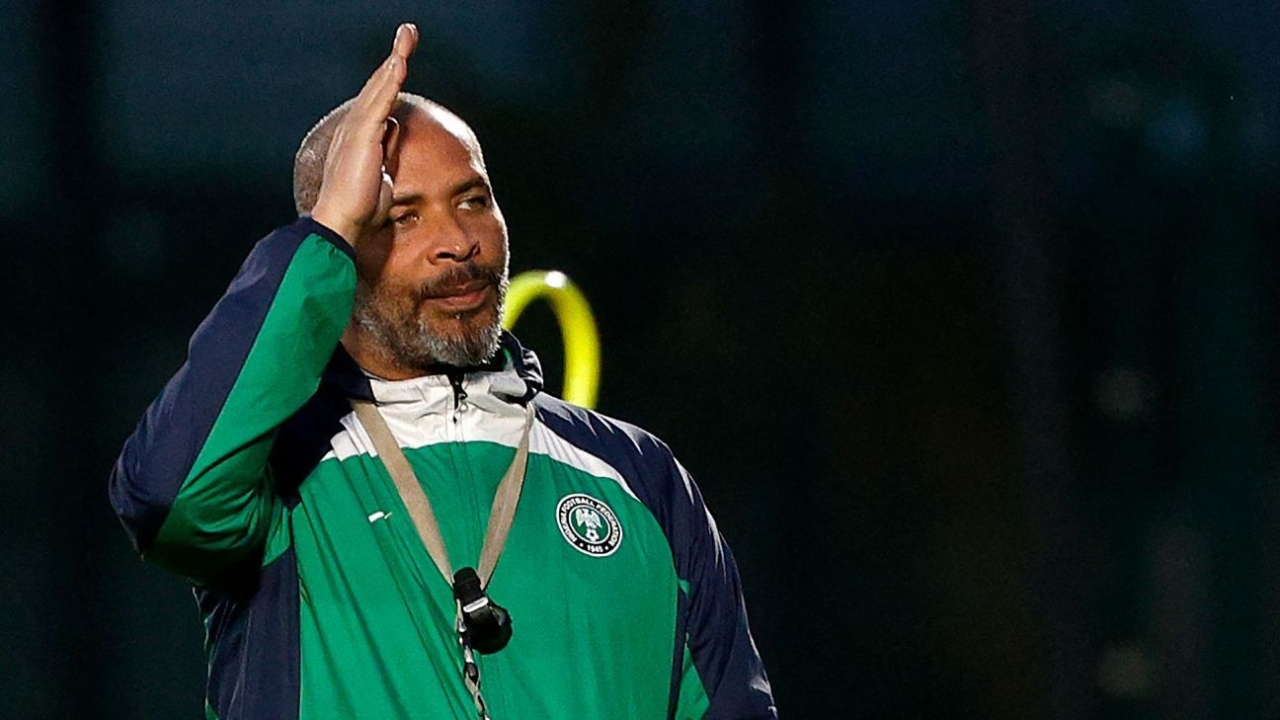
In the wake of Nigeria’s final game of the Africa Cup of Nations, where they secured bronze, one thing is undeniable: The Nigeria Football Federation need to do everything they can to hang on to their gem of a coach in Eric Chelle.
With their AFCON campaign concluded, ninth bronze medal in tow, what was obvious through the campaign is that for the first time in a long, long time the Super Eagles have not only found stability, but the swashbuckling football that Nigerians have been yearning for since forever.
Attacking football saw the team set a new standard. They harvested a team record 14 goals, more than any other Nigerian team in AFCON history, dominated possession by double figures in five straight games, and evened out in the other two.
They were outshooting and outscoring the opposition, except for the last two games. The defence also posted four consecutive clean sheets through the knockout rounds, for the first time ever.
They also went the entire competition unbeaten, winning five consecutive matches before draws against Morocco in the semifinals and Egypt in the third-place playoff that went to penalties.
Beyond the numbers, the team also passed the eye test, playing a brand of football that Super Eagles fans have not seen since the 1990s.
All of that is mostly down to Chelle.
Appointed in January last year, after a series of coaching upheavals that saw the team start the FIFA World Cup qualifiers with Jose Peseiro, then transition to Finidi George and Austin Eguavoen, it is exactly this stability that Chelle was expected to bring to the team.
In just one year, Chelle has completely transformed the Super Eagles, and the results speak for themselves. After 18 official games played, the Malian is yet to lose, racking up 11 wins and seven draws.
During this period, Nigeria have scored 35 goals while conceding just 13, turning the Super Eagles into an attacking force that has rekindled memories of the nation’s glory days.
The transformation has impressed more than just the fans. Nigerian football royalty Segun Odegbami, captain of the 1980 Nations Cup-winning squad, recognized shades of that championship team in Chelle’s Eagles, and gave his stamp of approval after their quarterfinal demolition of Algeria.
“These Super Eagles have awakened my once-waning spirit,” Odegbami told ESPN. “I sat and watched how they came out flying, totally dominating the match in every way.
“The Algerians did not even get a glimpse of the Nigerian goal until 80 minutes into the game, by which time, when they woke up from the slumber of hopelessness against a faster, stronger, more combative and sleeker Eagles, the match was over. They were left in a daze of confusion, wondering what had just hit them.”
Odegbami declared the performance a masterclass, adding: “The Eagles are a team on fire, a team now finding its rhythm, creating and scoring goals freely, and improving steadily from match to match.”
He is not alone. Nigerians on social media have echoed the same, asking the NFF to ensure that Chelle continues on the job. Those requests were reinforced by team captain Wilfred Ndidi, soon after the team were eliminated on penalties in the semifinal by Morocco.
“For continuity, I feel like the NFF should keep the coach because he’s a wonderful manager,” Ndidi told ESPN.
“The only thing we need now is continuity, not to try to change things now because we didn’t get to a final.
“Things have been amazing for a long time, and that boils down to the coach and the leaders of the team for the future.”
Ndidi’s plea is a player’s perspective of the painful reality of Nigeria’s failure to qualify for the World Cup. It stemmed mainly from the constant coaching changes, an upheaval which saw six coaching changes, and four coaches in one qualifying series between December 2021 and January 2025, disrupting team rhythm and preventing the sort of tactical cohesion now in full display under Chelle.
“We have to focus on the competitions ahead,” Ndidi added. “There are so many games ahead, and to focus on the team right now, I am proud of this set of players.”
Ndidi is right to be concerned. Nigeria’s history of replacing coaches has been anything but stellar and precedent suggests that the time cost attached to a coaching change will be paid for in bad results.
Here is why.
The NFF typically takes an average of six months between firing one permanent coach, and hiring the next.
That next coach would then require at least three months to implement his system, a nine-month transition that produces stumbles and poor results. With Nigeria’s AFCON 2027 qualifying campaign starting in September and only a March international window available beforehand, little margin exists for such disruption.
Chelle has laid a foundation, and a new coach would most probably have to tear it down in order to start his own rebuild. In his year at the helm, he has methodically built a cohesive unit that now operates with clear tactical identity and purpose.
That change has not just been evident on the pitch, but has secured players’ buy-in. Defender Bright Osayi-Samuel praised Chelle’s tactical implementation, particularly the team’s evolving mastery of the 4-4-2 diamond formation that has unlocked Nigeria’s attacking potential.
“The team is getting better match after match,” Osayi-Samuel said. “The manager is responsible. The formation that we are playing, the way we start games, kudos to the manager. There is confidence within the team.”
The defender acknowledged that there was a learning curve involved in adopting the new system: “It’s a lot of information. This is a formation that we only just started playing. You can see everyone is starting to understand and each game we are growing together as team.”
Midfielder Alex Iwobi added that the changes are more than just on the field: “There’s one thing that we have in our camp and it’s a message we say all the time that it doesn’t matter how you are physically, you have to make sure you are ready mentally and the coach says it to us all the time.
“Also off the pitch, there’s big unity, there’s a big family and it starts from the coach. He’s brought that brotherhood and it’s nice because we are one big family and you can see on the pitch that we are fighting for each other.
“That’s bringing out the best, not just in me but in all the players.”
Ndidi says that has fostered a collective ethos that prioritizes team over individuals: “We’re not a one-man show, it’s not just one person carrying the team. Even for new players coming in, they see we have one philosophy; that the team is bigger than anybody.”
The Abidjan-born coach has also forged strong personal bonds with his players, creating a family atmosphere that transcends the professional relationship, he has even been heard to call the players his brothers.
But Ndidi warns that that can be deceptive: “I laugh because looking at the eyes of the man, you wouldn’t think he’s so demanding. Not just on the pitch, but when we eat, when we have a meeting, the demands are very high.
“That’s when I talk about standards, he’s the one who sets these standards. If you come, you have to come correct.”a
Despite the high expectations, Chelle maintains an approachable demeanour that resonates with the squad.
“He’s a lovely guy, playing all the time,” Ndidi said. “Apart from being the manager, he plays with everyone.”
The good news is that the NFF president himself appears to be Chelle’s biggest cheerleader. Ibrahim Gusau acknowledged the initial scepticism surrounding Chelle’s appointment and seemed to suggest that the coach would be given time to continue.
“When we decided to hire this coach, a lot of people had a lot of doubt in him,” Gusau told reporters in Morocco.
“”But it is only when you give a coach time to form up a team that he will succeed. If you look at the way he started, about four to seven matches in, he was changing players. Now we have got to a point where he can say he has a starting eleven.”
That settled lineup, and eye-pleasing football, both evidence of the visible progress under Chelle’s guidance, have become a key strength and may be why the NFF keeps him.
Gusau added: “That is the greatest achievement we can be proud of going forward because we must be happy to see Nigerians playing the kind of football that Nigerians really know about Nigerian football.
“The most important thing is that we are seeing progress in the team, match in match out. That is what makes us happy. I know everybody has started to see the true Nigerian spirit in our game.”
Further good news for Nigerians is that despite reports of interest from other countries, Chelle himself has expressed strong commitment to continuing his project with Nigeria.
After the semifinal loss to Morocco, he addressed speculation about his position: “My future? Now I don’t know but I know something – I’m the coach of Nigeria and maybe in few days my president will tell me it’s finished for you or maybe you have to continue.
“I’m a fan of the Super Eagles team during many years, so this job is very important to me. But I’m not the boss, I just try to do my job.”
After the third-place playoff victory over Egypt, Chelle confirmed his intentions to build on the foundation he has laid.
“My mission is to keep this group of players, if I am still the coach of Nigeria’s Super Eagles, of course,” he said.
That must come as welcome relief to Super Eagles fans. Still, there is much work to be done in other areas if future success is to be assured.
Beyond retaining Chelle, the NFF must develop sustainable structures for identifying and developing talent from grassroots to senior level, balancing homegrown players with quality diaspora talent who can strengthen the national team.
There are two AFCON tournaments coming back to back in 2027 and 2028, and Nigeria must plan to win at least one of them. Resisting the familiar pattern of coaching upheaval is a good place to start.
