
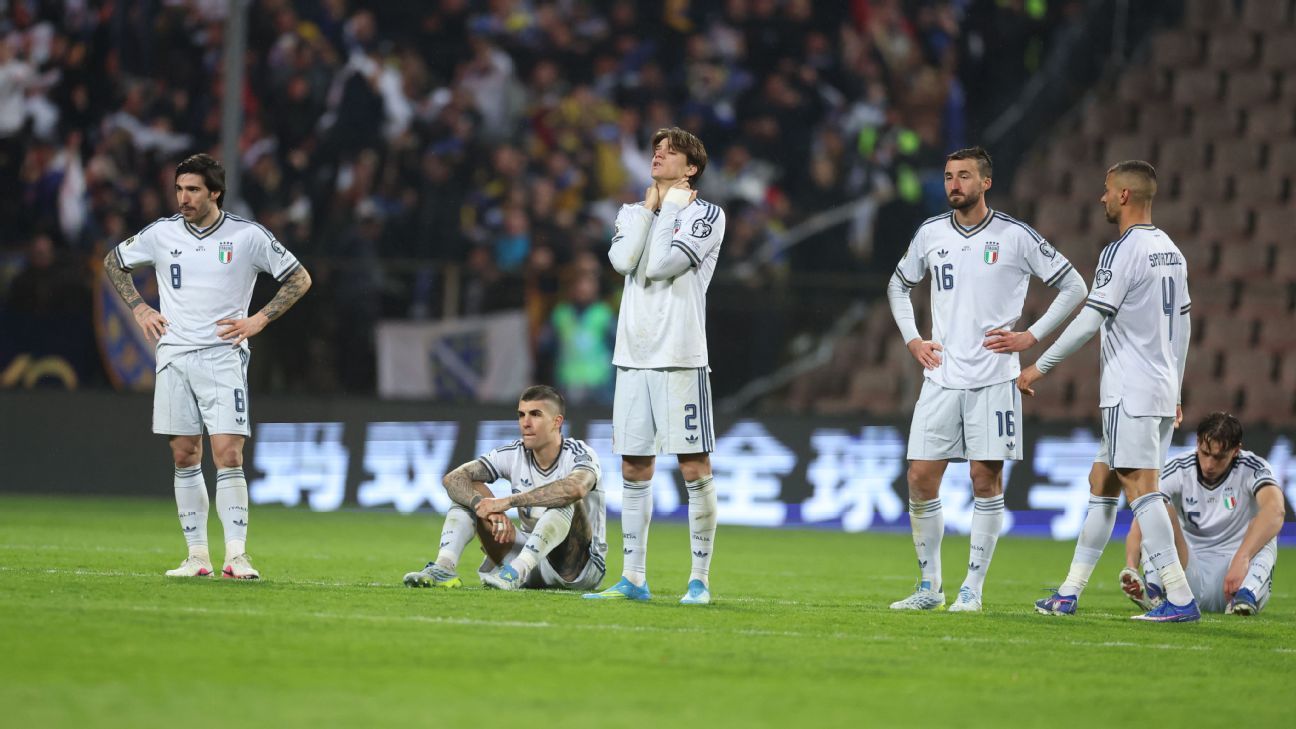
I could say that “this isn’t amusing anymore,” but I already used that line previously. I also mentioned the idea of “allowing someone else a chance to win a World Cup, since we have four of them at home — as many as England, Spain, and France combined — and we don’t want to be greedy,” back in 2018.
So where do you look now that Italy has not qualified for three consecutive World Cups, a feat no other World Cup-winning nation has accomplished? This is particularly notable given that the World Cup field has expanded by 50%, from 32 to 48 teams.
I’m uncertain, but I am quite sure about what is unnecessary following Tuesday’s penalty defeat against Bosnia-Herzegovina.
– Meet World Cup’s debutants: Curacao, Uzbekistan, Cape Verde, Jordan
– O’Hanlon: Ranking the 2026 World Cup field
– Karlsen: One tactical note to know about all 48 World Cup teams
What you don’t need are extensive analyses regarding the decline of Italian football and demands for comprehensive reviews. No, it’s not that Serie A today is inferior to what it was in the 1990s that led to Italy’s failure to qualify. Serie A was arguably not better — it may have been worse — when Italy reached the finals of the Euros in 2012 and 2021, winning the latter.
Or Gennaro Gattuso, the current Italy coach (at least for now), praising his team’s spirit and effort, claiming they did not deserve to be eliminated. While their heart and effort cannot be criticized, Bosnia displayed similar, if not greater, determination. They were coming off 120 minutes plus penalties against Wales away from home, featuring a 40-year-old forward. (If you want to discuss “heart” and “effort” today, look up Edin Dzeko.)
Or lamenting — Gattuso again — their missed opportunities and incidents. Certainly, if Moise Kean had converted his counterattack in the second half, or if Fede Dimarco had finished with his weaker foot, or if Francesco Pio Esposito’s header had evaded Nikola Vasilj, Italy would have qualified. Perhaps they would have advanced if Tarik Muharemovic had received a yellow card instead of a red. And — cruel irony! — if Gianluigi Donnarumma had not deflected Dzeko’s shot into the path of Haris Tabakovic for his goal, Italy would have progressed because the ball had touched Dzeko’s elbow. But so what? Donnarumma had to make 10 saves, several of which were world-class. Bosnia took 30 shots and squandered numerous chances as well.
The truth is, it’s not that complicated. Italy may not possess the depth of talent like France, Spain, or England, but they had sufficient quality to qualify. They are ranked 13th in the FIFA standings, after all. This is not an aging squad (only one starter, Matteo Politano, is over 30) or a disinterested one (effort and commitment were not the issues).
The reality is that they complicated their situation significantly at the beginning of the qualifying campaign, suffering an early loss to Norway (partly due to some poor decisions), which meant that, realistically, avoiding the playoffs was never truly within their control after that. Once you enter the knockout format, unexpected events can occur, and moments can take on disproportionate significance.
Alessandro Bastoni may be among the top central defenders, but that foolish red card after 41 minutes is a major reason why Italy will be watching the summer tournament from home. With 11 players on each side, you would have liked their chances not because they were performing well — at that point, the Azzurri had only managed two shots on goal with an xG of 0.15 — but because, with Italy leading 1-0 at that moment, there was a clear opportunity.
Maintain possession, force Bosnia-Herzegovina to chase, tire them out, and leverage your experience. That is what Gattuso executes reasonably well: straightforward game plans, playing the odds, and plenty of passion, energy, and gesturing on the sidelines.
However, being a man down changed everything. Italy shifted into a defensive mode and invited pressure from Bosnia. The match, for the players and the millions of Azzurri supporters, turned into an 80-minute ordeal directed by Esmir Bajraktarevic and Kerim Alajbegovic. It was a straightforward strategy from a simple coach in Gattuso who — beyond sideline enthusiasm — provided very little additional value during his tenure.
Which, it should be noted, was not lengthy at all: Gattuso had no more than 15 training sessions with his players in his 10 months in charge. Although, to be fair, one might wonder if more time could have led to more opportunities for mistakes because, there is no denying this, Gattuso did not assist his own cause.
When you have superior players compared to your opponent, the optimal strategy is typically to utilize that talent effectively, taking the initiative in the game. And as we observed, Gattuso did not do that, possibly due to being unsettled by the early lead they were given by the hosts, or perhaps paralyzed by fear following the red card.
Are there systemic issues that hinder the advancement of Italian football? Certainly. One could argue that there is too much focus on results and tactical acumen over development and technical skills at the youth level. It could also be noted that Serie A clubs are more hesitant to trust homegrown talent compared to those in other leagues, creating a “blockage in the pipeline” to first-team football, or that clubs do little or nothing to support the national team (evidenced by Gattuso’s inability to organize even a two-day training camp).
However, these are not the reasons Italy failed to qualify for the World Cup. Poor decisions and subpar performances during qualifying left them with margins that were far narrower than they should have been. Bosnia’s determination, resilience, and enthusiasm (along with some missed penalties) contributed to the outcome.
Not that it diminishes the pain, in any way, shape, or form, of course. When you have won four World Cups, believe me: it hurts even more.
