
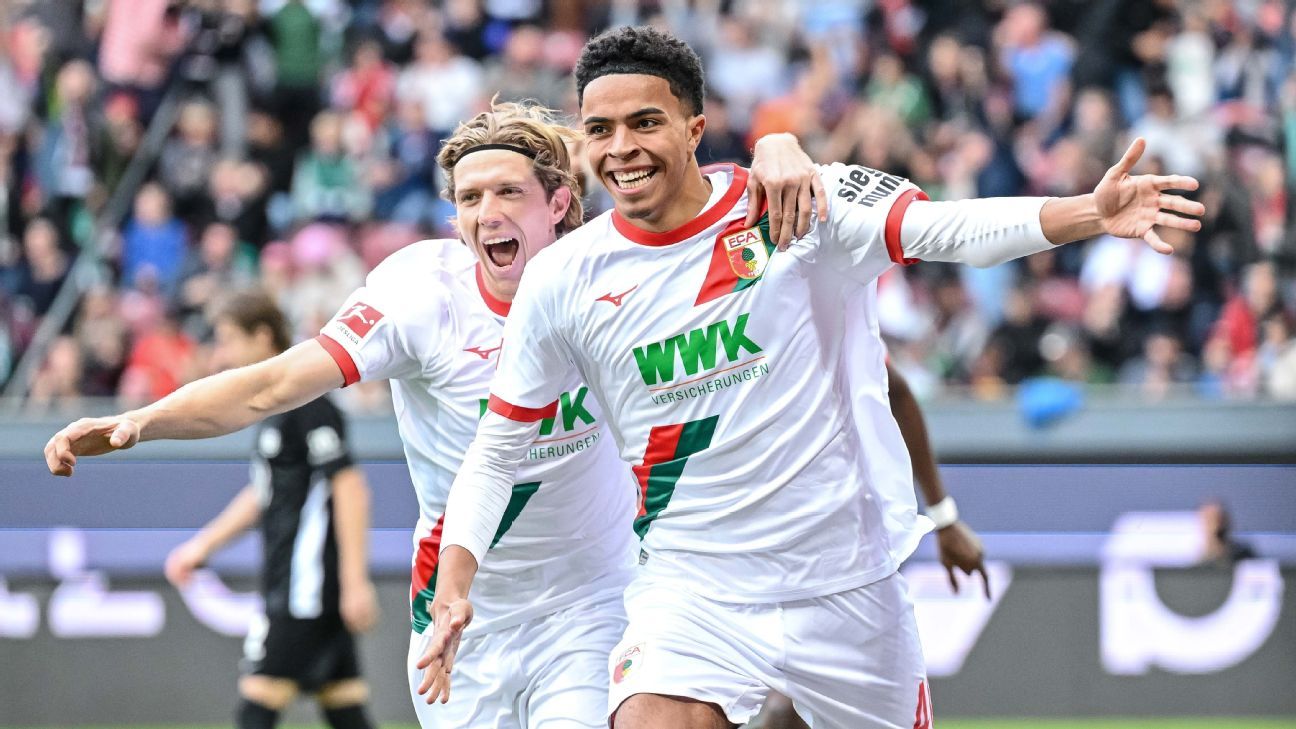
The first occasion Marko Mitrovic observed Noahkai Banks in action was in August 2022, when Banks played for FC Augsburg’s under-17 team against Bayern Munich’s under-17 squad. Mitrovic, who was then the head coach of the United States under-19 men’s national team, aimed to identify a potential talent for the U.S. U17 team, managed by Gonzalo Segares at the time.
It was not Banks’ finest performance. Bayern took an early lead, scoring two goals within five minutes, ultimately winning the match 5-1. When asked to reflect on the performance of the then-15-year-old Banks, Mitrovic remarked that Banks resembled “Bambi on ice,” indicating that he had yet to fully develop his 6-foot-4 physique.
“His hands and legs seemed to belong to four different individuals,” Mitrovic stated, who is now the head coach of the New England Revolution.
– USMNT 2026 World Cup big board 4.0: Roster coming into focus
– How MLS’ USMNTers endure long offseason to stay sharp for World Cup
– USMNT’s Christian Pulisic welcomes world to Milan for Winter Olympics
The purpose of such a visit was not solely to assess a player’s current abilities but also to envision their potential future. Mitrovic found several aspects of Banks’ game appealing. He was particularly impressed by Banks’ passing ability and his understanding of the game, noting that Banks possessed an exceptional soccer intellect, which boded well for his future prospects.
“Everything that [Banks] attempted in that match may not have been executed perfectly due to his physical development at that time, but all his decisions were correct both on and off the ball,” Mitrovic commented.
Mitrovic eventually recommended Banks for the U.S. U17 team. This proved to be a wise choice, as 3½ years later, the now 19-year-old is a regular player for Augsburg and is on the verge of earning his first cap with the U.S. national team, potentially even making the FIFA World Cup roster. Banks was called into a USMNT camp in September, although he did not play. Nonetheless, U.S. manager Mauricio Pochettino referred to Banks as “a massive talent.”
As Banks settles into a chair at Augsburg’s stadium, the backdrop reveals a typical cold, dark winter day in Germany—a time perhaps more suited for watching films, one of Banks’ preferred pastimes. However, despite enjoying a breakout season and being a bright spot for Augsburg, it is evident that his focus is not on the World Cup. Augsburg currently occupies 11th place in the 18-team Bundesliga, and their status in the top division remains uncertain.
“We have many games remaining, so I am concentrating on our current situation, and we will see what happens in the summer,” Banks stated in an exclusive interview with ESPN. “But I don’t believe this is the right time to think about the World Cup or anything beyond our matches, as our current position is more critical at this moment.”
The making of “Noki”
Banks was born in Honolulu to a U.S. serviceman, Sedrick Banks, and a Spanish-German mother, Nadine. According to Nadine, the family relocated to Germany when Noahkai was just 7 weeks old, alternating between Washington, D.C., and Germany. Nadine and Sedrick separated shortly thereafter, with Nadine returning to Dietmannsried, a small town near the Bavarian Alps with a population of approximately 8,500. Noahkai continued to visit Sedrick regularly, who, according to Noahkai, now volunteers with youth groups in the nation’s capital.
Nadine’s sister, Nicole, is the origin of Banks’ nickname, “Noki.” She appreciated how “Noki” rhymed with “schoki,” the German term for “chocolate bar,” and the nickname became established. Now, Banks mentions that only his mother refers to him as Noahkai, “when she’s upset with me.”
Banks developed a passion for soccer at a young age, always having a ball at his feet. Whenever Nadine would suggest going for a walk, he would be at the front door with three soccer balls. Whenever soccer was broadcast on television, Banks was fully engrossed.
“[Noki] was just captivated by soccer,” Nadine remarked. “I can’t explain it.”
By the age of 8, Banks had advanced enough to catch the attention of Augsburg, leading to a tryout. What transpired next was one of those pivotal moments that can alter a career’s trajectory. Some staff members at Augsburg expressed doubts about Banks’ abilities. However, one youth coach, Daniel Pawlitschko, recognized potential in young Noki.
“The scouts were uncertain, saying, ‘Oh, we don’t know if he has what it takes,'” Nadine recalled. “But [Pawlitschko] insisted, ‘No, I see his potential, and I want to keep him.’
Pawlitschko subsequently coached Banks through various age groups. During a later roundtable with reporters, Banks expressed gratitude towards Pawlitschko, stating, “Because of him, I’m here. So I’m extremely thankful to him.”
The aftermath of that tryout mirrored the experiences of many youth players in the U.S., characterized by lengthy drives to practice. Augsburg was a 90-minute journey from Dietmannsried, and Nadine would accompany Banks—along with his baby sister in the back seat—three times a week. “My friends often told me, ‘You must be crazy. Why are you doing this?'” Nadine recounted.
Eventually, Augsburg arranged bus transportation, although that resulted in an even longer commute: three hours each way. However, sports were deeply ingrained in Banks’ family, leading to a willingness to make such sacrifices.
Nadine was a dedicated basketball player in her youth and even had the chance to play at the collegiate level in the U.S., but her third ACL tear ended those aspirations. She later married Thomas Kinkel, who played and coached handball for 35 years. Banks’ strong work ethic complemented this background. The Augsburg coaches assigned players homework when they were not practicing with the team. The young defender was a perfectionist, dedicating hours in the backyard until he mastered his skills.
“There were many tears shed in our garden from Noki,” Kinkel, Banks’ stepfather, noted.
Banks is so cool he “pisses ice cubes”
Banks’ determination yielded results, and his physique matured. Kinkel remarked that Banks’ shoulders were so broad they resembled a “kleiderbugel,” or clothes hanger. Banks’ confidence, bolstered by frequently playing against older opponents, also grew. By the 2024-25 season, Banks was part of Augsburg’s first team, making his debut on January 12, 2025, in a home match against VfB Stuttgart. Defender Max Bauer had to leave the match due to injury after just 29 minutes, allowing Banks to step in and perform admirably, despite the team ultimately losing 1-0.
“It was surreal, not just for me, but for my mom as well. She was in the stadium. She cried. My grandpa was also there, and he cried too,” Banks reflected on his debut. “I honestly didn’t expect to come on in this game, as another center back was playing… Then everything happened so quickly that I couldn’t really process it.
“But the following day, it felt surreal. It was like a dream, to be honest.”
More joyful tears were shed last October when Banks netted his first Bundesliga goal in a 3-1 victory over VfL Wolfsburg. This time, both his mother and stepfather were present in the stands. Among the memorable moments from the match was a comment from Augsburg sporting director Benni Weber, who, impressed by Banks’ overall composure, remarked that the player “pisses ice cubes.” More significantly, it marked Banks’ emergence as a Bundesliga player, and he has maintained a consistent presence in the Augsburg lineup since then.
It would be understandable if all this newfound attention affected Banks’ demeanor—after all, few 19-year-olds are regular starters in the Bundesliga—but Banks remains grounded, both in his club and family. He asserts that there is no risk of arrogance taking hold.
“I think it’s quite simple because my mom would be furious if I didn’t stay humble,” he stated. “And yes, it’s easy because everyone at the club is very modest. It’s like a family here, so there’s no space for arrogance or anything like that. It’s quite straightforward, to be honest.”
It also helps that Banks does not engage with social media, although that does not prevent Nadine from sharing posts in the family group chat.
“I believe it’s crucial not to read too much online because when you perform well, everyone praises you. When you play poorly, you’re labeled the worst player ever, which can impact you,” he explained. “So I always tell my mom, since she sends a lot of things from Twitter, ‘Mom, don’t read that because it can affect me.’
Banks is acutely aware that he is far from a complete player. He observes team captain Jeffrey Gouweleeuw to gain insights that only experience can provide.
“When I watch [Gouweleeuw] train, he does some things differently than I do,” Banks noted. “He’s clever. Sometimes, he avoids following the striker’s run, allowing him to go offside. I believe those are aspects that come with time and that I can also improve upon.”
Will an early connection pay off for the USMNT?
Banks’ association with the U.S. national team program began in a rather unassuming manner. Segares recalled being in a meeting with Garrett Biller, then the USSF’s talent identification manager for the central region, when Biller remarked, “Hey, we have this kid from Germany that we need to evaluate.”
Mitrovic’s subsequent trip to Germany followed, leading to Banks attending training camps for the U.S. U17 national team. Banks’ passing ability caught Segares’ attention, as did his development from camp to camp. In each gathering, Banks demonstrated something new to Segares and the coaching staff.
“Suddenly, [Banks] would arrive at another camp, breaking lines with his dribbling and opening up defenses,” Segares noted. “For me, I had never seen a center back who found it so effortless, or possessed that capability. He could dribble past three players and then deliver an incredible pass.”
Banks was ultimately selected for the squad that participated in the 2023 FIFA under-17 World Cup. Segares recalled that Banks was one of the team’s “top performers,” although it ended in disappointment. The U.S. was eliminated in the round of 16 following a 2-1 loss to Germany, a match in which Banks was suspended due to yellow card accumulation.
Banks endeared himself to his teammates in various ways. In Segares’ squad, one consequence for tardiness was to sing in front of the entire team. Banks sang so frequently that Segares joked he must have been intentionally arriving late.
And what did Banks sing? “There was a lot of Justin Bieber in there,” said U.S. U17 teammate Pedro Soma, who now plays for San Diego FC. Segares recalls a rendition of the 1980s classic “99 Luftballons” by the German rock band Nena.
For decades, the USSF has made it a practice to introduce dual nationals to the benefits of the U.S. program during their teenage years. This strategy has helped solidify the commitment of players like defender Sergiño Dest and midfielder Yunus Musah, even when other nations expressed interest. It is evident that in Banks’ situation, the USSF has once again been strategic, and for the player, those experiences with the U17s left a lasting impact.
“When I received my first invitation [with the U.S.], it was clear to me that I wanted to participate,” Banks stated. “Since then, I have been extremely pleased with the U.S. because I have made many friends there. To this day, we still stay in touch. So yes, it has been wonderful. Additionally, the under-17 World Cup was a dream. Marco has been a fantastic experience with the under-20s. So, I was always very happy to join the national team and reunite with my friends. There was never really a consideration of anything else, to be honest.”
That has not deterred Germany from reaching out now. Banks acknowledged that there has been communication. There remains a possibility that he could switch allegiances since he has not yet participated in an official competition for the U.S.
However, Banks’ call-up in September was another instance of the U.S. continuing its recruitment efforts. Banks referred to Damion Downs and Alex Freeman as his “go-to guys” in terms of friendships formed, but he also expressed admiration for how welcoming the team was, including players like Tim Ream, Christian Pulisic, and Tim Weah. Teammates ensured he was included in team dinners. Pochettino, a former center back, provided Banks with insights on the nuances of the game.
“I genuinely enjoyed the camp because I thought as a young player, I might be treated differently,” Banks said. “But the way the guys helped me integrate into the team and training was incredible, to be honest. Even the prominent players like Christian Pulisic or Tim Weah, whom we might not expect to be so approachable, were fantastic.”
If Banks continues on his current trajectory, an even more significant summer awaits.
