
How the USMNT Player Pool Has Changed Since the 2022 World Cup and Its Implications for 2026
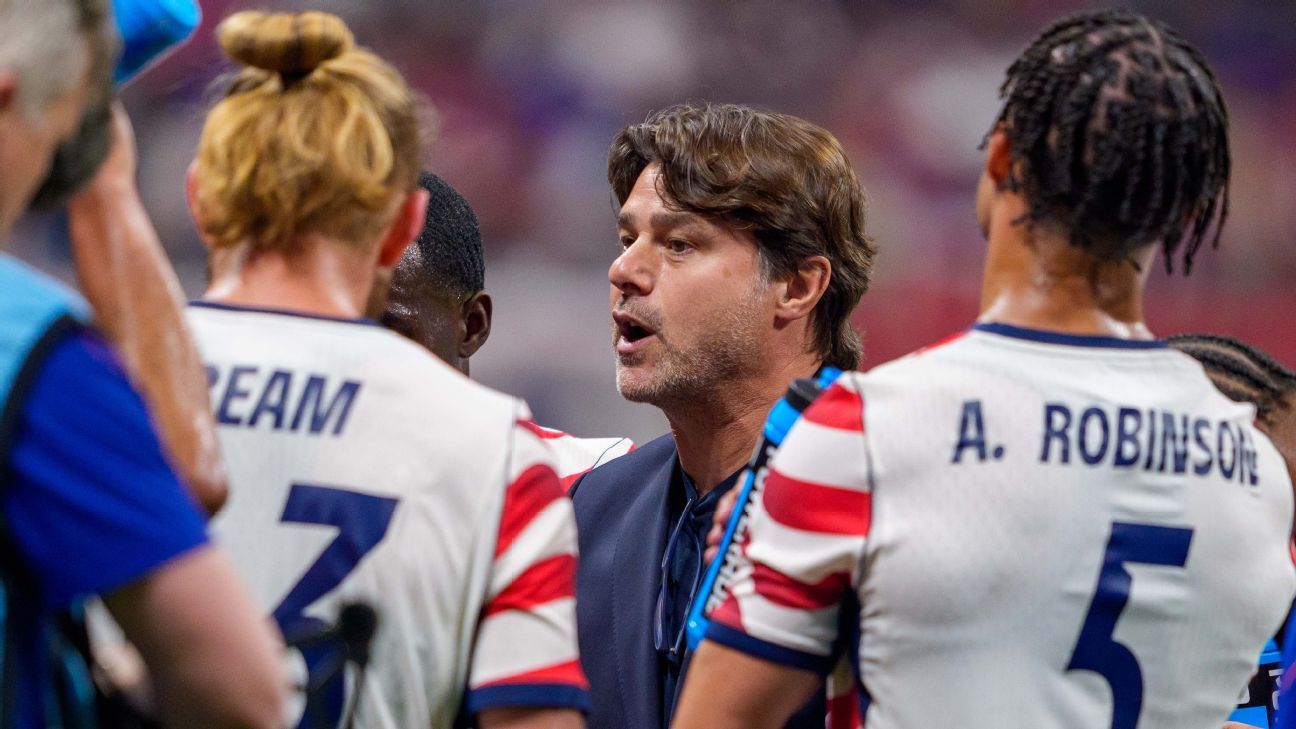
As the final whistle marked their 3-1 loss to the Netherlands in the 2022 World Cup round of 16, the U.S. men’s national team entered an unusual 3.5-year period. As co-hosts of the expanded 2026 World Cup, they were already qualified, meaning they wouldn’t engage in another significant match until the tournament commenced.
Numerous headlines were anticipated, including parting ways with Gregg Berhalter, re-hiring him, dismissing him after a disappointing Copa America group stage, securing two Nations League titles, losing two Gold Cups, and hiring Mauricio Pochettino. Each of these events held significance. However, the primary concern remained how the team would perform in the summer of 2026.
After Saturday’s defeat to Belgium in Atlanta, the U.S. has three matches left before the World Cup begins: they will face Portugal in Atlanta on Tuesday, Senegal in Charlotte on May 31, and Germany in Chicago on June 6, after which the tournament will commence. As the final preparations are underway, it is essential to review Pochettino’s lineup choices and the evolution of the player pool since the conclusion of the action in Qatar. Many key players from 2022 are still in contention, and while depth has improved in several positions, a shortage of options in central defense may pose challenges.
A lack of chemistry could also be a concern: Jeff Carlisle’s latest projected U.S. starters (all highlighted in the sections below) have yet to play together on the field.
Let’s analyze each position.
– Carlisle: USMNT faced a reality check against Belgium
– O’Hanlon: Does the U.S. finally possess enough depth to compete?
– What is it like to play for Pochettino? U.S. players share their thoughts
Goalkeeper
Minutes-adjusted average age under Pochettino: 28.4
Incumbents who remained involved:
1. Matt Turner (31): 810 minutes under Pochettino
2. Zack Steffen (30): 90 minutes
New names to emerge:
1. Matt Freese (27): 1,170 minutes under Pochettino
2. Patrick Schulte (25): 90 minutes
Following his strong showing in Qatar, it was reasonable to assume Turner would be the starting goalkeeper for 2026. However, his difficulties at the club level—having played minimally after joining Arsenal in 2022-23, struggling on loan with Nottingham Forest, and seeing limited action on loan with Crystal Palace—have opened the door for competition. Freese has capitalized on this opportunity.
Freese has accumulated more minutes than Turner under Pochettino, and in Turner’s last two U.S. appearances, he conceded nine goals with a save percentage below 50%. Freese’s shot-stopping metrics and buildup play have been slightly superior, and while the gap between the two does not seem vast, Freese appears to have the upper hand.
The future of the position looks promising as long as younger players continue to challenge Freese. Columbus’ Schulte, FC Cincinnati’s Roman Celentano, and San Diego FC’s CJ dos Santos (all 25 years old) could further enhance their profiles, and while no young player has emerged as a guaranteed future star, there are potential candidates. Gaga Slonina (22) was once one of the most exciting teenage prospects in the player pool, having already established a solid level of performance with the Chicago Fire; however, he has been somewhat lost in the Chelsea loan system and requires stability. Nevertheless, he remains young. Barcelona B goalkeeper Diego Kochen (20) is also in the mix. Chris Brady (22) is making a name for himself with the Chicago Fire as well.
There may be considerable competition for positions on the depth chart in the coming years, especially if Freese does not secure the No. 1 role.
Center-back
Minutes-adjusted average age under Pochettino: 30.6
Incumbents who remained involved:
1. Tim Ream (38): 1,558 minutes under Pochettino
2. Chris Richards (25): 1,094 minutes
3. Mark McKenzie (27): 899 minutes
4. Miles Robinson (29): 532 minutes
5. Walker Zimmerman (32): 187 minutes
6. Cameron Carter-Vickers (28): 90 minutes
New names to emerge:
1. Tristan Blackmon (29): 174 minutes under Pochettino
2. Auston Trusty (27): 100 minutes
3. George Campbell (24): 88 minutes
 play3:03Is the USMNT prepared for the World Cup?
The ‘FC TV’ crew reacts to USMNT’s 5-2 loss to Belgium.
No position group has undergone less change over the past four years than this one. At times, this can be viewed positively. However, on Saturday, it was not the case.
Players such as Zimmerman, Aaron Long, Matt Miazga, and Erik Palmer-Brown seem to have been phased out of the player pool, but Ream played every minute of the 2022 World Cup for the U.S., and Richards likely would have as well if not for injury. They have certainly been the top two names under Pochettino, and while Richards’ ongoing development at Crystal Palace has been one of the most encouraging stories for the U.S. in recent years, Ream has begun to show signs of aging. He struggled on Saturday against Belgium, and his difficulties were compounded by the absence of both Richards and Miles Robinson due to minor injuries. With no other clear options, Ream and McKenzie still played the full 90 minutes.
One of the most intriguing questions regarding this group, in relation to the World Cup, is whether two or three will be included in the starting lineup. Until Saturday, Pochettino had utilized either a 3-4-3 or 3-4-2-1 formation in the previous six U.S. matches, during which the team remained unbeaten; without Richards and Robinson against Belgium, Pochettino reverted to a 4-2-3-1. What choices might he make if all options are available in June? If he loses confidence in Ream or McKenzie in the upcoming weeks, could former full-backs like Joe Scally or Alex Freeman become candidates for a three-man back line?
Of the seven center-backs who have played at least 90 minutes under Pochettino (excluding Scally or Freeman), six will be at least 31 years old by 2030. While this position typically skews older, the minutes-adjusted age is already over 30, and the lack of reliable depth necessitates the emergence of new names.
This could mean players like West Brom’s Campbell or L.A. Galaxy’s Justin Haak (24) taking on greater responsibilities. Anticipated youngsters such as New York Red Bulls’ Justin Che (22) or Bayern loan army member Grayson Dettoni (20) may begin to break through. Alternatively, the ongoing recruitment efforts for dual-national Noahkai Banks may finally yield results. The 19-year-old, born in Hawaii, has already established himself as an impressive Bundesliga defender for Augsburg and would rise to the top of the hypothetical 2030 U.S. depth chart if he opts to represent this country instead of Germany. He has yet to make a decision.
Full-back / Wing-back
Minutes-adjusted average age under Pochettino: 23.7
Incumbents who remained involved:
1. Joe Scally (23): 581 minutes under Pochettino
2. Tim Weah (26): 521 minutes
3. Antonee Robinson (28): 356 minutes
4. Sergiño Dest (25): 214 minutes
5. Shaq Moore (29): 121 minutes
New names to emerge:
1. Max Arfsten (24): 1,112 minutes under Pochettino
2. Alex Freeman (21): 1,002 minutes
3. John Tolkin (23): 233 minutes
4. Marlon Fossey (27): 135 minutes
5. Kristoffer Lund (23): 134 minutes
6. Nathan Harriel (24): 121 minutes
7. DeJuan Jones (28): 115 minutes
8. Caleb Wiley (21): 24 minutes
In an ideal scenario— or at least one with optimal player health— Robinson and Dest would be clear, first-choice selections on the flanks as either full-backs or wing-backs. They are athletic, strong in offensive roles, and Robinson has been among the top full-backs in the Premier League at his best in recent years. However, Dest missed a significant portion of 2024-25 due to an ACL injury, and Robinson has faced challenges with both injury and form in 2025-26: he has played only 1,339 minutes across all competitions, and after recording 10 assists last season, he has managed just one this campaign. Neither has exceeded 300 minutes under Pochettino yet, and Dest was sidelined once again with a minor injury on Saturday. In his absence, Weah struggled significantly against Belgium’s exceptional Jérémy Doku.
Weah appears more suited for a wing-back role than a full-back, but there are additional options available on the flanks. Scally has performed adequately for both club (Borussia Monchengladbach) and country, while Arfsten and Freeman have both made strong cases for inclusion in the World Cup squad. Only Ream, Freese, and Richards have logged more minutes under Pochettino, and while Arfsten’s defensive weaknesses are concerning, his five assists for the U.S. are the highest of anyone during Pochettino’s tenure.
Freeman’s athleticism—he moves across the pitch as if he is the offspring of a well-known American football player (which he is)—recently caught the attention of LaLiga’s Villarreal. Although he hasn’t played extensively since joining the Spanish club, it would be surprising if either Freeman or Arfsten did not make the squad, even if they do not start in the World Cup.
Regardless of the outcome this summer, it seems the U.S. is better equipped than ever on the flanks. Robinson will be 32 during the 2030 World Cup, but even if he ages out, Dest will only be 29, Arfsten will be 28, Scally and John Tolkin will be 27, and Freeman will be 25. Additionally, others like Chelsea loan army member Caleb Wiley (currently 21), recent Manchester City signee Christian McFarlane (19), Vancouver Whitecaps’ Tate Johnson (20), or even Wolfsburg’s Kevin Paredes (23) could still find new levels of performance. Paredes made his breakthrough with Wolfsburg in 2023-24 but has struggled with injuries since.
Central midfield
Minutes-adjusted average age under Pochettino: 25.1
Incumbents who remained involved:
1. Tyler Adams (27): 697 minutes under Pochettino
2. Luca De La Torre (27): 590 minutes
3. Yunus Musah (23): 461 minutes
5. Cristian Roldan (30): 332 minutes
6. Johnny Cardoso (24): 216 minutes
7. Gianluca Busio (23): 169 minutes
8. James Sands (25): 64 minutes
New names to emerge:
1. Sebastian Berhalter (24): 730 minutes under Pochettino
2. Tanner Tessmann (24): 615 minutes
3. Aidan Morris (24): 450 minutes
4. Quinn Sullivan (22): 140 minutes
5. Alex Zendejas (28): 139 minutes
6. Emeka Eneli (26): 115 minutes
7. Benjamin Cremaschi (21): 110 minutes
 play3:14Should the USMNT be concerned with Christian Pulisic’s form?
The ‘FC TV’ crew discusses the USMNT’s 5-2 defeat to Belgium.
This is another area where injuries have limited the first-choice players from seeing significant time under Pochettino. Tyler Adams has been crucial to the U.S.’s success at times, but he missed a large portion of 2023-24 due to injury, started only 21 of 38 Premier League matches with Bournemouth last season, and has started just 18 of 31 this season. He was also unavailable for this important international window due to a minor injury.
Adams’ inconsistent availability has allowed Pochettino to experiment extensively, and he seems to have developed a particular affinity for Roldan (who provided two assists against Australia), Tessmann (who scored against Uruguay), and Morris (who has won a team-high 18 ground duels during this six-match stretch). In an interesting development, he also appears to have a favorable view of Sebastian Berhalter, the son of the former USMNT coach.
With players from major clubs (Adams, Lyon’s Tessmann, Atletico Madrid’s Cardoso, Atalanta’s Musah) alongside Pochettino’s somewhat surprising recent favorites, there are numerous options available in this area. With Pochettino seemingly favoring McKennie in a more attacking role, many of these players could make the team this summer.
Four years from now, Roldan will be 34, and Adams and McKennie will be 31, but a significant portion of the players listed above will be either 27 or 28, still within their peak athletic range. Additionally, others like Venezia’s Busio, Houston’s Jack McGlynn (noted as an attacking midfielder below), Philadelphia’s Quinn Sullivan, and Parma’s Cremaschi (via Inter Miami) still have ample time to develop further and establish themselves as viable options.
 play1:55Pochettino acknowledges Belgium loss is a ‘reality check’ for the USMNT
Mauricio Pochettino responds to the USMNT’s 5-2 defeat to Belgium.
Wingers and attacking midfielders
Minutes-adjusted average age under Pochettino: 24.1
Incumbents who remained involved:
1. Malik Tillman (23): 1,004 minutes under Pochettino
2. Christian Pulisic (27): 692 minutes
3. Brendan Aaronson (25): 557 minutes
4. Weston McKennie (27): 509 minutes
5. Gio Reyna (23): 145 minutes
New names to emerge:
1. Diego Luna (22): 953 minutes under Pochettino
2. Jack McGlynn (22): 441 minutes
3. Caden Clark (23): 135 minutes
4. Brian Gutiérrez (22): 118 minutes
5. Matko Miljevic (24): 110 minutes
6. Timothy Tillman (27): 90 minutes
7. Indiana Vassilev (25): 86 minutes
8. Paxten Aaronson (22): 54 minutes
Stop me if you’ve heard this before: With a star sidelined due to injury and/or needing rest, Pochettino has been able to explore different options within this group. Pulisic has performed adequately under Pochettino, scoring twice and providing three assists from 19 chances created, but he has only played 692 minutes across 11 matches. He is currently experiencing a significant productivity slump. McKennie, on the other hand, has logged 509 minutes in seven matches.
However, in their respective absences, Pochettino has given extended opportunities to both Bayer Leverkusen’s Malik Tillman and Real Salt Lake’s Diego Luna (who is unavailable for this international window after recently returning from injury). They have delivered, combining for seven goals and eight assists from 46 chances created.
McGlynn (two goals and two assists from 13 chances created) has also made the most of his chances, and in limited appearances, both Reyna and Miljevic have shown promise. Miljevic, currently with Racing Club in Argentina, performed well against Venezuela last January but has not had another opportunity since; Reyna, on the other hand, evidently impressed Pochettino during last November’s international window—he scored against Paraguay and recorded an assist in 29 minutes against Uruguay—leading to his call-up this month despite limited recent playing time with his club team (Borussia Monchengladbach). He had little impact in 20 minutes against Belgium.
The long-term outlook is promising. Pulisic, McKennie, and even Weah could remain strong options for another World Cup cycle, and based on their ages, Tillman, Luna, McGlynn, Reyna, and most of the other names mentioned can anticipate continued improvement over the next few years.
Center-forwards
Minutes-adjusted average age under Pochettino: 25.2
Incumbents who remained involved
1. Ricardo Pepi (23): 292 minutes under Pochettino
2. Haji Wright (27): 282 minutes
3. Josh Sargent (26): 260 minutes
New names to emerge
1. Patrick Agyemang (25): 825 minutes under Pochettino
2. Folarin Balogun (24): 480 minutes
3. Brian White (30
