
How poor analytics contributed to a Tottenham squad facing potential relegation
There is an amusing yet educational anecdote in Michael Lewis’ “Moneyball” that has largely been forgotten because it does not feature Billy Beane and thus was never depicted on film by Brad Pitt.
In the late 1970s or early 1980s, the Houston Astros initiated a study to assess the potential impact on their team’s performance if they relocated the outfield fences closer to home plate. Their intention was to bring the fences in, believing it would result in an increase in home runs, which fans enjoy, and consequently lead to higher ticket sales. However, the study’s authors concluded that, given the types of hitters and pitchers on Houston’s roster, moving the fences in would actually result in more losses for the Astros.
Consequently, the decision-makers in Houston reviewed the findings and opted … to keep the study confidential. They had already resolved to move the fences in and sought only data that would validate their decision.
A similar narrative was shared with me regarding a professional soccer club by an individual with over a decade of experience in the industry. The team tasked him with creating scouting reports for three different players. He provided a detailed analysis for each player, concluding that none should be signed. The club then inquired if he could provide positive scouting reports for each player, as they had already committed to signing all of them.
In both instances, the organizations aimed to utilize data, but not to enhance decision-making. They sought it to validate choices they had already made.
• Why missing the Champions League might boost PL teams
• Premier League without set-piece goals: What would the table look like?
• 2026 World Cup squads ranked: All 48 national teams
These anecdotes may seem like relics from a simpler era. Almost every baseball team now operates with significantly more sophisticated analytical models than what is publicly available. Additionally, soccer data is ubiquitous; Amazon is powering Bundesliga broadcasts, and “expected goals” have become a standard term for nearly every English-language broadcaster.
However, while baseball teams have largely progressed beyond using statistics to reinforce their existing biases, soccer clubs have not. They remain far from this advancement. If you doubt this, simply examine the team that was reportedly contemplating informing its own supporters that it had “redefined what a modern football club can be.”
In other words, just look at Tottenham Hotspur.
What we know about how soccer works
Perhaps the fundamental realization of soccer’s analytics movement is something widely acknowledged: The best team does not always emerge victorious.
This is essentially what expected goals convey. At nearly any point during a season, a team’s expected-goal differential serves as a more reliable predictor of future performance than other prominent metrics such as shots, goals, or points. If the best team consistently won, then previous victories would immediately indicate who the top teams are, and those past victories would forecast future outcomes.
Instead, it appears that the best teams are those that accumulate the highest proportion of expected goals in their matches. Simplifying this concept beyond the complexity of an ever-evolving algorithm that assigns a specific conversion probability to each attempt in a match, the best teams are simply those that generate superior chances compared to their opponents.
This is something anyone who has played or observed the sport for an extended period truly comprehends on a fundamental level—regardless of whether they are willing to acknowledge it. However, by recognizing this, we accept that a significant amount of randomness is inherent in the outcome of any given soccer match, due to the unpredictable nature of kicking a bouncing ball with an imperfect foot past the sole player on the field permitted to use his hands.
The Premier League season is relatively short, and each season consists of approximately 20 distinct team-level experiments. Thus, over a decade, we witness 200 different small experiments. Over these 200 seasons, we would expect to find several instances where randomness either favors or penalizes a team throughout an entire season.
This is precisely what we observe. Below is a summary of every Premier League season since 2010, organized by how much a team underperformed or overperformed its xG differential:
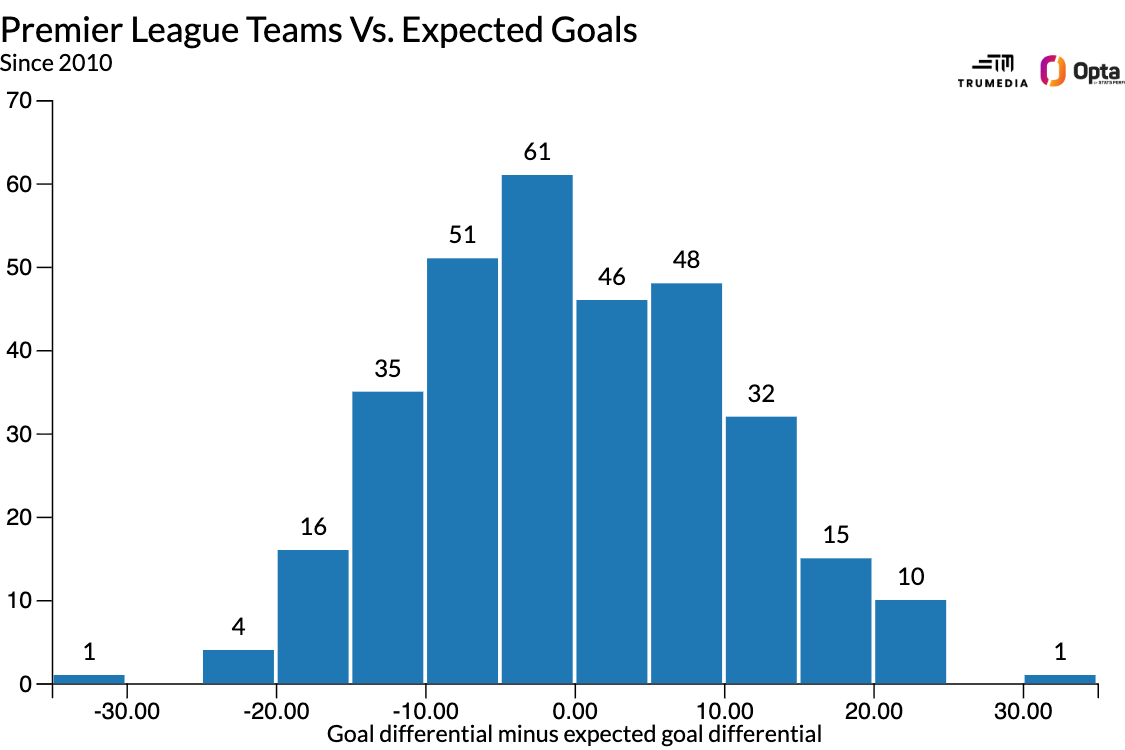
The team positioned all the way to the right is Tottenham in 2016-17. If you had to select a candidate for the far-left position, Tottenham in 2025-26 would appear to be a reasonable choice, correct? For one of the ten wealthiest teams globally to be engaged in a relegation battle with six matches remaining in the season, surely “historically bad luck” must play a role?
Nope. That distinction belongs to Sheffield United in 2023-24.
This season, Tottenham is not an outlier at all. Their goal differential (plus-11) is actually slightly better than their xG differential (plus-15.13), but not by much.
How, then, does a team with what is estimated to be the ninth-most valuable roster in the world find itself among the worst teams in the Premier League? One explanation: They focus on measuring attributes they think are important—rather than those that genuinely matter.
Tottenham’s major issue: They can’t pass
Typically, soccer is a multifaceted, dynamic sport where individual skills are challenging to isolate from the interconnectedness of roster composition, managerial directives, and on-field interactions. However, sometimes a team like Tottenham emerges, where the diagnosis is quite straightforward: They struggle with passing.
At Gradient Sports, a team evaluates every Premier League match and grades each pass made by a player on a scale from minus-2 to plus-2. Here’s how they outline the process:
For instance, consider a center-back passing the ball at the halfway line. A standard, unpressured pass to an open teammate would receive a 0, as this meets the expectations of our expert grading team. A precise, line-breaking pass under pressure would earn a positive grade. Conversely, an underhit pass to a teammate—even if completed—would receive a negative grade if it falls short of the expected standard. This reflects our emphasis on assessing performance rather than merely outcomes.
The grading process is guided by comprehensive frameworks designed to minimize subjectivity and ensure consistency. Once raw grades are compiled, they undergo multiple layers of quality control, including senior review of flagged actions, consistency checks, ongoing analysis, and dedicated quality assurance processes.
Based on this evaluation of passing, here’s how Tottenham’s five best passers rank in the Premier League this season:
1. Cristian Romero: 19th
2. Mickey van de Ven: 87th
3. Destiny Udogie: 152nd
4. Kevin Danso: 167th
5. Mohamed Kudus: 186th
Passing is the essential skill in this sport. The average Premier League team attempts 450 passes per game. No other metric comes close: in a single match, the average team attempts eight shots, crosses the ball 18 times, tries to dribble past defenders 18 times, attempts 16 tackles, and makes eight interceptions. If you cannot pass the ball, then nothing else is significant. It is the driving force at the core of the game that lends meaning to everything else.
So, how does one of the wealthiest teams globally—one that claims to exemplify the modern soccer club—assemble a squad with only two of the 150 best passers in its own league?
 play1:35Will Tottenham get relegated from the Premier League?
Janusz Michallik discusses Tottenham’s Premier League survival prospects following their 1-0 defeat to Sunderland.
The rise of the wrong analytics
In recent years, a new set of metrics has emerged in the soccer landscape. Rather than quantifying elements that contribute to winning, they measure attributes that scouts and coaches have traditionally valued: Who is large and who is quick? Who appears impressive? Who could be unstoppable if properly coached?
Several companies, such as Gradient and SkillCorner, now provide a range of physical metrics that track how frequently a player is running—both in and out of possession, at top speed, at high speed, etc. I do not criticize these companies for their offerings; it is beneficial that these datasets exist. One of the gaps in soccer data has been the lack of information regarding off-ball activities. The average player possesses the ball for only a few minutes per game, and most soccer data only quantifies that brief moment. It fails to capture the complete picture, but it does highlight the most critical aspects.
When utilized effectively, this off-ball physical data can be immensely valuable. If you manage a team and can learn to integrate these physical metrics with what drives winning and scoring goals, you will develop a more comprehensive understanding of player value, giving you an advantage over those who rely solely on passing and shots to assess performance. However, this integration is challenging, and due to its complexity, it is not widely practiced.
Instead, as a source who has collaborated with several Champions League clubs explained to me, the physical metrics are merely enabling clubs to affirm their own biases—the same biases that have been discussed in the ongoing debate between scouts and statistics since “Moneyball” was published. Now, we have new statistics that validate the scouts’ perspectives.
How else can we interpret what transpired with Spurs?
Tottenham’s roster is filled with dynamic athletes capable of running. Utilizing their physical metrics, Gradient developed an “athleticism” score that combines endurance, explosiveness, and speed, adjusted for position and size. This score is on a 1-100 scale. Tottenham has seven players scoring 90 or above, and five of them—Wilson Odobert, Lucas Bergvall, Archie Gray, Dominic Solanke, Conor Gallagher—were acquired after Johan Lange assumed the role of technical director in October 2023. The first four were the four outfield players signed during Lange’s initial summer in charge.
It is impossible to construct a roster that cannot pass unless there is a systematic focus on alternative player attributes that creates an institutional blind spot. Given that Romero—by far their best passer—was signed in 2021, and James Maddison, who has been sidelined all season but is clearly their other best passer and was signed in the summer of 2023, the neglect of what truly matters becomes even more apparent.
One of the more memorable anecdotes from “Moneyball” involves Billy Beane arguing with his scouts, who are fixated on a player’s physical appearance, such as the size of his backside, his facial features, or the attractiveness of his girlfriend. Beane repeatedly emphasizes the question, “But can he hit?” Eventually, he becomes frustrated and exclaims to everyone in the room, “I repeat: We’re not selling jeans here.”
It has been suggested that having someone who comprehends data and is given a genuine voice within your club is valuable simply because of the numerous pitfalls they can help you avoid by reminding you to focus on what truly matters. But can he hit? At Spurs, however, it appears that a new set of metrics may have obscured the club’s understanding, leading them to believe they were in the business of selling jeans. What they genuinely required—and what could have prevented them from facing relegation—was someone who continually posed a straightforward question:
But can he pass?
