
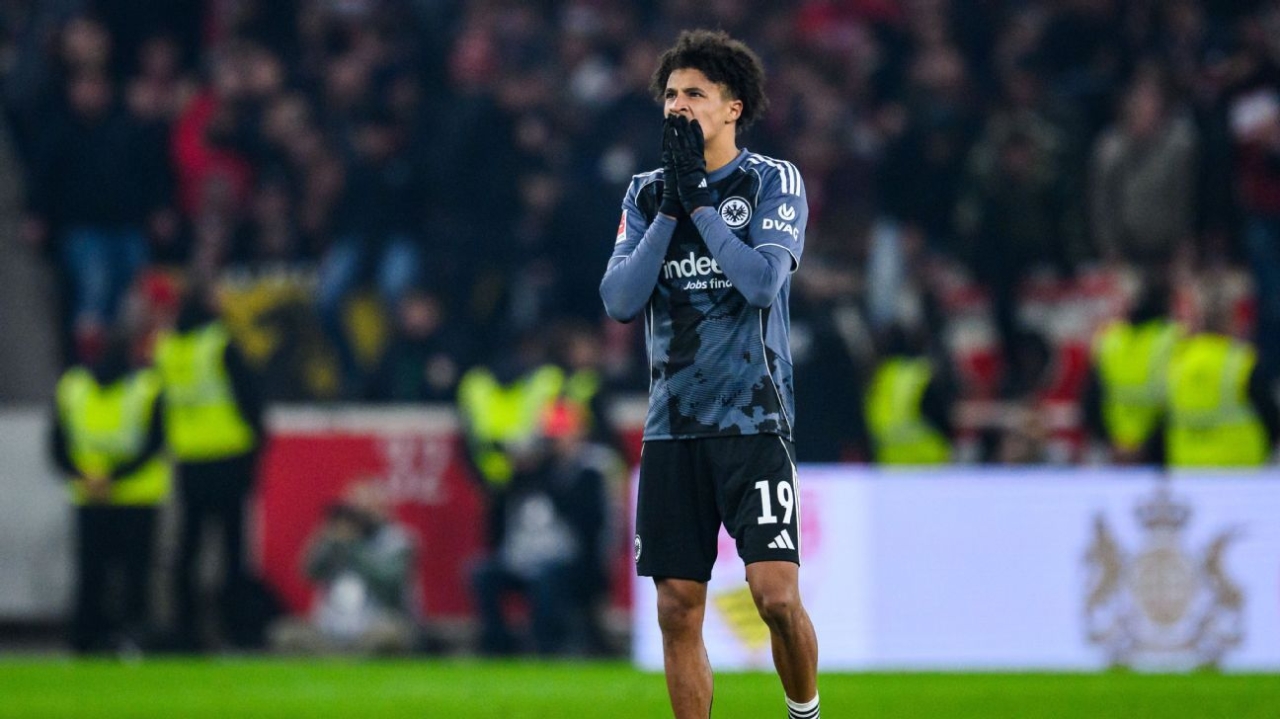
Deprived of key forwards Ekitike and Marmoush, Eintracht is struggling.
Those who have traveled to Frankfurt will recognize it as a city that, unlike many others in Germany, does not prominently feature beer culture. While there are enjoyable brews available in Hessen, the predominant beverage is Äppelwoi — which translates to apple wine or hard cider.
It is safe to say that many are expressing gratitude for Äppelwoi this week in the Main-Metropole (metropolis on the River Main).
The departure of Dino Toppmöller as coach of Eintracht Frankfurt aligns with the typical decision-making patterns observed in German football clubs. When challenges become overwhelming and results decline, it becomes difficult for anyone to retain their position, regardless of their popularity.
Toppmöller, the son of former high-profile coach Klaus Toppmöller, was a well-regarded figure within the community, having spent a significant portion of his youth in Frankfurt. He dedicated time to fans and media, providing detailed insights and analysis during his often lengthy press conferences.
Last season, his coaching was highly commended for leading Eintracht into the UEFA Champions League, particularly as he had to adjust after losing Omar Marmoush midway through the season. This term, however, Toppmöller’s strategy was undermined by an excessive number of individual mistakes.
Eintracht was still capable of scoring numerous goals, but defending against them proved to be a perplexing issue. In recent weeks, Arthur Theate has been especially prone to critical errors, though he is not the only one.
In November, Frankfurt shifted to a more defensive style and experienced brief success, such as against Napoli in the Champions League and Mainz in the Bundesliga, managing to silence their opponents. However, this came at the cost of their usual attacking prowess, and they quickly reverted to their former style.
After enduring one too many high-scoring contests — including a 3-3 draw at Werder Bremen — Toppmöller was dismissed.
To compound the difficulties for Eintracht supporters, on Wednesday — under the guidance of interim coaches Dennis Schmitt and Alex Meier — the team was eliminated from the Champions League following another defensively shaky performance from Robin Koch, Kauã Santos & Co., this time in Baku against Qarabag.
Markus Krösche, the club’s esteemed sporting director, will retain Schmitt and the other coaches for Saturday’s home match against TSG Hoffenheim.
Eintracht’s business model, which involves providing young, promising players with significant opportunities and then aiming to sell them for a considerable profit, always carries a degree of risk. What succeeded with Hugo Ekitike, for instance, did not yield the same results with Elye Wahi.
Securing the right head coach appointment is crucial. Despite Eintracht’s challenges, a return to the Champions League next season is not entirely out of reach.
Bayern’s dominance goes beyond stars
Bayern Munich’s 2-0 Champions League victory over Union St.-Gilloise was far from their most impressive display of the season, yet it keeps Germany’s Rekordmeister well-positioned to achieve their objectives in the competition. They now require only a draw at PSV Eindhoven next week to secure second place in the group stage behind Arsenal, thus ensuring home advantage for the return leg starting in the round of 16.
It is easy to spotlight Harry Kane and Michael Olise each week — their abilities often make everything appear remarkably effortless — but Bayern is noticeably incorporating academy players more frequently into the matchday squad, and this includes more than just the exceptionally talented Lennart Karl.
Felipe Chávez, David Daiber, Wisdom Mike, and Javier Fernández are just a few of the youth players from the Bayern-Campus whose names are regularly appearing on the bench. The club is also closely monitoring Noël Aséko Nkili, who has received high praise for his performances in the 2. Bundesliga, where he is currently on loan at Hannover 96.
Contenders looking more like pretenders
Borussia Dortmund and Bayer Leverkusen’s midweek Champions League outings are best left forgotten.
BVB’s lackluster, passive first half on a rainy night in London against Tottenham Hotspur, whose pressing tactics posed significant challenges, left die Schwarz-Gelben with too much to overcome after the break. Their current standing in the Champions League accurately reflects Dortmund’s reality.
Leverkusen’s concerning start to 2026 continued with another shaky performance and a defeat away to Olympiacos, who pressed aggressively from the outset and created numerous difficulties for Loïc Badé and Robert Andrich in particular. The momentum gained in December, when Bayer 04 eliminated BVB from the DFB-Pokal and triumphed over RB Leipzig in the Bundesliga, has dissipated.
Cologne find success in simplicity
At times, a straightforward, direct approach can yield significant rewards.
Last weekend, FC Cologne struggled in the first half at home against Mainz, and while trailing 0-1, the players were met with a concert of whistles in Müngersdorf. Under pressure, coach Lukas Kwasniok introduced aerial specialist Ragnar Ache immediately after the break, along with Mainz loanee Tom Krauss, setting the stage for the club’s first victory since early November — and against a direct rival, no less.
Both goals were headers from Ache — one from a cross by Alessio Castro-Montes and the other from a corner taken by Luca Waldschmidt. Cologne had not scored a Bundesliga goal from a corner all season.
Just like that, fans in the Domstadt (cathedral city) are feeling much more at ease.
