
Champions League semifinal forecasts: Will Arsenal and PSG progress?
The team recognized for having the most potent offense globally (Bayern Munich) faces off against the team known for its superior possession play and the second most effective attack worldwide (Paris Saint-Germain). The squad with the top defense in the world (Arsenal) goes up against what could be the finest defensive unit of the past decade (Atlético Madrid). It is fair to say that the soccer deities have provided us with two thematically fitting UEFA Champions League semifinal matchups.
The quarterfinals largely met expectations, with three out of four ties going down to the final moments. The most compelling matchup in the sport currently (Barcelona-Atletico Madrid) was as thrilling as anticipated, while the most frequently contested matchup in the competition’s history (Bayern-Real Madrid) was even more exhilarating. Now, we have our semifinalists: Arsenal and Bayern have been the most outstanding teams overall since the season began, PSG appears to be the most in-form team, and Diego Simeone’s Atlético has triumphed in two of their three prior semifinal appearances.
Let’s examine two captivating semifinal matchups.
– UCL Talking Points: What was Slot thinking? Are Bayern favorites now?
– Olley: While other giants falter, Arsenal continue to flicker
– Lindop: PSG demonstrate to Liverpool that it requires more than star power to shine

 BAYERN MUNICH vs. PARIS SAINT-GERMAIN
First leg: April 28 | Second leg: May 6
Bayern and PSG are becoming quite familiar with each other. They have already met twice in the past nine months — PSG emerged victorious in the Club World Cup, while Bayern won during the Champions League group stage — and this matchup will mark their 11th and 12th encounters in the last decade. Bayern has claimed victory in seven of the last 10 meetings, but PSG has a title to defend, and if the previous round is any indication, their defense appears to be more robust at this moment.
Current Opta world rankings and title odds: No. 1 Bayern (60.6%), No. 4 PSG (39.4%)
How Bayern advanced: They invited Real Madrid to a fast-paced contest (and narrowly triumphed). There are various strategies to defend a one-goal lead, but most teams tend to adopt a cautious approach — not necessarily parking the bus, as 90 minutes is a lengthy period for that. At a minimum, they maintain a balance between offense and defense.
Bayern, conversely, executed strategies like this throughout the night.
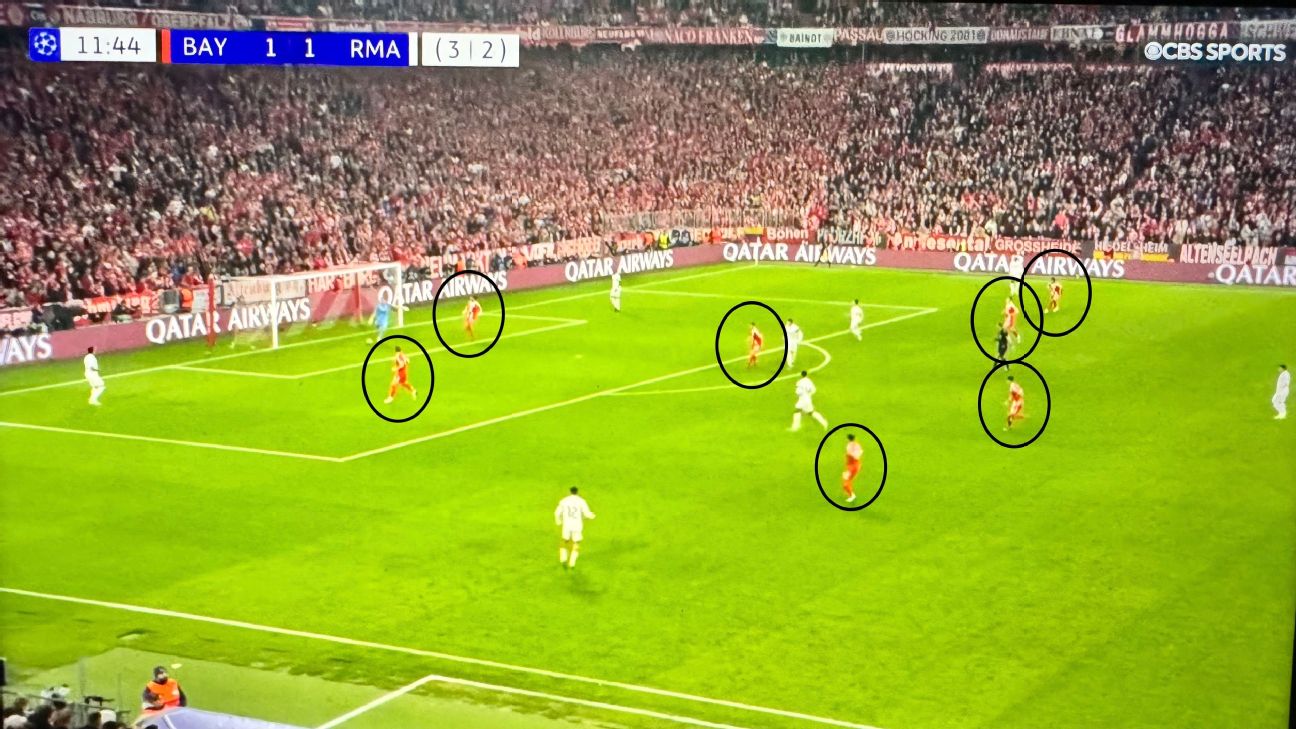
Courtesy of Paramount+
This image shows seven Bayern players pressing in the attacking third while Real Madrid — a team featuring Kylian Mbappé, arguably the most formidable attacker in open space, and Vinícius Júnior, the 2024 Ballon d’Or runner-up — attempted to build from the back. Instead of compelling Real Madrid to create scoring opportunities in congested areas after taking a 2-1 lead home from last week’s match in Madrid, Vincent Kompany wanted Bayern to leverage their strengths, pinning Real Madrid in their own half and betting that this high-risk strategy would generate as many goals as it conceded.
He was correct. Eventually. Real Madrid found the net three times — Arda Güler capitalized on a misplaced Manuel Neuer pass and scored from long range just 35 seconds into the match, then curled in a stunning free kick in the 29th minute, and that Mbappé player found ample space on a breakaway late in the first half. However, goals from Aleksandar Pavlovic and Harry Kane kept the overall score level, and a stalemate ensued in the second half as both teams squandered good chances.
When Eduardo Camavinga received a foolish second yellow card in the 86th minute, the momentum shifted toward the home side. Luis Díaz netted a deflected goal, and Michael Olise sealed the victory with the final kick of the match.
LUIS DÍAZ AND MICHAEL OLISE SECURE VICTORY FOR BAYERN AT THE LAST MOMENT ?
THEY ELIMINATE 15-TIME CHAMPIONS REAL MADRID FROM THE UCL ? pic.twitter.com/sS4AWvsEgs
— CBS Sports Golazo ⚽️ (@CBSSportsGolazo) April 15, 2026
Bayern’s high-risk approach was ultimately (and narrowly) rewarded, and after a nine-match winless streak, they achieved their first victories over Real Madrid since 2012. Now, they face an even tougher challenge against the defending champions.
How PSG advanced: With control, then with composure. PSG’s aggregate 4-0 victory over Liverpool was both thorough and methodical. Initially, in Paris, they took complete command of the tie by dominating possession (74%), pinning Liverpool deep and attempting 18 shots compared to the visitors’ three, leading to a 2-0 win.
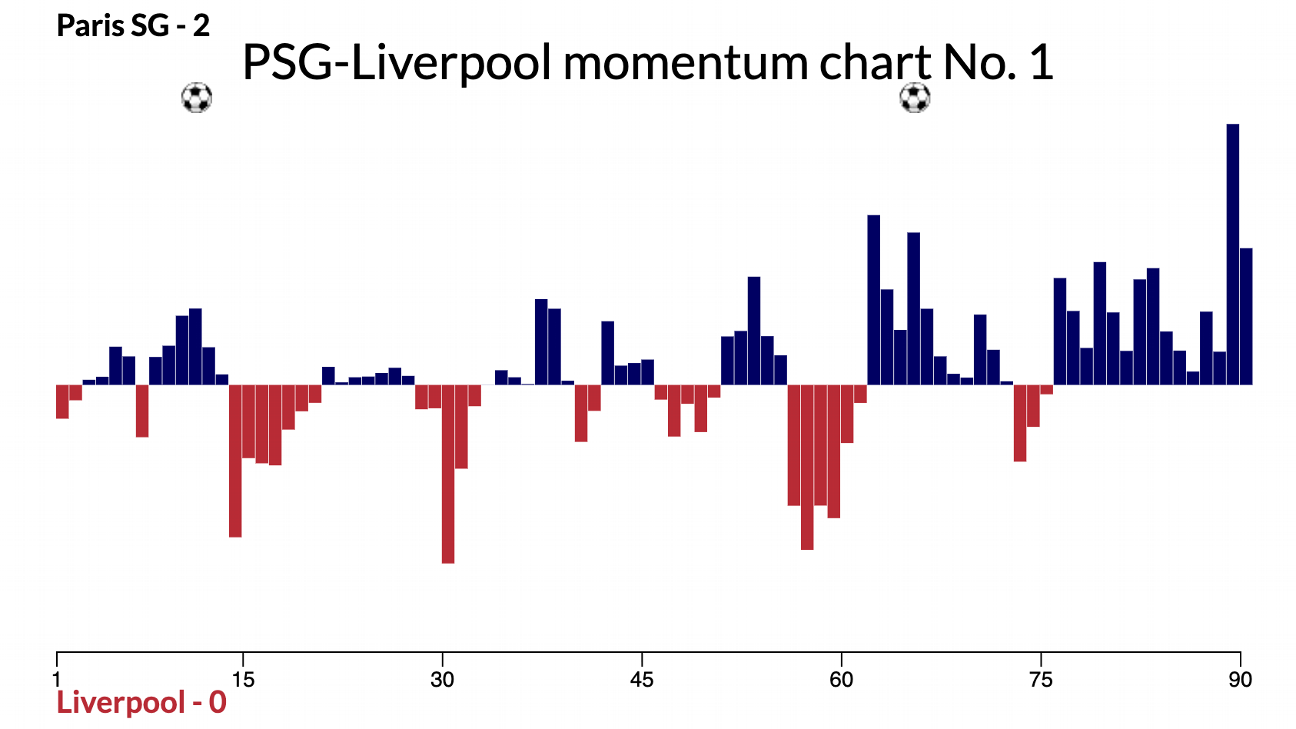
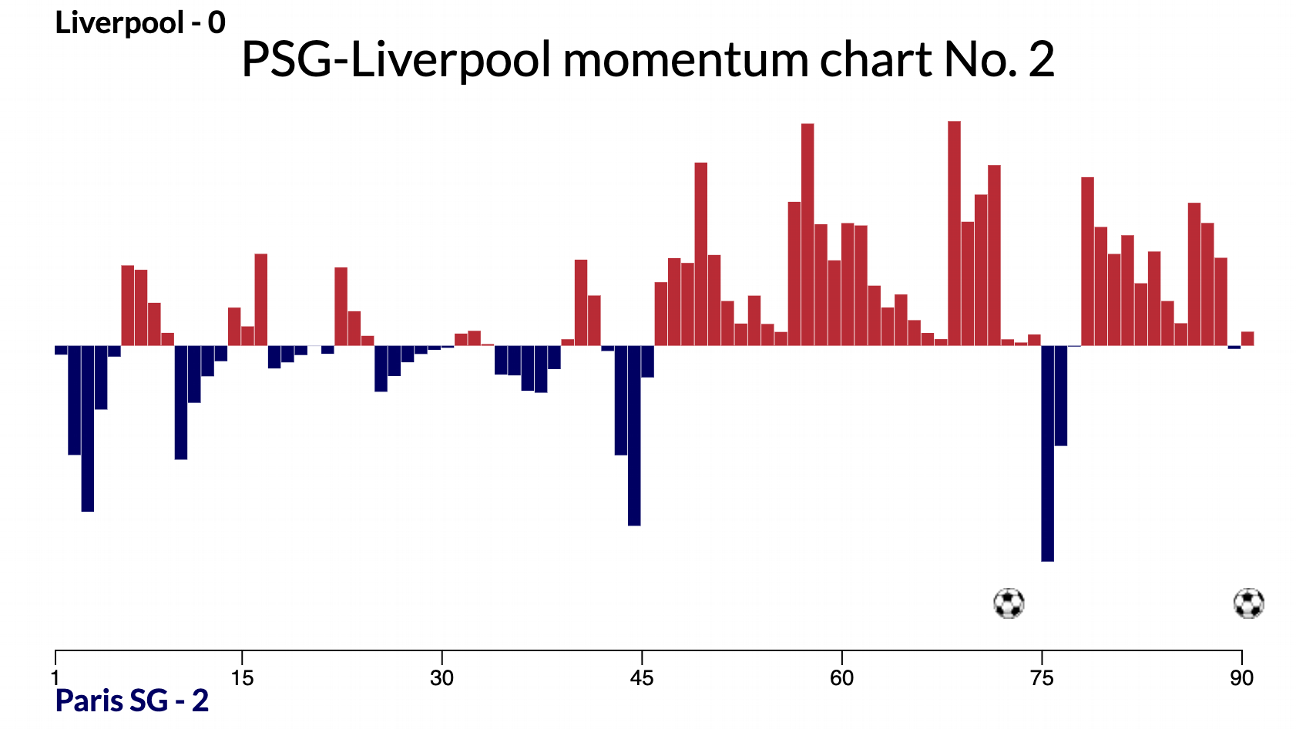
The scoring margin left a slight opening for an Anfield miracle, but in Tuesday’s match in Liverpool, they absorbed pressure, allowing Liverpool more of the ball (52% possession) while blocking one-third of Liverpool’s shots and avoiding significant danger. As Liverpool grew increasingly confident and somewhat too dominant in possession, PSG struck back, securing the win with a beautiful goal from Ousmane Dembélé. (He then added another for good measure.)
Dembele and Khvicha Kvaratskhelia were exceptional against Liverpool. Dembele scored twice, created seven chances for teammates, and completed 17 progressive passes, ranking second on the team behind the highly progressive Vitinha; Kvaratskhelia, on the other hand, scored once, drew eight fouls (the most on the team), won 13 ground duels (tied for first with João Neves), and made 18 progressive carries (tied for first with Vitinha and Achraf Hakimi). PSG’s midfield — Vitinha, Neves, and an increasingly impressive Warren Zaïre-Emery — dominated Liverpool’s, and while Liverpool’s own attack was ineffective (they failed to score even once from shots worth 2.1 xG), PSG capitalized on their opportunities.
After a lackluster start to the season, PSG are indicating that they may have found their peak form just in time to secure a couple more significant trophies.
Why Bayern will win: They can’t stop scoring. Last weekend, Bayern set the all-time Bundesliga scoring record with their 105th goal of the season. This is not surprising upon first hearing it — it is Bayern, after all — but consider it for a moment. They have now outscored numerous other incredibly prolific Bayern teams … and they broke the record with five matches remaining in the league season. Incredible!
In 46 matches across all competitions, Bayern have netted 157 goals at an average of 3.4 per match. They have scored at least five goals in 10 matches. They have netted 16 in four knockout round matches. Olise has 18 goals and 25 assists, Díaz has 24 and 15 respectively, and in just over 2,000 minutes, Serge Gnabry has contributed 10 goals and 12 assists. Somehow, there have been enough scoring chances left for Kane* to score 50 goals with six additional assists. Lennart Karl has nine more goals! Nicolas Jackson has eight! This may be the most formidable attack the sport has ever witnessed, and Jamal Musiala (four goals and four assists in 588 minutes) has not even made a significant contribution since returning from his summer ankle injury (sustained against PSG).
(*According to Opta odds, there is currently a 16% chance that Kane wins the Champions League while his former team, Tottenham Hotspur, faces relegation. I have no particular point to make here: I just find that fascinating. Apologies for the digression, Spurs fans.)
Of course, they must also prevent PSG from scoring. Perhaps the most crucial player on the entire squad has been center-back Dayot Upamecano, without whom Real Madrid might have scored approximately 20 more goals. Frequently isolated against Mbappé and Vini Júnior, he led the team with eight quarterfinal tackles (seven in the defensive third) and six interceptions among 31 total defensive actions. He also won eight of 11 ground duels and made 38 combined progressive carries and passes. Additionally, he assisted Kane’s goal on Wednesday. He was nearly superhuman, and he may need to be even better against Dembélé, Kvaratskhelia, and their teammates.
 play2:28Burley: Liverpool didn’t get embarrassed by PSG
Steve Nicol and Craig Burley react to Liverpool’s Champions League exit vs. PSG.
Why PSG will win: They’re the best possession team remaining in the tournament. The first two-thirds of this season resembled one extensive experiment for Luis Enrique and PSG. Due to injuries and the necessity to keep a large squad properly engaged, Enrique frequently shuffled his lineup, and their results suffered somewhat as a result. They finished just 11th in the Champions League group stage, and until recently, they struggled to distance themselves from a spirited Lens team in Ligue 1 play. (They now lead by four points with a game in hand.) However, we are aware of PSG’s potential; they have always posed a threat to find their rhythm when the matches truly mattered.
In PSG’s last six matches, including two each against Liverpool and the Chelsea team that defeated them in last summer’s FIFA Club World Cup final, they have won all six by a combined score of 19-3. Chelsea came out aggressively but faltered quickly, losing by a combined 8-2 in the Champions League round of 16; Liverpool defended well and contained PSG’s attack more effectively, but could not generate any offense until the final 45 minutes of the tie and failed to convert the chances they created.
Even with all the early lineup changes, PSG’s possession statistics are the best in the tournament. They rank first by a significant margin in possession rate (66.3%), first in pass completion rate in the attacking third (90.3%), and second in buildup attacks* per game (6.3). They are also superior at disrupting opponents’ buildup play: They have allowed the fewest average passes per defensive action (PPDA) at 8.4, rank first in progressive carries allowed (37.5), second in buildup attacks allowed (1.2 per game), and first in goals scored from high turnovers (1.1 per game). Bayern dominated PSG in a 2-1 victory back in November, but they did not dominate this PSG.
(*Buildup attacks: open-play sequences that feature at least 10 passes and produce either a shot or a touch in the opposition’s box.)
Prediction: PSG 4, Bayern 3. This matchup is challenging, as I would choose either team to win in the final based on their current form. However, even with Upamecano’s impressive performances, I trust PSG’s defense slightly more at this time. With the second leg in Munich, PSG will face pressure to take an early lead, but they are more than capable of doing so.

 ARSENAL vs. ATLETICO MADRID
First leg: April 29 | Second leg: May 5
This is a clash of intellect versus instinct. The intellect suggests that Arsenal has been the most consistently outstanding team in Europe throughout the season. They have conceded only 38 goals in 54 matches across all competitions. They lead the Premier League by six points (although second-place Manchester City has a game in hand), and they have outscored opponents 27-5 in 12 unbeaten Champions League matches. They are currently grappling with a finishing slump, but their underlying statistics remain strong. They have defeated many teams superior to Atlético Madrid this season. Furthermore, they dominated Atleti, 4-0, last October.
The instinct, however, indicates that Arsenal is shaky, and Diego Simeone was born to excel in a matchup like this.
 play1:25Marcotti: Atletico ‘awkward’ opponent for Arsenal
Gabriele Marcotti states that Atletico could do “something special” in the Champions League and will pose a significant challenge for Arsenal.
Current Opta world rankings and title odds: No. 2 Arsenal (74.9%), No. 12 Atletico Madrid (25.1%)
How Arsenal advanced: How else? With exceptional defense. Arsenal clearly has a bit of an attacking issue at present. In their last five matches across all competitions, they have scored only three goals while being outscored 6-2 in open play. Over the last eight matches, they have converted shots worth 12.9 xG into just eight goals. Kai Havertz, Gabriel Martinelli, Bukayo Saka, Leandro Trossard, and Gabriel Jesus during this period: two goals from 5.3 xG. Meanwhile, Eberechi Eze and Martin Ødegaard, key creators, have both faced recent injuries, and one of the few reliable finishers, Viktor Gyökeres, has averaged only 2.1 shots per 90 minutes, a concerning average for a center forward.
However, they can still defend effectively. In 180 minutes, Sporting attempted just 19 shots worth a combined xG of 1.0 and failed to score. João Simões nearly managed to poke one past David Raya in the dying seconds of Wednesday’s 0-0 draw, but at 0.07 xG, from 17 meters out, it was Sporting’s most high-quality shot of the match.
This shot map is an absolute showcase of Arsenal’s defensive prowess … at least if you only examine the right half of it.
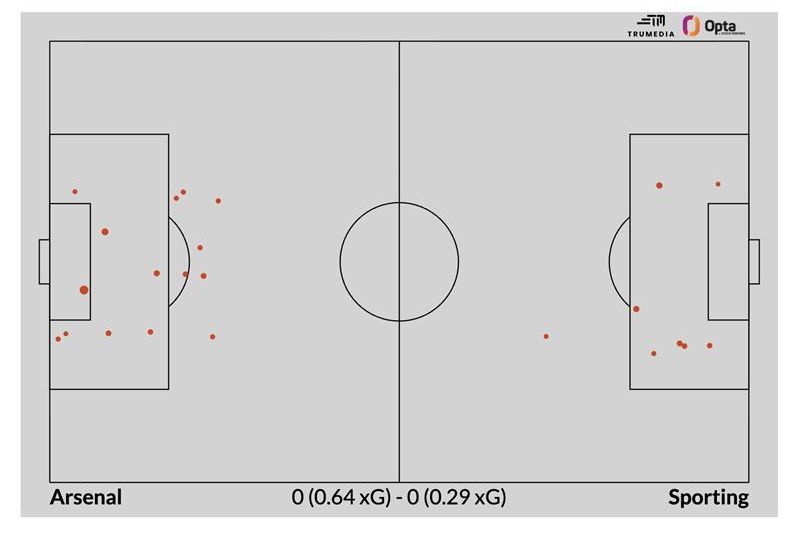
Indeed, Arsenal has now allowed only five goals in 12 Champions League matches, an astonishing figure. However, their next opponent features Julián Álvarez and a great deal of confidence.
How Atletico advanced: Finishing and red cards. The most entertaining current rivalry in the sport delivered once again. Ten matchups between Barcelona’s Hansi Flick and Atletico’s Diego Simeone have resulted in five Barcelona wins, four Atleti victories, and one draw. We have witnessed scores of 4-4, 4-2, 3-1, 4-0, and 3-0 — the 4-4 occurred in last year’s Copa del Rey and might be my favorite draw of all time — and in two different home-and-away knockout ties in the last two months, we have seen Barcelona nearly come back from four down in one and two down in the other.
Atletico held them off once more. Following last week’s 2-0 win in Barcelona, Simeone’s squad saw Barcelona quickly equalize on Tuesday with goals from the ever-dominant Lamine Yamal (fourth minute) and Ferran Torres (24th minute), but Ademola Lookman finished a perfect counterattack shortly thereafter, and Atletico managed to maintain the lead.
ADEMOLA LOOKMAN PUTS ATLÉTICO BACK IN FRONT ???
Atlético leads 3-2 on aggregate ⚽️ pic.twitter.com/zEW4q6IgAZ
— CBS Sports Golazo ⚽️ (@CBSSportsGolazo) April 14, 2026
Both teams squandered solid scoring opportunities on Tuesday, but overall, Atletico was significantly more efficient in the finishing department. Over the two legs, Barcelona attempted 33 shots worth 3.4 xG but scored only twice, while Atletico attempted 20 shots worth 2.1 xG and converted three of them. Their counterattacks generated both dangerous chances and two red cards — Barcelona’s Pau Cubarsí was sent off in the first match, and Eric García in the second, both for denying goal-scoring opportunities on counters — and it was just enough to survive 180 minutes against Spain’s best overall team.
Why Arsenal will win: If you can’t score, they don’t have to. Arsenal now has 13 days to regain their form — they appeared fatigued on Wednesday — and rediscover their finishing touch. This could prove challenging considering they have their most significant Premier League match of the season, against Manchester City, this coming Sunday. A win or draw would restore their league title odds to “nearly certain,” but a loss would raise alarm bells as they head to Madrid.
However, they possess the best
